
Archimedes' Semicircle Exploration
Loading the math board and drawing, please wait…
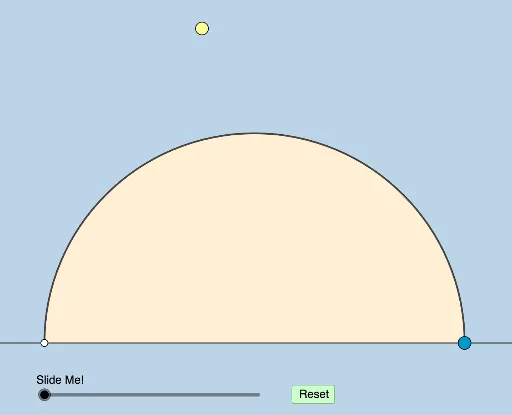
This dynamic and modifiable geometric problem illustrates Archimedes' semicircle properties, involving circles, angles, and geometric transformations. Using GeoGebra commands such as point, midpoint, semicircle, line, circle arc, intersection, dilation, segment, angle, circle, rotation, etc., the example provides a clear understanding of geometric transformations and circle properties. Suitable for high school geometry learners and educators.
GeoGebra Commands & Parameters
Point(Ray[A, A + (1, 0)]) → BMidpoint(A, B) → CSemicircle(A, B) → cLine(A, B) → fPointIn(p) → DCircleArc(C, B, A) → dSemicircle(D, C) → gSemicircle(C, D) → hMidpoint(D, C) → EIntersect(h, c) → F, , ,Intersect(g, c) → G, , ,Line(D, F) → iLine(D, G) → jLine(A, G) → kLine(B, F) → lIntersect(k, l) → HLine(D, H) → mDilate(D, If[0 < q ≤ 1, 1 - q, 0], F) → D'Dilate(D, If[0 < q ≤ 1, 1 - q, 0], G) → D'_1Segment(D, D') → rSegment(D, D'_1) → sAngle(D, G, C) → αAngle(C, F, D) → βDilate(C, If[0 < q ≤ 1, 1 - q, 0], G) → C'Dilate(C, If[0 < q ≤ 1, 1 - q, 0], F) → C'_1Segment(C, C') → tSegment(C, C'_1) → f_1Dilate(A, If[2 < q ≤ 3, 3 - q, 0], G) → A'Segment(A, A') → g_1Dilate(B, If[3 < q ≤ 4, 4 - q, 0], H) → B'Segment(B, B') → h_1Dilate(H, If[4 < q ≤ 5, 5 - q, 0], F) → H'Segment(H, H') → i_1Intersect(f, m) → IMin({Distance[I, H], Distance[I, B], Distance[I, A]}) → uDilate(D, If[5 < q ≤ 6, 6 - q, 0], I) → D'_2Segment(D, D'_2) → j_1Circle(I, (0.45 * u)) → c_1Intersect(c, f, 2) → LIntersect(c_1, f) → M, NRotate(N, If[6.5 < q ≤ 7.5, ((q - 6.5) * π / 2), π / 2], I) → N'CircleSector(I, N, N') → d_1Rotate(d_1, If[8.25 < q ≤ 9.25, ((q - 8.25) * π / 2), π / 2], I) → e_1