
Arbitrary Parabolic Loading: Shear and Bending Moment Diagram
Loading the math board and drawing, please wait…
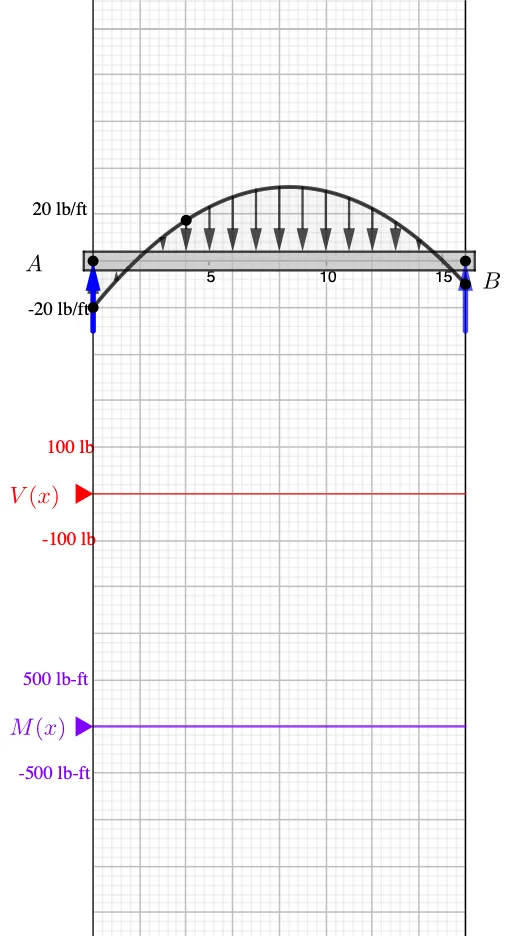
This example demonstrates the calculation and visualization of shear and bending moment diagrams under arbitrary parabolic loading on a beam. Key math concepts include integral calculus, derivatives, function graphing, and vector operations. GeoGebra commands like Point, Polynomial, Integral, IntegralBetween, Segment, Textfield, Polygon, Length, Vector, Sequence, Max, Min are utilized to dynamically compute and display the load, shear force, and bending moment. Suitable for high school students and engineering professionals studying structural mechanics and engineering applications.
GeoGebra Commands & Parameters
Point(Line[B, B + j]) → B'Point(Line[A, A + j]) → A'Polynomial(Stretch[{A', C', B'}, xAxis, Scale_w / AxisStepY[]]) → wIntegral(w, 0, beamLen) → WIntegralBetween((w(x))^(2) / 2, 0, 0, beamLen) → QxIntegral((x * w(x)), 0, beamLen) → QyPoint(x = ((-AxisStepX[])) / 4) → Vmember(A, B, (0.2 * AxisStepY[])) → beam, beam_t, beam_b, beam_L, beam_rPoint(x = ((-AxisStepX[])) / 4) → MSegment(V', (x(V'), v'(right))) → v_rIntegral(v) → mTextfield(Scale_V) → InputBoxVTextfield(Scale_M) → InputBoxMPolygon((right, y(Corner[2])), (right, y(Corner[3])), Corner[3], Corner[2]) → mask, mask_l, mask_t, mask_r, mask_bSegment((0, y(V)), (right, y(V))) → VaxisSegment((0, y(M)), (right, y(M))) → MaxisLength(userObjects) → c_1Length(userObjects) → c_1Length(userObjects) → c_1Length(userObjects) → c_1Length(userObjects) → c_1Length(userObjects) → c_1Length(userObjects) → c_1Length(userObjects) → c_1Length(userObjects) → c_1Length(userObjects) → c_1Length(userObjects) → c_1Length(userObjects) → c_1Length(userObjects) → c_1Length(userObjects) → c_1Length(userObjects) → c_1Length(userObjects) → c_1Length(userObjects) → c_1Length(userObjects) → c_1Length(userObjects) → c_1Length(userObjects) → c_1Length(userObjects) → c_1Length(userObjects) → c_1Length(userObjects) → c_1Length(userObjects) → c_1Length(userObjects) → c_1Length(userObjects) → c_1Length(userObjects) → c_1Length(userObjects) → c_1Length(userObjects) → c_1Length(userObjects) → c_1Length(userObjects) → c_1Length(userObjects) → c_1Length(userObjects) → c_1Length(userObjects) → c_1Length(userObjects) → c_1Length(userObjects) → c_1Length(userObjects) → c_1Integral(w', 0, beamLen) → W'Vector(A - (1.5 * j), A) → aVector(B - (1.5 * j), B) → bSequence(Vector[(k, w'(k)), (k, (0.4 * sgn(w'(k))))], k, 0, beamLen, 1) → distLoadTextfield(Scale_w) → InputBoxWSegment((0, y(V)), (0, v'(0.0001))) → v_AMax({y(Max[v, 0, beamLen]), F_A, (-F_B)}) → V_{max}Min({y(Min[v, 0, beamLen]), F_A, (-F_B)}) → V_{min}