
Number Line Visualizations: Addition and Riemann Sum Intuition
Loading the math board and drawing, please wait…
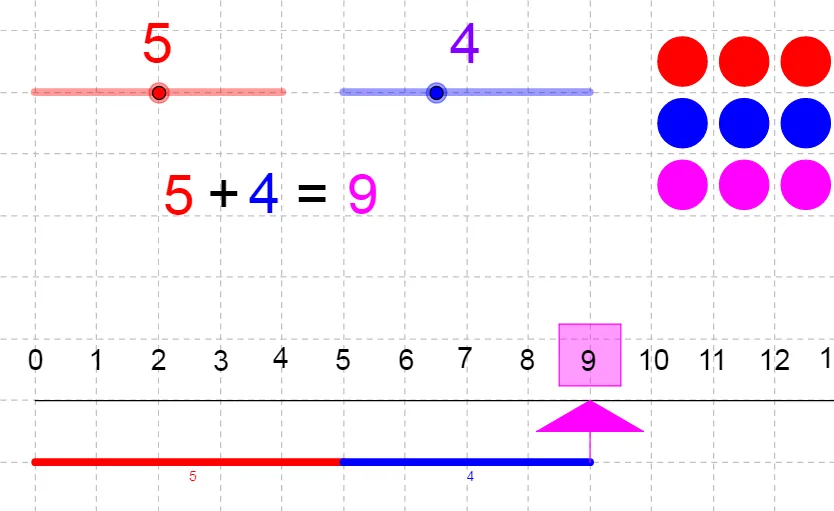
This example constructs key points and intervals on a number line to build an intuitive geometric picture of addition relationships and the idea of upper/lower sums (Riemann sums) over an interval. It connects number-line visualization with linear-function thinking, including the geometric meaning behind tangent-function behavior, and relates scatter/graphing-style representations to rectangle-based area approximations. The construction uses GeoGebra commands—Intersect, Point, Segment, Circle, Polygon, and Translate—together with many generated points (a, b, A, c_1, B, c, d_1, C, d, D, e_2, E, e, f_1, F, f, g, h, k, G, H) and polygonal objects such as poly1 to create interval frames and rectangle-like partitions. It also leverages Translate to show how the interval pieces shift along the number line. Suitable for middle school through early university use, especially for classroom demonstrations and self-study on summation concepts and their geometric interpretation.
GeoGebra Commands & Parameters
Intersect(xAxis, yAxis) → APoint(Circle[A, abs(a)]) → BSegment(A, B) → cPoint(Circle[B, abs(b)]) → CSegment(B, C) → dPoint(yAxis) → DPoint(Circle[D, abs(a + b)]) → ESegment(D, E) → ePoint(Circle[D, 20]) → FSegment(D, F) → fSegment(C, E) → gCircle(E, Segment[E, C]) → hCircle(C, Segment[C, E]) → kIntersect(h, k, 2) → GIntersect(h, k, 1) → HPolygon(G, H, E) → poly1, e_1, g_1, h_1Point(Circle[I, 1]) → JSegment(I, J) → iPoint(Circle[I, 1]) → KSegment(I, K) → jPoint(Circle[K, 1]) → LSegment(K, L) → lSegment(L, J) → mPolygon(K, I, J, L) → poly2, k_1, i_1, j_1, l_1Circle(M, 0.4) → pTranslate(p, (1, 0)) → p'Translate(p, (2, 0)) → p'_1Translate(p, (3, 0)) → p'_2Translate(p, (4, 0)) → p'_3Translate(p, (5, 0)) → p'_4Translate(p, (6, 0)) → p'_5Translate(p, (7, 0)) → p'_6Translate(p, (8, 0)) → p'_7Translate(p, (0, 1)) → p'_8Translate(p, (1, 1)) → p'_9Translate(p, (2, 1)) → p'_{10}Translate(p, (3, 1)) → p'_{11}Translate(p, (4, 1)) → p'_{12}Translate(p, (5, 1)) → p'_{13}Translate(p, (6, 1)) → p'_{14}Translate(p, (7, 1)) → p'_{15}Translate(p, (8, 1)) → p'_{16}Translate(p, (0, -1)) → p'_{17}Translate(p, (1, -1)) → p'_{18}Translate(p, (2, -1)) → p'_{19}Translate(p, (3, -1)) → p'_{20}Translate(p, (4, -1)) → p'_{21}Translate(p, (5, -1)) → p'_{22}Translate(p, (6, -1)) → p'_{23}Translate(p, (7, -1)) → p'_{24}Translate(p, (8, -1)) → p'_{25}Translate(p, (9, -1)) → p'_{26}Translate(p, (0, -2)) → p'_{27}Translate(p, (1, -2)) → p'_{28}Translate(p, (2, -2)) → p'_{29}Translate(p, (3, -2)) → p'_{30}Translate(p, (4, -2)) → p'_{31}Translate(p, (5, -2)) → p'_{32}Translate(p, (6, -2)) → p'_{33}Translate(p, (7, -2)) → p'_{34}
AI Drawing Prompt Reference
Draw a number line starting from the origin. First, draw line segments of lengths a and b. Then, draw a line segment of length a+b. Next, draw a circle with radius a+b and take a segment as line segment e. Draw another circle with radius 20 and take a segment as line segment f. Draw a rectangle connecting line segments e and f. Then, draw a circle with radius 1 and take four segments to form a small rectangle. Translate a small circle p 8 times, each time by 1 unit, forming 8 identical small circles. Then, move these circles up and down by 1 unit, forming 16 identical small circles.
The prompt above was compiled from the original drawing commands and is for reference only.