
Approximating π with Euler's Zigzag Numbers
Loading the math board and drawing, please wait…
In collections
Pi Approximations
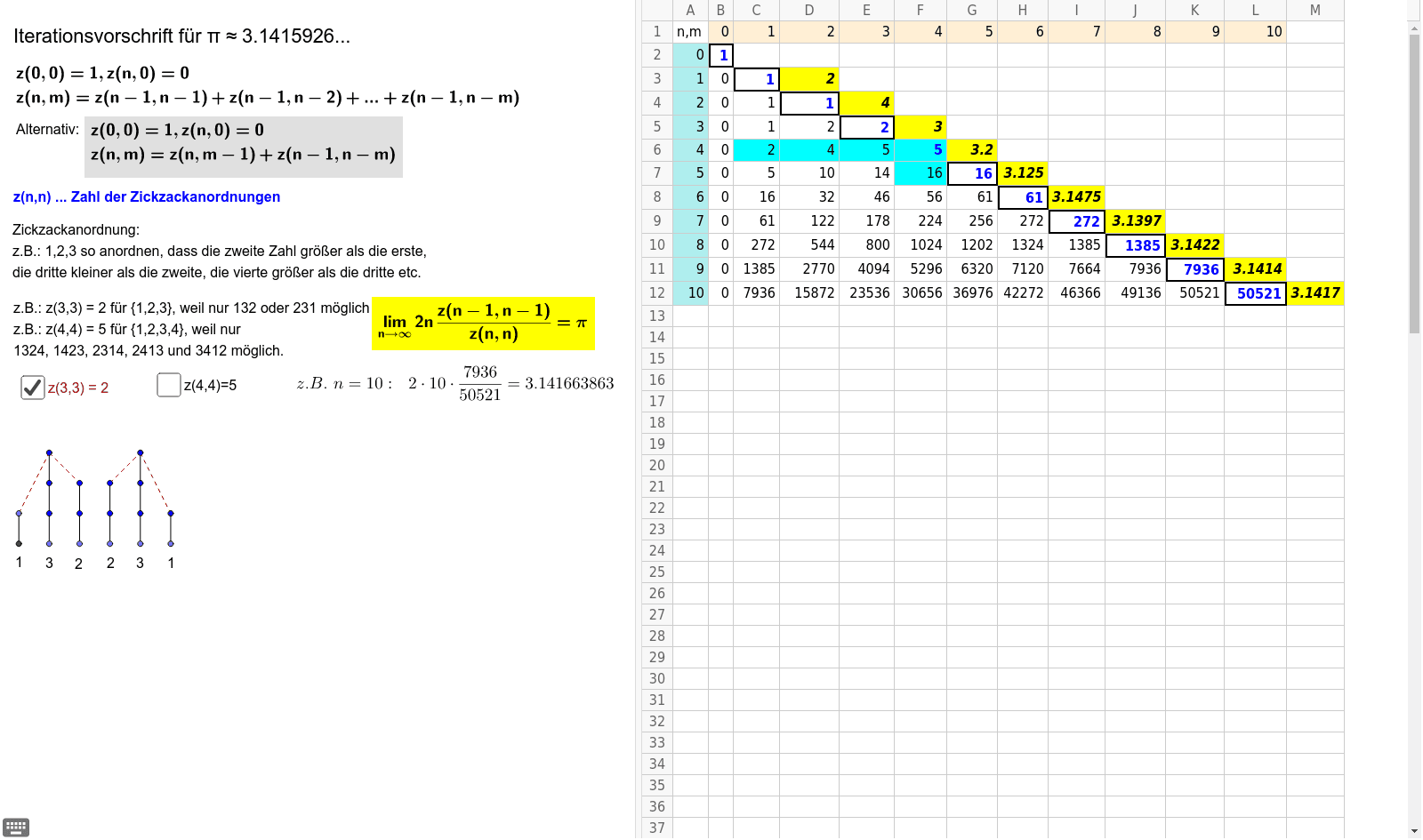
This example demonstrates how to approximate π using Euler's zigzag numbers. Key mathematical concepts include sequence approximation, geometric construction, and limit ideas. Construction involves GeoGebra commands like Sum, Intersect, Point, and Segment, using objects such as B1 to L1 and A2 to A12. Suitable for high school students learning geometry and sequences, or for mathematical modeling education.
GeoGebra Commands & Parameters
Sum(D5:E5) → D6Sum(C5:E5) → E6Sum(B5:E5) → F6Sum(E5:E5) → C6Sum(B3:C3) → D4Sum(C4:D4) → D5Sum(B4:D4) → E5Sum(E6:F6) → D7Sum(D6:F6) → E7Sum(C6:F6) → F7Sum(B6:F6) → G7Sum(F7:G7) → D8Sum(E7:G7) → E8Sum(D7:G7) → F8Sum(C7:G7) → G8Sum(B7:G7) → H8Sum(G8:H8) → D9Sum(F8:H8) → E9Sum(E8:H8) → F9Sum(D8:H8) → G9Sum(C8:H8) → H9Sum(B8:H8) → I9Sum(H9:I9) → D10Sum(G9:I9) → E10Sum(F9:I9) → F10Sum(E9:I9) → G10Sum(D9:I9) → H10Sum(C9:I9) → I10Sum(B9:I9) → J10Sum(I10:J10) → D11Sum(H10:J10) → E11Sum(G10:J10) → F11Sum(F10:J10) → G11Sum(E10:J10) → H11Sum(D10:J10) → I11Sum(C10:J10) → J11Sum(B10:J10) → K11Sum(J11:K11) → D12Sum(I11:K11) → E12Sum(H11:K11) → F12Sum(G11:K11) → G12Sum(F11:K11) → H12Sum(E11:K11) → I12Sum(D11:K11) → J12Sum(C11:K11) → K12Sum(B11:K11) → L12Intersect(xAxis, yAxis) → APoint(yAxis) → BPoint(xAxis) → CPoint(xAxis) → GSegment(A, B) → aSegment(C, F) → bSegment(G, I) → cSegment(B, F) → dSegment(F, I) → ePoint(xAxis) → JPoint(xAxis) → MPoint(xAxis) → QSegment(J, L) → fSegment(M, P) → gSegment(Q, R) → hSegment(L, P) → iSegment(P, R) → jIntersect(xAxis, yAxis) → SPoint(yAxis) → TPoint(xAxis) → UPoint(xAxis) → A_1Point(xAxis) → D_1Point(xAxis) → I_1Point(xAxis) → K_1Point(xAxis) → P_1Point(xAxis) → S_1Point(xAxis) → W_1Point(xAxis) → B_2Point(xAxis) → F_2Point(xAxis) → H_2Point(yAxis) → M_2Point(yAxis) → N_2Point(yAxis) → O_2Segment(S, T) → mSegment(U, Z) → nSegment(A_1, C_1) → pSegment(D_1, H_1) → qSegment(I_1, J_1) → rSegment(K_1, O_1) → sSegment(P_1, R_1) → tSegment(S_1, V_1) → a_1Segment(W_1, A_2) → b_1Segment(B_2, E_2) → c_1Segment(F_2, G_2) → d_1Segment(H_2, L_2) → e_1Segment(M_2, O_2) → f_1Segment(P_2, B_3) → g_1Segment(T_2, U_2) → h_1Segment(V_2, A_3) → i_1Segment(C_3, P_3) → j_1Segment(F_3, J_3) → k_1Segment(K_3, L_3) → l_1Segment(M_3, O_3) → m_1Segment(T, Z) → n_1Segment(Z, C_1) → p_1Segment(C_1, H_1) → q_1Segment(J_1, O_1) → r_1Segment(O_1, R_1) → s_1Segment(R_1, V_1) → t_1Segment(A_2, E_2) → a_2Segment(E_2, G_2) → b_2Segment(G_2, L_2) → c_2Segment(O_2, B_3) → d_2Segment(B_3, U_2) → e_2Segment(U_2, A_3) → f_2Segment(P_3, J_3) → g_2Segment(J_3, L_3) → h_2Segment(L_3, O_3) → i_2
AI Drawing Prompt Reference
Draw a geometric illustration showing how Euler's zigzag numbers approximate π, constructed through a series of summations and intersections starting from basic geometric units, gradually building complex patterns that resemble a circle, demonstrating sequence approximation, geometric construction, and limit concepts.
The prompt above was compiled from the original drawing commands and is for reference only.