
Approximating the Area of a Circle by Jack D. Gittinger
Loading the math board and drawing, please wait…
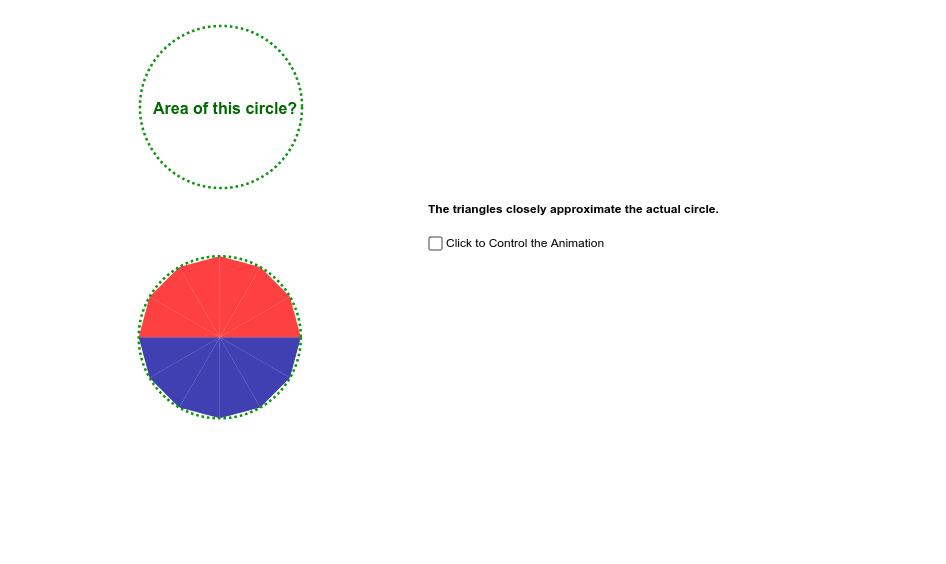
This example demonstrates how to approximate the area of a circle using similarity transformations and geometric constructions. Key math concepts include circle, similarity transformation, equilateral triangles, and differential equations. GeoGebra commands and objects like Circle, Point, Vector, Translate, Rotate, Line, Angle, Mirror, Polygon, OrthogonalLine, Segment are utilized in the construction. Suitable for high school and above students to understand circle area calculation methods.
GeoGebra Commands & Parameters
Circle(A, a) → cPoint(c) → BVector(B, A) → uTranslate(C, Vector[(-u)]) → C'_2Rotate(C'_2, ((g / 100 * 15))°, C'_2) → C''_2Line(B, A) → bRotate(B, 30°, A) → B'Angle(B, A, B') → αLine(B', A) → dCircle(C, a) → eVector(A, B') → vVector(B, B') → wTranslate(C, v) → C'_1Rotate(C'_2, 60°, C) → C''_1Rotate(C'_1, 60°, C) → DLine(C'_2, C) → fMirror(C'_1, f) → EMirror(C''_1, f) → C'''Mirror(D, f) → D'Polygon(E, C'_2, C) → poly1, c_1, e_1, c'Rotate(E, ((g / 100 * 15))°, C'_2) → E'_1Rotate(C, ((g / 100 * 15))°, C'_2) → C'_3Polygon(E'_1, C''_2, C'_3) → poly1', c'_1, e', c''Polygon(C''', E, C) → poly2, c_2, c''', e_2Rotate(C''', (g / 100 * β), F) → GRotate(E, (g / 100 * β), F) → E'Rotate(C, (g / 100 * β), F) → C'_4Polygon(G, E', C'_4) → poly2', c'_2, g_1, e'_1Polygon(C, D', C''') → poly3, c'''_1, c_3, d'Rotate(C, (g / 100 * γ), H) → C'Rotate(D', (g / 100 * γ), H) → D''Rotate(C''', (g / 100 * γ), H) → IPolygon(C', D'', I) → poly3', i, c'_3, d''Mirror(C', f) → C''_3Mirror(D'', f) → D'''_1Mirror(I, f) → I'_1Polygon(C''_3, D'''_1, I'_1) → poly3''_1, i', c''_1, d'''Mirror(G, f) → G'_1Mirror(E', f) → E''_1Mirror(C'_4, f) → JPolygon(G'_1, E''_1, J) → poly2''_1, j, g', e''Mirror(E'_1, f) → KMirror(C''_2, f) → LMirror(C'_3, f) → MPolygon(K, L, M) → poly1''_1, m, k, lOrthogonalLine(C, f) → hMirror(C', h) → C''Mirror(D'', h) → D'''Mirror(I, h) → I'Polygon(C'', D''', I') → poly3'', i'_1, c''_2, d'''_1Mirror(G, h) → G'Mirror(E', h) → E''Mirror(C'_4, h) → NPolygon(G', E'', N) → poly2'', n, g'_1, e''_1Mirror(E'_1, h) → OMirror(C''_2, h) → PMirror(C'_3, h) → QPolygon(O, P, Q) → poly1'', q, o, pMirror(K, h) → K'Mirror(L, h) → L'Mirror(M, h) → M'Polygon(K', L', M') → poly4, m', k', l'Mirror(G'_1, h) → RMirror(E''_1, h) → SMirror(J, h) → J'Polygon(R, S, J') → poly5, j', r, sMirror(C''_3, h) → TMirror(D'''_1, h) → UMirror(I'_1, h) → VPolygon(T, U, V) → poly6, v_1, t, u_1Vector((0, 0), (-3.27, 2.09)) → offsetvectorPoint(c) → WRotate(W, 30°, A) → W'Angle(W, A, W') → δVector(W', W) → zVector(W', A) → w_1Polygon(TestPoint, E_1, D_1, J_1, TestB, Z, F_1, A_1, G_1, B_1, H_1, C_1, I_1) → poly7, testpoint, i_1, d_1, j_1, testb, e_3, z_1, f_1, a_1, g_2, b_1, h_1, c_4Translate(TestPoint, Vector[((g - 100) / 100 * w_1)]) → TestPoint'_1Translate(E_1, Vector[((g - 100) / 100 * w_1)]) → K_1Translate(Z, Vector[((g - 100) / 100 * w_1)]) → Z'_1Translate(F_1, Vector[((g - 100) / 100 * w_1)]) → L_1Translate(A_1, Vector[((g - 100) / 100 * w_1)]) → M_1Translate(G_1, Vector[((g - 100) / 100 * w_1)]) → N_1Translate(B_1, Vector[((g - 100) / 100 * w_1)]) → O_1Translate(H_1, Vector[((g - 100) / 100 * w_1)]) → P_1Translate(C_1, Vector[((g - 100) / 100 * w_1)]) → Q_1Translate(I_1, Vector[((g - 100) / 100 * w_1)]) → R_1Translate(D_1, Vector[((g - 100) / 100 * w_1)]) → S_1Translate(J_1, Vector[((g - 100) / 100 * w_1)]) → T_1Translate(TestB, Vector[((g - 100) / 100 * w_1)]) → TestB'_1Polygon(TestPoint'_1, K_1, S_1, T_1, TestB'_1, Z'_1, L_1, M_1, N_1, O_1, P_1, Q_1, R_1) → poly7'_1, testpoint', r_1, s_1, t_1, testb', k_1, z', l_1, m_1, n_1, o_1, p_1, q_1Mirror(TestPoint, h) → TestPoint'Mirror(E_1, h) → U_1Mirror(Z, h) → Z'Mirror(F_1, h) → V_1Mirror(A_1, h) → W_1Mirror(G_1, h) → Z_1Mirror(B_1, h) → A_2Mirror(H_1, h) → B_2Mirror(C_1, h) → C_2Mirror(I_1, h) → D_2Mirror(D_1, h) → E_2Mirror(J_1, h) → F_2Mirror(TestB, h) → TestB'Polygon(TestPoint', U_1, E_2, F_2, TestB', Z', V_1, W_1, Z_1, A_2, B_2, C_2, D_2) → poly7', testpoint'_1, d_2, e_4, f_2, testb'_1, u_2, z'_1, v_2, w_2, z_2, a_2, b_2, c_5Segment(G_2, H_2) → h_2Segment(I_2, J_2) → i_2Circle(C_3, a) → e_5