
A Plane Intersecting a Cone
Loading the math board and drawing, please wait…
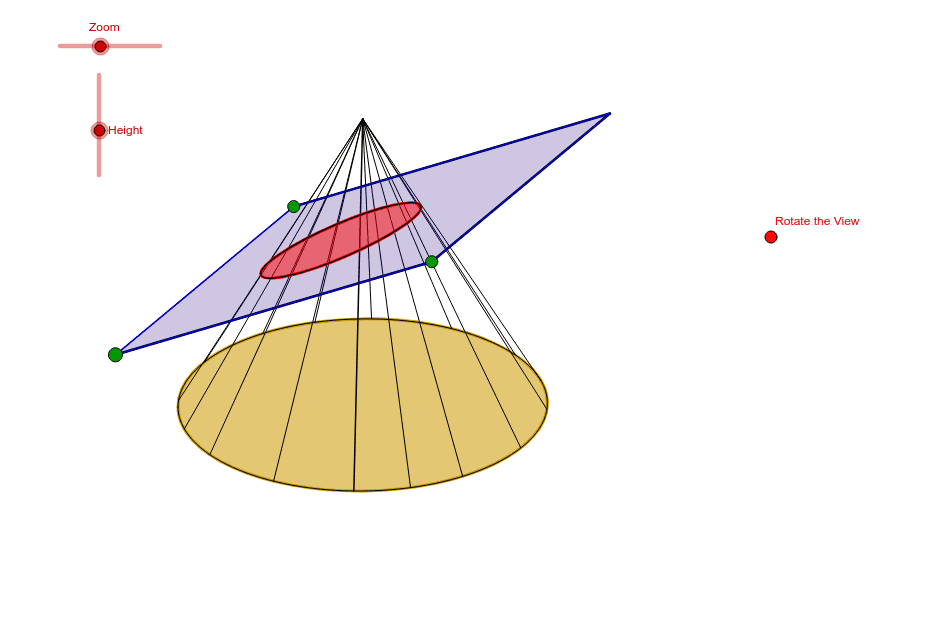
This example demonstrates the geometric shapes formed when a cone is intersected by a plane. Key mathematical concepts include cones, plane intersections, right triangles, and the Pythagorean theorem. Using GeoGebra commands such as Vector, OrthogonalLine, Translate, Mirror, etc., the intersection shape can be constructed. Suitable for high school geometry education and learning.
GeoGebra Commands & Parameters
Vector(B_1, X) → uVector(B_1, Z) → wOrthogonalLine(Vues, yAxis) → aOrthogonalLine(Vues, xAxis) → bVector(B_1, Y) → vTranslate(O, Vector[(R * u)]) → O'_1Translate(O, Vector[(R * v)]) → O'_2Mirror(O'_2, O) → O''Mirror(O'_1, O) → APolygon(A, O'_2, O'_1, O'') → poly1, a_1, o', o'_1, o''Midpoint(a_1) → BMidpoint(o'') → CMidpoint(o'_1) → DMidpoint(o') → EConic(E, B, C, D, E) → dMidpoint(O, O'_2) → FMidpoint(F, B) → GMidpoint(O, G) → HMidpoint(O, G) → IMidpoint(G, I) → JMirror(J, G) → J'Conic(E, J', B, C, D) → eTranslate(O, Vector[(h * w)]) → SSegment(S, O) → fLine(O'_2, f) → iLine(A, f) → jLine(O'', f) → lPoint(j) → KPoint(i) → LPoint(l) → MSegment(K, L) → mSegment(K, M) → nLine(L, n) → pLine(M, m) → qIntersect(p, q) → NPolygon(K, L, N, M) → poly2, k_1, l_1, n_1, m_1Midpoint(k_1) → PMidpoint(l_1) → QMidpoint(m_1) → S_2Midpoint(n_1) → TLine(S, E) → rLine(B, S) → sLine(S, D) → tLine(S, C) → b_1Line(S_2, Q) → c_1Line(P, T) → d_1Intersect(c_1, r) → UIntersect(c_1, b_1) → VIntersect(s, d_1) → WIntersect(t, d_1) → A_1Segment(S, D) → e_1Segment(S, C) → f_1Segment(S, B) → g_1Segment(S, E) → h_1Line(V, m_1) → i_1Line(W, k_1) → j_1Line(U, l_1) → p_1Line(A_1, n_1) → q_1Intersect(p_1, j_1) → C_1Intersect(i_1, j_1) → D_1Intersect(q_1, i_1) → E_1Intersect(q_1, p_1) → F_1Polygon(D_1, C_1, F_1, E_1) → poly3, d_2, c_2, f_2, e_2Midpoint(C_1, E_1) → G_1Mirror(V, G_1) → V'Conic(U, V', W, V, A_1) → r_1Segment(O'_1, A) → s_1Segment(O'_2, O'') → t_1Intersect(e, s_1) → H_1, I_1Intersect(e, t_1) → J_1, K_1Segment(S, I_1) → a_2Segment(S, J_1) → b_2Segment(S, H_1) → g_2Segment(S, K_1) → h_2AngularBisector(O'_2, O, B) → i_2AngularBisector(A, O, B) → j_2AngularBisector(C, O, A) → k_2AngularBisector(O'', O, C) → l_2Midpoint(B, A) → L_1Midpoint(O'_2, B) → M_1Midpoint(O'_2, E) → N_1Midpoint(A, C) → O_1Line(O, L_1) → m_2Line(N_1, O) → n_2Line(M_1, O) → p_2Line(O_1, O) → q_2Intersect(e, p_2) → P_1, Q_1Intersect(e, m_2) → R_1, S_1Intersect(e, q_2) → T_1, U_1Intersect(e, n_2) → V_1, W_1Segment(Q_1, S) → r_2Segment(W_1, S) → s_2Segment(T_1, S) → t_2Segment(S_1, S) → a_3Segment(R_1, S) → b_3Segment(U_1, S) → c_3Segment(S, V_1) → d_3Segment(P_1, S) → e_3Intersect(e, r_1) → Z_1, A_2, B_2, C_2Conic(E, J', B, C, D) → f_3Conic(U, V', W, V, A_1) → g_3Polygon(K, L, N, M) → poly4, k_3, l_3, n_3, m_3Polygon(A, O'_2, O'_1, O'') → poly5, a_4, o'_2, o'_3, o''_1