
AP Calculus 2013 AB Problem 5(b): Volume of Revolution via Integral Construction
Loading the math board and drawing, please wait…
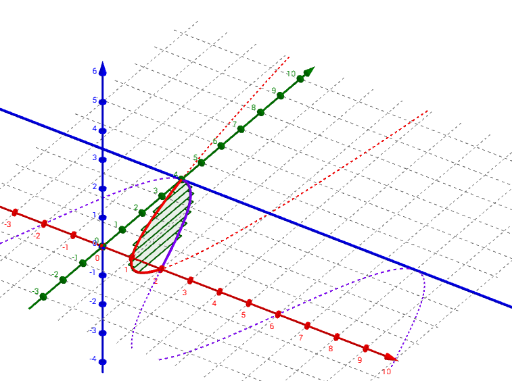
This GeoGebra example demonstrates the construction of a volume-of-revolution problem from AP Calculus 2013 AB, part (b). It visualizes a plane region rotated about an axis, using integral and rectangle-sum approximations to show how the volume accumulates. Core mathematical concepts include definite integrals, volume formulas for solids of revolution (disk/washer method), function graphing, and area partitioning. The construction uses commands such as Sequence, Polygon, Rotate, Integral, Surface, and RectangleSum; objects include the function f, rotation axis, rectangle sequences, inner/outer surfaces, and volume integral expressions. Suitable for advanced high school or introductory college calculus, this example helps students grasp the geometric meaning of volume integrals and numerical approximation methods.
GeoGebra Commands & Parameters
Sequence(Polygon[((k * h), f(((k + p) * h))), (((k + 1) * h), f(((k + p) * h))), (((k + 1) * h), g(((k + p) * h))), ((k * h), g(((k + p) * h)))], k, 0, m - 1) → RectanglesPolygon(((DK * h), g(((DK + p) * h))), (((DK + 1) * h), g(((DK + p) * h))), (((DK + 1) * h), f(((DK + p) * h))), ((DK * h), f(((DK + p) * h)))) → Rectangle1, b, c, d, eRotate(Rectangle1, α, a) → Rectangle1'Integral((π * ((4 - f(x))^(2) - (4 - g(x))^(2))), 0, 2) → VolIntegRotate(f_1, α, a) → iRotate(g_1, α, a) → jSurface(((DK + 1) * h), 4 - ((4 - u) * cos(β)), ((4 - u) * sin(β)), u, f(((DK + p) * h)), g(((DK + p) * h)), β, 0, α) → SideRight1Surface((DK * h), 4 - ((4 - u) * cos(β)), ((4 - u) * sin(β)), u, f(((DK + p) * h)), g(((DK + p) * h)), β, 0, α) → SideLeft1Surface(u, 4 - ((4 - f(((DK + p) * h))) * cos(β)), ((4 - f(((DK + p) * h))) * sin(β)), u, (DK * h), ((DK + 1) * h), β, 0, α) → Outer1Surface(u, 4 - ((4 - g(((DK + p) * h))) * cos(β)), ((4 - g(((DK + p) * h))) * sin(β)), u, (DK * h), ((DK + 1) * h), β, 0, α) → Inner1Rotate(Rectangles, α, a) → Rectangles'Surface(u, 4 - ((4 - g(u)) * cos(β)), ((4 - g(u)) * sin(β)), u, 0, 2, β, 0, (2 * π)) → InnerSurface(u, 4 - ((4 - f(u)) * cos(β)), ((4 - f(u)) * sin(β)), u, 0, 2, β, 0, (2 * π)) → OuterSequence(Surface[u, 4 - ((4 - g(((k + p) * h))) * cos(β)), ((4 - g(((k + p) * h))) * sin(β)), u, (k * h), ((k + 1) * h), β, 0, α], k, 0, m - 1) → InnersSequence(Surface[u, 4 - ((4 - f(((k + p) * h))) * cos(β)), ((4 - f(((k + p) * h))) * sin(β)), u, (k * h), ((k + 1) * h), β, 0, α], k, 0, m - 1) → OutersSequence(Surface[(k * h), 4 - ((4 - u) * cos(β)), ((4 - u) * sin(β)), u, f(((k + p) * h)), g(((k + p) * h)), β, 0, α], k, 0, m - 1) → SidesLeftSequence(Surface[((k + 1) * h), 4 - ((4 - u) * cos(β)), ((4 - u) * sin(β)), u, f(((k + p) * h)), g(((k + p) * h)), β, 0, α], k, 0, m - 1) → SidesRightRectangleSum(A, 0, (m * h), m, p) → WS