
AP Calculus 2010AB_4b Volume of Revolution Problem
Loading the math board and drawing, please wait…
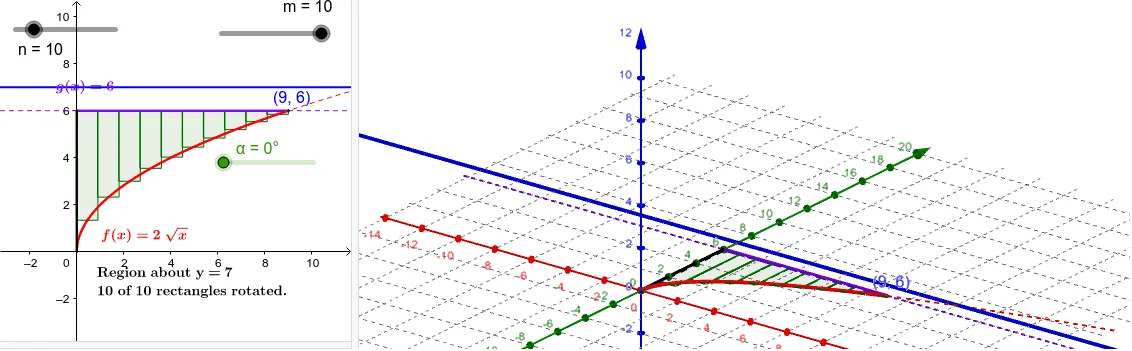
This example demonstrates how to generate a 3D solid by revolving a planar region and compute its volume, serving as a dynamic visualization of part (b) of Problem 4 from the 2010 AP Calculus AB exam. Core mathematical concepts include definite integrals for volumes of revolution (disk/washer method), the relationship between function graphs and the axis of rotation, and the geometric construction of volume integrals. Construction highlights: using GeoGebra commands such as Sequence, Polygon, Rotate to generate cross-sections, Integral and Surface to compute and display the volume integral and the surface of revolution, RectangleSum and Rectangle objects to illustrate Riemann sum approximations, and Inner/Outer objects to represent the inner and outer radii in the washer method. Suitable for high school AP Calculus courses or introductory college calculus, this example helps students intuitively understand the derivation and calculation of volume formulas for solids of revolution.
GeoGebra Commands & Parameters
Sequence(Polygon[((k * h), f(((k + p) * h))), (((k + 1) * h), f(((k + p) * h))), (((k + 1) * h), g(((k + p) * h))), ((k * h), g(((k + p) * h)))], k, 0, m - 1) → RectanglesPolygon(((DK * h), f(((DK + p) * h))), (((DK + 1) * h), f(((DK + p) * h))), (((DK + 1) * h), g(((DK + p) * h))), ((DK * h), g(((DK + p) * h)))) → Rectangle1, b, c, d, eRotate(Rectangle1, α, a) → Rectangle1'Integral((π * ((7 - f(x))^(2) - (7 - g(x))^(2))), 0, 9) → VolIntegRotate(Rectangles, α, a) → Rectangles'Rotate(g_1, α, a) → iRotate(f_1, α, a) → jSurface(u, 7 - ((7 - g(((DK + p) * h))) * cos(β)), ((7 - g(((DK + p) * h))) * sin(β)), u, (DK * h), ((DK + 1) * h), β, 0, α) → Inner1Surface(u, 7 - ((7 - f(((DK + p) * h))) * cos(β)), ((7 - f(((DK + p) * h))) * sin(β)), u, (DK * h), ((DK + 1) * h), β, 0, α) → Outer1Surface((DK * h), 7 - ((7 - u) * cos(β)), ((7 - u) * sin(β)), u, f(((DK + p) * h)), g(((DK + p) * h)), β, 0, α) → SideLeft1Surface(((DK + 1) * h), 7 - ((7 - u) * cos(β)), ((7 - u) * sin(β)), u, f(((DK + p) * h)), g(((DK + p) * h)), β, 0, α) → SideRight1Surface(u, 7 + ((7 - g(u)) * cos(β)), ((7 - g(u)) * sin(β)), u, 0, 9, β, 0, (2 * π)) → InnerSurface(u, 7 - ((7 - f(u)) * cos(β)), ((7 - f(u)) * sin(β)), u, 0, 9, β, 0, (2 * π)) → OuterSegment((0, 0, 0), (0, 6, 0)) → kRotate(k, α, a) → k'Sequence(Surface[u, 7 - ((7 - g(((k + p) * h))) * cos(β)), ((7 - g(((k + p) * h))) * sin(β)), u, (k * h), ((k + 1) * h), β, 0, α], k, 0, m - 1) → InnersSequence(Surface[u, 7 - ((7 - f(((k + p) * h))) * cos(β)), ((7 - f(((k + p) * h))) * sin(β)), u, (k * h), ((k + 1) * h), β, 0, α], k, 0, m - 1) → OutersSequence(Surface[(k * h), 7 - ((7 - u) * cos(β)), ((7 - u) * sin(β)), u, f(((k + p) * h)), g(((k + p) * h)), β, 0, α], k, 0, m - 1) → SidesLeftSequence(Surface[((k + 1) * h), 7 - ((7 - u) * cos(β)), ((7 - u) * sin(β)), u, f(((k + p) * h)), g(((k + p) * h)), β, 0, α], k, 0, m - 1) → SidesRightRectangleSum(A, 0, (m * h), m, p) → WS