
Animation: Triangle and Vector Transformations
Loading the math board and drawing, please wait…
In collections
Congruence (CO) Cluster
Congruence (Vol 2)
CCSS High School: Geometry (Congruence) Volume 2
CCSS High School: Geometry (Congruence) Volume 2
CCSS High School: Geometry (Congruence) Volume 2
Geometry (Congruence) Volume 2
CCSS High School: Geometry (Congruence) Volume 2
CCSS High School: Geometry (Congruence) Volume 2
CCSS High School: Geometry (Congruence) Volume 2
CCSS High School: Geometry (Congruence) Volume 2
CCSS High School: Geometry (Congruence) Volume 2
CCSS High School: Geometry (Congruence) Volume 2
CCSS High School: Geometry (Congruence) Volume 2
Gail LeBlancCCSS High School: Geometry (Congruence) Volume 2
CCSS High School: Geometry (Congruence) Volume 2
Unit 5: Triangle Congruence
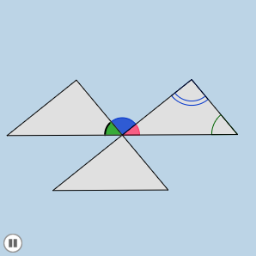
This example demonstrates the transformation of a triangle through various vector operations. Key mathematical concepts include triangles, vectors, and geometric transformations. Using GeoGebra commands such as Ray, Point, Angle, Circle, Intersect, Vector, Translate, Dilate, and Mirror, the example dynamically shows the rotation, translation, and scaling of a triangle. Suitable for middle school and above students to learn about geometric transformations and vectors.
GeoGebra Commands & Parameters
Ray(A, B) → aRay(B, C) → bRay(C, A) → cPoint(a) → D_1Point(b) → E_1Point(c) → F_1Ray(A, F_1) → dRay(B, D_1) → eRay(C, E_1) → fPoint(e) → DPoint(f) → EPoint(d) → FAngle(B, A, C) → αAngle(C, B, A) → βAngle(A, C, B) → γAngle(F, A, B) → δAngle(D, B, C) → εAngle(E, C, A) → ζCircle(A, 1.5) → gCircle(B, 1.5) → hCircle(C, 1.5) → kIntersect(g, c, 1) → GIntersect(g, a, 1) → HIntersect(g, c, 2) → IIntersect(h, b, 1) → JIntersect(h, a, 1) → KIntersect(h, a, 2) → LIntersect(k, b) → M, NIntersect(k, c) → O,CircleSector(A, H, G) → pCircleSector(B, J, K) → qCircleSector(C, O, M) → rCircleSector(C, N, O) → sCircleSector(B, L, J) → tCircleSector(A, I, H) → c_1Line(C, a) → iVector(B, C) → uVector(A, C) → vTranslate(q, u) → q'Dilate(C, If[0 < j ≤ 1, j, 0], B) → C'Vector(B, C') → wTranslate(q, w) → q'_1Mirror(q', C) → q''Dilate(A, If[2 < j ≤ 3, 3 - j, 0], C) → C'_1Vector(A, C'_1) → mTranslate(p, m) → p'Dilate(C, If[0 < n ≤ 1, n, 0], B) → C'_2Dilate(A, If[1 < n ≤ 2, 2 - n, 0], C) → A'Vector(B, C'_2) → u_1Vector(A, A') → v_1If(0 < n ≤ 1, Translate[t, u_1], Translate[t, u]) → e_1If(1 < n ≤ 2, Translate[c_1, v_1], Translate[c_1, v]) → f_1Polygon(A, B, C) → poly1, c_2, a_2, b_1Line(A, B) → g_1Point(i) → PPoint(i) → QAngle(A, C, B) → ηCircleSector(C, M, O) → p_1CircleSector(B, K, J) → q_1CircleSector(A, G, H) → r_1Translate(q_1, w) → s_1Translate(q_1, w) → t_1Vector(B, C) → w_1Translate(q_1, w_1) → e_2Rotate(e_2, 180°, C) → f_2Translate(r_1, m) → g_2CircleSector(C, O, N) → k_2CircleSector(B, J, L) → p_2CircleSector(A, H, I) → q_2Translate(p_2, u_1) → r_2Translate(p_2, u) → s_2Translate(q_2, v_1) → t_2Translate(q_1, u) → d_2Translate(q_1, w) → c_3Translate(A, w) → A'_1Translate(B, w) → B'Translate(C, w) → C'_3Polygon(A'_1, B', C'_3) → poly1', c'_3, a'_1, b'Translate(A, w_1) → A'_2Translate(B, w_1) → B'_1Translate(C, w_1) → C'_4Polygon(A'_2, B'_1, C'_4) → poly1'_1, c'_4, a'_2, b'_1Segment(C'_3, A'_1) → lSegment(A'_1, B') → l_1Segment(B', C'_3) → m_1Segment(C'_4, A'_2) → n_1Segment(A'_2, C'_3) → b_2Segment(C'_3, C'_4) → i_2Rotate(d_2, (((j - 1) * 180))°, C) → h_2Translate(r_1, m) → d_3Translate(A, m) → A'_3Translate(B, m) → B'_2Translate(C, m) → C'_5Polygon(A'_3, B'_2, C'_5) → poly1'_2, c'_5, a'_3, b'_2Segment(B'_2, C'_5) → i_1Segment(C'_5, A'_3) → j_1Segment(A'_3, B'_2) → k_1Line(A, C) → j_2Intersect(k, j_2) → R, SRotate(S, (((j - 3) * 180))°, C) → S'CircleArc(C, S, S') → e_3Segment(A, B) → l_2Segment(B, C) → m_2Segment(A, C) → n_2Translate(q, w) → d_1Translate(q, u) → q'_2Rotate(q'_2, If[1 < j ≤ 2, (((-(j - 1)) * 180))°, 180°], C) → p''Translate(p, m) → p'_1Rotate(S, (((-(j - 3)) * 180))°, C) → S'_1CircleArc(C, S'_1, S) → f_3Ray(C, A) → a_3
AI Drawing Prompt Reference
Draw a triangle ABC and demonstrate its rotation, translation, and scaling through vector operations and geometric transformations. First, draw the three sides of the triangle, then generate three points D, E, and F through the sides. Next, draw the three interior angles α, β, and γ, as well as three circles with radii of 1.5 centered at the vertices. Use the intersection points of circles and sides to generate new points G, H, I, J, K, L, M, N, and O. Draw three arcs p, q, and r using these points. Then, perform translation and scaling transformations using vectors u and v to generate new arcs q', q'_1, and q''. Finally, complete the transformation display by mirroring and scaling operations to generate new points and vectors.
The prompt above was compiled from the original drawing commands and is for reference only.