
Animation Demonstrating Sequence and Function Intersection
Loading the math board and drawing, please wait…
In collections
Congruence (CO) Cluster
Congruence (Vol 1)
Congruence (Vol 1) Over 80 Resources
Geometry (Congruence) Volume 1
CCSS High School: Geometry (Congruence) Volume 1 S N ATTAR
CCSS High School: Geometry (Congruence) Volume 1
CCSS High School: Geometry (Congruence) Volume 1
CCSS High School: Geometry (Congruence) Volume 1
CCSS High School: Geometry (Congruence) Volume 1
CCSS High School: Geometry (Congruence) Volume 1
CCSS High School: Geometry (Congruence) Volume 1
CCSS High School: Geometry (Congruence) Volume 1
CCSS High School: Geometry (Congruence) Volume 1
CCSS High School: Geometry (Congruence) Volume 1
CCSS High School: Geometry (Congruence) Volume 1
Congruence: Volume 1 - Chapter 1
Congruence: Volume 1 - Chapter 1
Congruence V1C1 Check
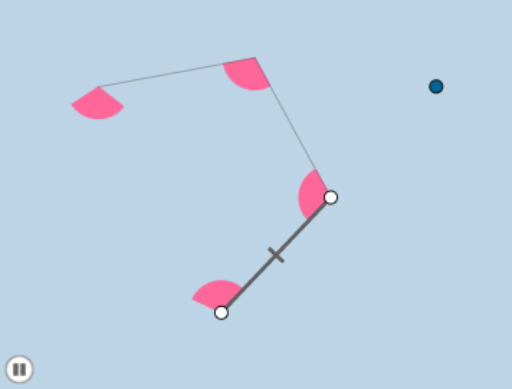
This example visually demonstrates the dynamic relationship between a sequence and a rectangle through animation, showing the changing intersection points between a function graph and a sequence. Key mathematical concepts include sequences, rectangles, tangent functions, real numbers, and intersection calculations. GeoGebra commands and objects used in construction are Rotate, Ray, Point, Segment, Circle, Intersect, Line, Angle, Min, CircleSector, Dilate, Vector, Translate, Polygon. Suitable for high school mathematics education, helping students understand sequence limits, function properties, and geometric intersection problems.
GeoGebra Commands & Parameters
Rotate(A, 108°, B) → A'Ray(B, A') → gRay(B, A) → fPoint(f) → CSegment(C, B) → nCircle(C, n) → d_1Rotate(B, (-(108°)), C) → B'Ray(C, B') → hIntersect(d_1, h, 1) → GCircle(G, n) → e_1Point(h) → DRotate(C, (-(108°)), D) → C'Ray(D, C') → iPoint(i) → ERotate(D, (-(108°)), E) → D'Ray(E, D') → jIntersect(g, j) → FSegment(F, E) → kSegment(E, D) → lLine(G, l) → g_1Intersect(e_1, g_1, 1) → JLine(J, k) → h_1Intersect(h_1, g) → KAngle(A, B, A') → αAngle(B', C, B) → βAngle(C', D, C) → γAngle(D', E, D) → δSegment(D, C) → mSegment(B, F) → pMin(list) → aCircle(B, (0.2 * n)) → qIntersect(q, p) → H,Intersect(q, n) → I,CircleSector(B, I, H) → rDilate(B, If[0 < o ≤ 1, 1 - o, 0], C) → B'_1Vector(B, B'_1) → uTranslate(r, u) → r'Rotate(r', If[1 < o ≤ 2, (((o - 1) * 2) * π / 5), (2 * π / 5)], C) → r''Dilate(C, If[2 < o ≤ 3, 3 - o, 0], G) → C'_1Vector(C, C'_1) → vTranslate(r'', v) → r'''Rotate(r''', If[3 < o ≤ 4, (((o - 3) * 2) * π / 5), (2 * π / 5)], G) → sDilate(G, If[4 < o ≤ 5, 5 - o, 0], J) → D'_1Vector(G, D'_1) → wTranslate(s, w) → s'Rotate(s', If[5 < o ≤ 6, (((o - 5) * 2) * π / 5), (2 * π / 5)], J) → s''Dilate(J, If[6 < o ≤ 7, 7 - o, 0], K) → E'Vector(J, E') → tTranslate(s'', t) → s'''Circle(J, n) → k_1Rotate(s''', If[7 < o ≤ 8, (((o - 7) * 2) * π / 5), (2 * π / 5)], K) → c_1Segment(B, B'_1) → bSegment(C, C'_1) → cSegment(G, D'_1) → dSegment(J, E') → eDilate(K, If[8 < o ≤ 9, 9 - o, 0], B) → K'Segment(K, K') → f_1Polygon(B, C, G, J, K) → poly1, b_1, c_2, g_2, j_1, k_2Rotate(B, If[9 < o ≤ 10, ((-(o - 9)) * α), (-α)], C) → B'_2Rotate(B'_1, If[9 < o ≤ 10, ((-(o - 9)) * α), (-α)], C) → LSegment(B'_2, L) → b'Rotate(B'_2, If[10 < o ≤ 11, ((-(o - 10)) * α), (-α)], G) → MRotate(L, If[10 < o ≤ 11, ((-(o - 10)) * α), (-α)], G) → L'Segment(M, L') → b''Rotate(M, If[11 < o ≤ 12, ((-(o - 11)) * α), (-α)], J) → M'Rotate(L', If[12 < o ≤ 13, ((-(o - 12)) * α), (-α)], J) → L''Segment(M', L'') → b'''Rotate(M', If[12 < o ≤ 13, ((-(o - 12)) * α), (-α)], K) → M''Rotate(L'', If[12 < o ≤ 13, ((-(o - 12)) * α), (-α)], K) → L'''Segment(M'', L''') → i_1
AI Drawing Prompt Reference
Create an animation showing the dynamic relationship between a sequence and a rectangle, highlighting the intersection points between a function graph and a sequence. Include rotating rays, points, segments, circles, and sectors, along with intersections of sequences and rectangles. Demonstrate sequence limits and function properties through rotation and dilation, suitable for high school mathematics education.
The prompt above was compiled from the original drawing commands and is for reference only.