
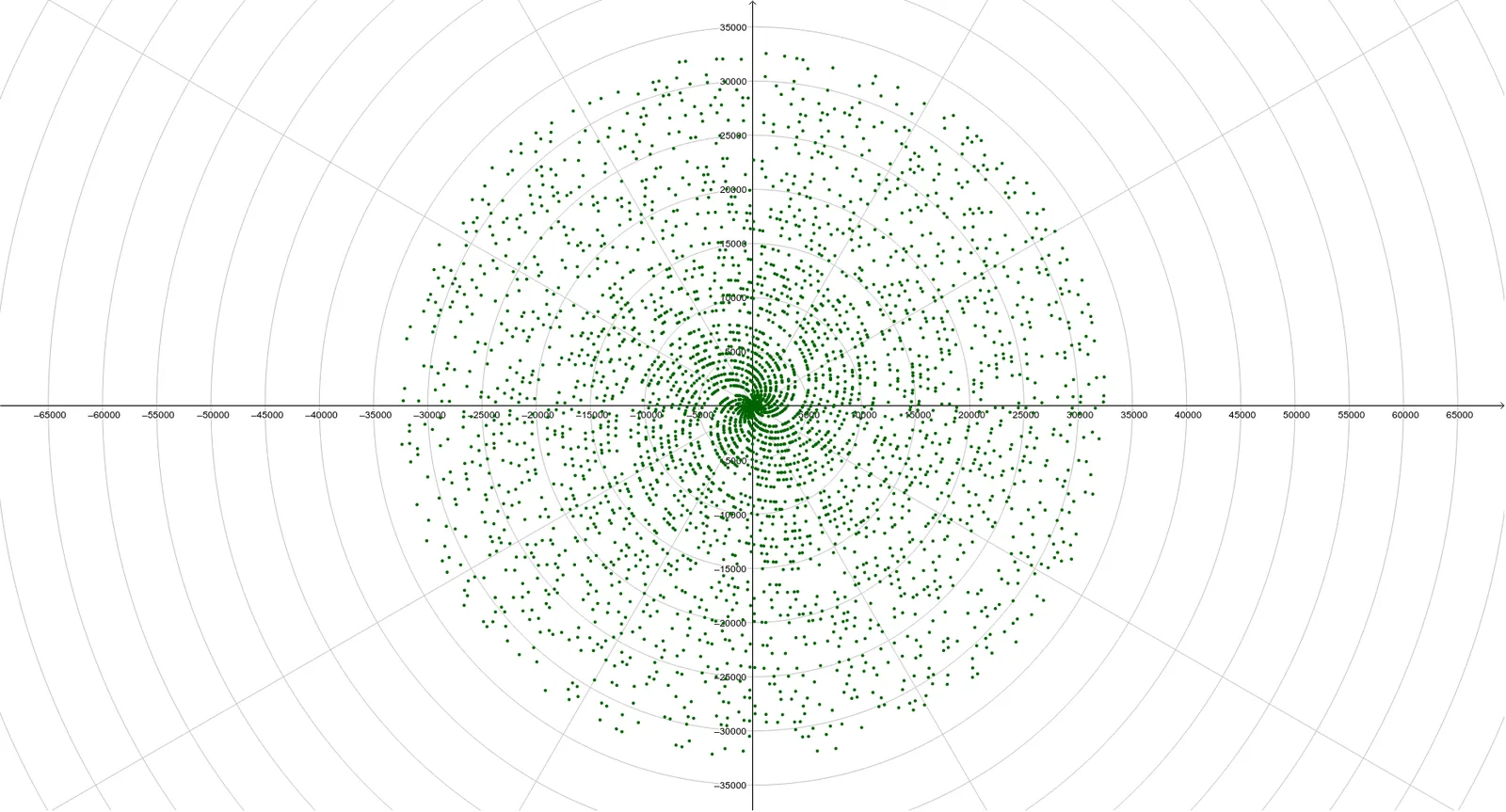
First 3500 Prime Numbers on Polar Grid
Loading the math board and drawing, please wait…
This example demonstrates the visualization of the first 3500 prime numbers on a polar grid, integrating concepts of prime numbers, polar coordinates, trigonometric functions, and coordinate geometry. The construction involves specific GeoGebra commands/objects like A1, B1, C1, ..., I4, J4, showcasing geometric and analytical techniques. Suitable for high school and above, it serves as an educational tool for exploring prime number distributions and polar coordinate systems.
GeoGebra Commands & Parameters
22371528183891167714951183292185125409289493237752978419116811495718341218592541128961523815303842311689149691835321863254232897972383530984291169914983183672187125439290091123895323843111701150131837121881254472901713239353338443117171501718379218932545329021
AI Drawing Prompt Reference
Plot the distribution of the first 3500 prime numbers on a polar grid, where each prime number corresponds to a point with its position determined by the square root of the prime number, and the angle is a multiple of the prime number divided by 360. First, draw the polar coordinate system, then plot each point according to the prime number list.
The prompt above was compiled from the original drawing commands and is for reference only.