
Animation Demonstrating Incircle and 3D Vectors
Loading the math board and drawing, please wait…
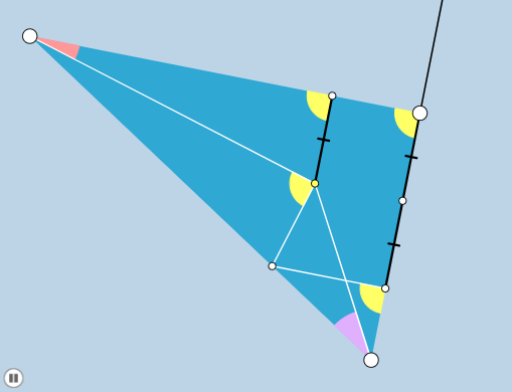
This example demonstrates the formation of a triangle's incircle and its relationship with 3D vectors through animation. It involves core mathematical concepts such as the incircle, 3D vectors, coordinate geometry, orthocenter, and fraction calculations. The construction utilizes commands like semicircle, point, segment, minimum, midpoint, orthogonal line, circle, intersection, circle sector, dilation, vector, polygon, angle, rotation, ray, line, and translation in GeoGebra. Suitable for high school and above, it illustrates the application of spatial geometry and algebra.
GeoGebra Commands & Parameters
Semicircle(A, B) → dPoint(d) → CSegment(C, B) → fSegment(A, C) → eSegment(A, B) → aMin(a, f) → mMin(a, e) → lMin(l, m) → nMidpoint(a) → C_1OrthogonalLine(C_1, a) → bCircle(C_1, A) → cOrthogonalLine(C, a) → gIntersect(g, a) → ESegment(C, E) → hCircle(A, (0.2 * n)) → kCircle(C, (0.2 * n)) → pCircle(B, (0.2 * n)) → qIntersect(p, h, 1) → IIntersect(p, f, 1) → JIntersect(q, a, 1) → KIntersect(q, f, 1) → LIntersect(k, a, 1) → MIntersect(k, e, 1) → NCircleSector(A, M, N) → rDilate(C, If[-2 < i < -1, -1 - i, 0], E) → D'Dilate(A, If[-0.5 < i ≤ 0.5, 0.5 - i, 0], C) → A'Vector(A, A') → uDilate(B, If[1.5 < i ≤ 2.5, 2.5 - i, 0], C) → B'Vector(B, B') → vPolygon(A, B, C) → poly3, d_3, a_2, b_2Angle(C, B, A) → δRotate(C, δ / 2, B) → C'Angle(C, B, C') → εRay(B, C') → h_1Intersect(e, h_1) → DAngle(B, A, C) → ζRotate(B, ζ / 2, A) → B'_1Angle(B, A, B'_1) → ηRay(A, B'_1) → i_1Intersect(f, i_1) → OIntersect(h_1, i_1) → PIntersect(q, h_1, 1) → QIntersect(q, f, 1) → RIntersect(k, a, 1) → SIntersect(k, i_1, 1) → TCircleSector(A, S, T) → c_1CircleSector(B, R, Q) → k_1Polygon(A, B, C) → poly1, c_2, a_1, b_1OrthogonalLine(P, a) → jIntersect(a, j) → FAngle(P, F, A) → αLine(B, C) → j_1Circle(C, 1) → d_1Intersect(d_1, j_1, 2) → GRay(C, G) → l_1Circle(C, (0.5 * Radius[k])) → e_1Intersect(e_1, e, 1) → HIntersect(e_1, l_1, 1) → UCircleSector(C, U, H) → p_1Rotate(p_1, If[0 < i ≤ 1, (i * π / 2), π / 2], C) → sDilate(A, If[1 < i ≤ 2, 2 - i, 0], P) → A'_1Dilate(B, If[1 < i ≤ 2, 2 - i, 0], P) → B'_2Segment(A, T) → tSegment(B, B'_2) → f_1Segment(A, A'_1) → g_1OrthogonalLine(P, g_1) → m_1Line(C, m_1) → n_1Line(C, g_1) → q_1Rotate(k_1, If[2.5 < i ≤ 3.5, ((i - 2.5) * ε), ε], B) → r_1Rotate(c_1, If[3.5 < i ≤ 4.5, ((i - 3.5) * ζ / 2), ζ / 2], A) → s_1Intersect(m_1, a) → VDilate(P, If[4.5 < i ≤ 5.5, 5.5 - i, 0], V) → P'Segment(P, P') → t_1Dilate(C, If[5.5 < i ≤ 6.5, 6.5 - i, 0], P) → C'_1Vector(C, C'_1) → u_1Translate(s, u_1) → s'Point(q_1) → WAngle(W, C, A) → βRotate(s', If[6.5 < i ≤ 7.5, ((-(i - 6.5)) * β), (-β)], P) → s''Segment(C, B) → g_2OrthogonalLine(V, l_1) → h_2Line(C, B) → i_2Intersect(i_2, h_2) → ZDilate(V, If[7.5 < i ≤ 8.5, 8.5 - i, 0], Z) → V'Segment(V, V') → j_2Dilate(C, If[8.5 < i ≤ 9.5, 9.5 - i, 0], Z) → C'_2Vector(C, C'_2) → v_1Translate(s, v_1) → s'_1Line(A, C) → k_2OrthogonalLine(P, k_2) → l_2Intersect(k_2, l_2) → A_1Dilate(P, If[9.5 < i ≤ 10.5, 10.5 - i, 0], A_1) → P'_1Segment(P, P'_1) → f_2Dilate(C, If[10.5 < i ≤ 11.5, 11.5 - i, 0], A_1) → C'_3Vector(C, C'_3) → w_1Translate(s, w_1) → s'_2Dilate(A_1, If[11.5 < i ≤ 12.5, 12.5 - i, 0], C) → B_1Vector(A_1, B_1) → u_2Translate(P, u_2) → P'_2Translate(P'_1, u_2) → D_1Segment(P'_2, D_1) → m_2Dilate(A_1, If[12.5 < i ≤ 13.5, 13.5 - i, 0], P'_2) → E_1Vector(A_1, E_1) → v_2Translate(P, v_2) → P'_3Translate(P'_1, v_2) → F_1Segment(P'_3, F_1) → n_2
AI Drawing Prompt Reference
Draw a triangle ABC with A, B, and C as vertices. Demonstrate the relationship between the incircle of the triangle and 3D vectors through animation. First, draw the three sides of the triangle, then find the incenter of the triangle and draw the incircle. Show the relationship between the incircle and the sides of the triangle. Finally, use rotation and scaling operations to demonstrate the interaction between vectors and the sides of the triangle.
The prompt above was compiled from the original drawing commands and is for reference only.