
Animation Demonstrating Geometric Transformations and Probability Distributions
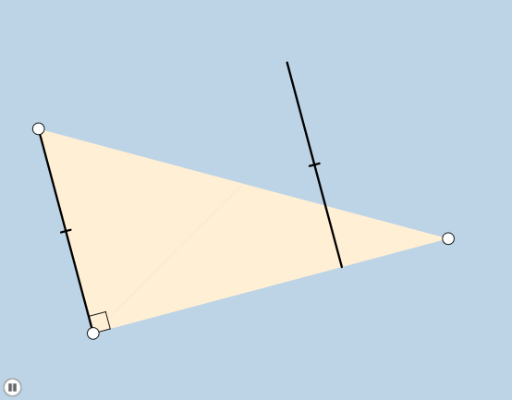
Loading the math board and drawing, please wait…
This example dynamically illustrates geometric transformations and probability distributions through animation. Key math concepts include geometric transformations (rotation, translation, dilation), probability & statistics (normal distribution, geometric distribution, percentages), and data visualization (histogram). Construction highlights involve commands/objects like Segment, OrthogonalLine, Point, Ray, Angle, Circle, Intersect, Rotate, Midpoint, Polygon, Min, CircleSector, Dilate, Vector, Translate from GeoGebra. Suitable for high school and above, enhancing spatial visualization and data analysis skills in geometry and probability.
GeoGebra Commands & Parameters
Segment(A, B) → fOrthogonalLine(A, f) → gPoint(g) → CRay(A, C) → hRay(A, C) → iPoint(i) → DSegment(A, D) → jSegment(D, B) → kAngle(B, A, D) → αCircle(B, j) → cIntersect(c, k, 1) → ESegment(B, E) → lSegment(D, E) → mOrthogonalLine(E, j) → nAngle(A, D, E) → βRotate(A, β / 2, D) → A'Angle(A, D, A') → γRay(D, A') → pIntersect(n, p) → FMidpoint(m) → GIntersect(n, j) → HSegment(A, E) → rSegment(G, F) → qSegment(F, A) → sIntersect(p, r) → IOrthogonalLine(B, f) → tPoint(t) → JAngle(J, B, E) → δPolygon(D, A, E) → poly1, e, d, aPolygon(A, B, E) → poly2, e_1, a_1, bSegment(D, H) → f_1Segment(D, G) → g_1Min(f_1, g_1) → oCircle(D, (0.6 * o)) → c_1Segment(D, E) → h_1Intersect(c_1, h_1, 1) → KIntersect(c_1, j, 1) → LIntersect(c_1, p, 1) → MCircleSector(D, L, M) → d_1Dilate(A, If[0 < u ≤ 1, 1 - u, 0], B) → A'_1Vector(A, A'_1) → vTranslate(A, v) → A'_2Translate(D, v) → D'Segment(A'_2, D') → j'Rotate(A'_2, If[1 < u ≤ 2, ((u - 1) * δ), δ], B) → NRotate(D', If[1 < u ≤ 2, ((u - 1) * δ), δ], B) → D''Segment(N, D'') → j''Dilate(E, If[2 < u ≤ 3, 3 - u, 0], G) → E'Segment(E, E') → i_1Rotate(E, If[3 < u ≤ 4, ((u - 3) * π), π], G) → E'_1Rotate(E', If[3 < u ≤ 4, ((u - 3) * π), π], G) → E''Segment(E'_1, E'') → j_1Dilate(A, If[4 < u ≤ 5, 5 - u, 0], E) → A'_3Segment(A, A'_3) → k_1Polygon(A, E, D) → poly3, d_2, a_2, e_2Segment(E, H) → l_1Angle(A, H, E) → εDilate(E, If[5 < u ≤ 6, 6 - u, 0], H) → E'_2Segment(E, E'_2) → m_1Dilate(D, If[6 < u ≤ 7, 7 - u, 0], F) → D'_1Segment(D, D'_1) → n_1Dilate(F, If[7 < u ≤ 8, 8 - u, 0], I) → F'Segment(F, F') → p_1Rotate(d_1, If[8 < u ≤ 9, ((u - 8) * γ), γ], D) → q_1Dilate(A, If[9 < u ≤ 10, 10 - u, 0], F) → A'_4Segment(A, A'_4) → r_1Dilate(F, If[10 < u ≤ 11, 11 - u, 0], G) → F'_1Segment(FF, F'_1) → s_1