
Animation 63
Loading the math board and drawing, please wait…
In collections
Geometry Review
Similarity & Right Triangle Trigonometry
Similarity, Right Triangles, and Trigonometry (SRT) Cluster
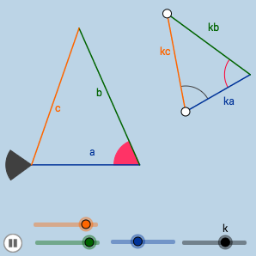
This example demonstrates the similarity transformation of triangles. Key mathematical concepts include the properties of similar triangles and transformations. Using GeoGebra commands such as Circle, Intersect, Segment, and Polygon, dynamic geometric figures can be constructed. Suitable for students at junior high school level and above to learn about similarity transformations and geometric constructions.
GeoGebra Commands & Parameters
Circle(A, a) → dIntersect(d, e) → B_1, BCircle(B, b) → fSegment(A, B) → gCircle(A, c) → k_1Intersect(k_1, f) → C, G, ,Segment(B, C) → hSegment(C, A) → iPolygon(A, B, C) → poly1, f_1, a_1, c_1Point(Circle[D, (k * i)]) → FSegment(D, F) → nCircle(D, (k * g)) → pCircle(F, (k * h)) → qIntersect(p, q, 2) → ESegment(D, E) → rSegment(F, E) → sCircle(A, 2) → tCircle(B, 2) → e_1Circle(D, 1.5) → d_1Circle(E, 1.5) → g_1Intersect(t, g, 1) → HIntersect(t, i, 1) → IIntersect(e_1, h, 1) → JIntersect(e_1, g, 1) → KIntersect(g_1, r, 1) → LIntersect(g_1, s, 1) → MIntersect(d_1, r, 1) → NIntersect(d_1, n, 1) → OCircleSector(D, N, O) → h_1CircleSector(E, M, L) → p_1Dilate(E, If[0 < o ≤ 1, 1 - o, 0], B) → D'Vector(E, D') → uDilate(D, If[2 < o ≤ 3, 3 - o, 0], A) → D'_1Vector(D, D'_1) → vLine(E, h) → b_1Intersect(g_1, b_1) → P, QAngle(M, E, Q) → αTranslate(p_1, u) → q_1Rotate(q_1, If[1 < o ≤ 2, ((o - 1) * α), α], B) → r_1CircleArc(E, M, L) → s_1Translate(h_1, v) → t_1Line(D, i) → i_1Intersect(d_1, i_1) → R, SAngle(O, D, R) → γRotate(t_1, If[3 < o ≤ 4, ((o - 3) * γ), γ], A) → c_2CircleArc(D, N, O) → d_2
AI Drawing Prompt Reference
Create a dynamic geometric illustration showing the similarity transformation of triangles. Begin by drawing two triangles using circles and intersection points to define key vertices, then construct their sides and interiors. Next, apply scaling and rotation to demonstrate how one triangle transforms into another through similarity. Include auxiliary circles and lines to highlight geometric relationships during the transformation, suitable for learning about similarity and geometric constructions.
The prompt above was compiled from the original drawing commands and is for reference only.