
Animation 182: Trigonometry and Geometric Transformations with Unit Circle and I
Loading the math board and drawing, please wait…
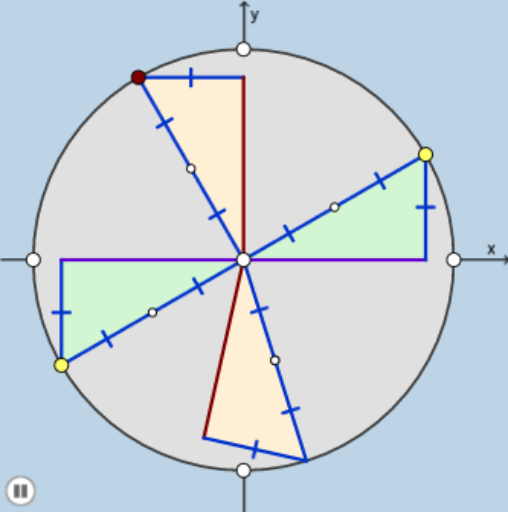
① This example demonstrates a dynamic animation involving the unit circle, an incircle, and complex configurations built from similar triangles, geometric means, and algebraic relationships, with continuous transformations such as rotation, translation, and dilation. ② Core mathematical concepts include trigonometric functions (sine and cosine on the unit circle), incircle, similar triangles, geometric mean, algebra, and squares. ③ Construction highlights: based on the summary, GeoGebra commands such as Mirror, Intersect, Dilate, Segment, Polygon, Midpoint, Rotate, Circle, Line, CircleSector, Vector, Translate, and Angle are used, creating multiple points, lines, circles, and polygons, likely driven by sliders or animation. ④ Suitable for high school or early college students to explore connections between trigonometry and geometric transformations, and for teachers to demonstrate dynamic geometry and algebra integration.
GeoGebra Commands & Parameters
Mirror(G, f) → G'Mirror(F, f) → F'Mirror(E, g) → E'Mirror(F, g) → F'_1Mirror(G, g) → G'_1Mirror(F', g) → F''Mirror(G', g) → G''Mirror(E, f) → E'_1Mirror(E'_1, g) → HIntersect(g, j) → IIntersect(g, i) → JIntersect(g, h) → KDilate(L, If[0 < a ≤ 1, 1 - a, 0], K) → L'Segment(L, L') → kDilate(K, If[1 < a ≤ 2, 2 - a, 0], E) → K'Segment(K, K') → lPolygon(L, K, E) → poly1, e, l_1, k_1Midpoint(L, E) → MDilate(E, If[2 < a ≤ 3, 3 - a, 0], M) → E'_2Segment(E, E'_2) → mDilate(M, If[3 < a ≤ 4, 4 - a, 0], L) → M'Segment(M, M') → nRotate(K, If[4 < a < 5, ((-(a - 4)) * π / 3), ((-π)) / 3], E) → K'_1Rotate(K', If[4 < a < 5, ((-(a - 4)) * π / 3), ((-π)) / 3], E) → K''Segment(K'_1, K'') → l'Rotate(K'_1, If[5 < a < 6, ((-(a - 5)) * π), (-π)], M) → NRotate(K'', If[5 < a < 6, ((-(a - 5)) * π), (-π)], M) → K'''Segment(N, K''') → l''Rotate(L, If[6 < a < 7, ((a - 6) * π / 2), π / 2], L) → L'_1Rotate(K, If[6 < a < 7, ((a - 6) * π / 2), π / 2], L) → K'_2Rotate(E, If[6 < a < 7, ((a - 6) * π / 2), π / 2], L) → E'_3Polygon(L'_1, K'_2, E'_3) → poly1', e'_3, l'_1, k'_2Rotate(K, If[6 < a < 7, ((a - 6) * π / 2), π / 2], L) → K'_3Rotate(K', If[6 < a < 7, ((a - 6) * π / 2), π / 2], L) → K''_1Segment(K'_3, K''_1) → l'_2Rotate(L, If[6 < a < 7, ((a - 6) * π / 2), π / 2], L) → L'_2Rotate(L', If[6 < a < 7, ((a - 6) * π / 2), π / 2], L) → L''Segment(L'_2, L'') → k'Rotate(K'_1, If[6 < a < 7, ((a - 6) * π / 2), π / 2], L) → ORotate(K'', If[6 < a < 7, ((a - 6) * π / 2), π / 2], L) → K'''_1Segment(O, K'''_1) → l''_1Rotate(N, If[6 < a < 7, ((a - 6) * π / 2), π / 2], L) → N'Rotate(K''', If[6 < a < 7, ((a - 6) * π / 2), π / 2], L) → PSegment(N', P) → l'''Rotate(L'_1, If[7 < a < 8, ((a - 7) * π / 2), π / 2], L) → QRotate(K'_2, If[7 < a < 8, ((a - 7) * π / 2), π / 2], L) → RRotate(E'_3, If[7 < a < 8, ((a - 7) * π / 2), π / 2], L) → SPolygon(Q, R, S) → poly1'', s, q, rRotate(K'_3, If[7 < a < 8, ((a - 7) * π / 2), π / 2], L) → TRotate(K''_1, If[7 < a < 8, ((a - 7) * π / 2), π / 2], L) → USegment(T, U) → pRotate(L'_2, If[7 < a < 8, ((a - 7) * π / 2), π / 2], L) → VRotate(L'', If[7 < a < 8, ((a - 7) * π / 2), π / 2], L) → L'''Segment(V, L''') → k''Rotate(O, If[7 < a < 8, ((a - 7) * π / 2), π / 2], L) → O'Rotate(K'''_1, If[7 < a < 8, ((a - 7) * π / 2), π / 2], L) → WSegment(O', W) → tRotate(N', If[7 < a < 8, ((a - 7) * π / 2), π / 2], L) → N''Rotate(P, If[7 < a < 8, ((a - 7) * π / 2), π / 2], L) → P'Segment(N'', P') → bRotate(Q, If[8 < a < 9, ((a - 8) * π / 2), π / 2], L) → Q'Rotate(R, If[8 < a < 9, ((a - 8) * π / 2), π / 2], L) → R'Rotate(S, If[8 < a < 9, ((a - 8) * π / 2), π / 2], L) → S'Polygon(Q', R', S') → poly1''', s', q', r'Rotate(V, If[8 < a < 9, ((a - 8) * π / 2), π / 2], L) → V'Rotate(L''', If[8 < a < 9, ((a - 8) * π / 2), π / 2], L) → ZSegment(V', Z) → k'''Rotate(N'', If[8 < a < 9, ((a - 8) * π / 2), π / 2], L) → N'''Rotate(P', If[8 < a < 9, ((a - 8) * π / 2), π / 2], L) → P''Segment(N''', P'') → b'Rotate(O', If[8 < a < 9, ((a - 8) * π / 2), π / 2], L) → O''Rotate(W, If[8 < a < 9, ((a - 8) * π / 2), π / 2], L) → W'Segment(O'', W') → t'Rotate(T, If[8 < a < 9, ((a - 8) * π / 2), π / 2], L) → T'Rotate(U, If[8 < a < 9, ((a - 8) * π / 2), π / 2], L) → U'Segment(T', U') → p'Intersect(d, f) → A_1Dilate(A_1, If[9 < a ≤ 10, 10 - a, 0], G) → B_1Segment(A_1, B_1) → f_1Rotate(K'_3, If[10 < a < 11, ((a - 10) * π), π], A_1) → C_1Rotate(K''_1, If[10 < a < 11, ((a - 10) * π), π], A_1) → D_1Segment(C_1, D_1) → g_1Rotate(K'_1, If[11 < a < 12, ((a - 11) * π / 6), π / 6], L) → E_1Rotate(K'', If[11 < a < 12, ((a - 11) * π / 6), π / 6], L) → K'''_2Segment(E_1, K'''_2) → l''_2Rotate(M, If[11 < a < 12, ((a - 11) * π / 6), π / 6], L) → M'_1Rotate(N, If[11 < a < 12, ((a - 11) * π / 6), π / 6], L) → N'_1Rotate(K''', If[11 < a < 12, ((a - 11) * π / 6), π / 6], L) → F_1Segment(N'_1, F_1) → l'''_1Rotate(A_1, π / 2) → G_1Rotate(G_1, π / 2) → H_1Dilate(G_1, If[9 < a ≤ 10, 10 - a, 0], E'_1) → I_1Dilate(H_1, If[9 < a ≤ 10, 10 - a, 0], G'') → J_1Dilate(K, If[9 < a ≤ 10, 10 - a, 0], E') → K'_4Segment(G_1, I_1) → h_1Segment(H_1, J_1) → i_1Segment(K, K'_4) → j_1Rotate(C_1, π / 2, L) → K_1Rotate(D_1, π / 2, L) → L_1Segment(K_1, L_1) → m_1Rotate(C_1, π, L) → M_1Rotate(D_1, π, L) → N_1Segment(M_1, N_1) → n_1Rotate(C_1, (3 * π / 2), L) → O_1Rotate(D_1, (3 * π / 2), L) → P_1Segment(O_1, P_1) → p_1Polygon(L, G, A_1) → poly2, a_1, l_2, g_2Polygon(L, E'_1, G_1) → poly3, g_3, l_3, e'_1Polygon(L, G'', H_1) → poly4, h_2, l_4, g''Polygon(L, K, E') → poly5, e', l_5, k_2Rotate(M'_1, π, L) → Q_1Rotate(M'_1, π / 2, L) → R_1Rotate(M'_1, (3 * π / 2), L) → S_1Rotate(E_1, π / 2, L) → T_1Rotate(K'''_2, π / 2, L) → U_1Segment(T_1, U_1) → q_1Rotate(E_1, π, L) → V_1Rotate(K'''_2, π, L) → W_1Segment(V_1, W_1) → r_1Rotate(E_1, (3 * π / 2), L) → Z_1Rotate(K'''_2, (3 * π / 2), L) → A_2Segment(Z_1, A_2) → s_1Rotate(N'_1, π / 2, L) → B_2Rotate(F_1, π / 2, L) → C_2Segment(B_2, C_2) → t_1Rotate(N'_1, π, L) → D_2Rotate(F_1, π, L) → E_2Segment(D_2, E_2) → b_1Rotate(N'_1, (3 * π / 2), L) → F_2Rotate(F_1, (3 * π / 2), L) → G_2Segment(F_2, G_2) → c_1Circle(L, (0, 0.5)) → d_1Intersect(d_1, x = 0) → H_2, I_2Line(G, L) → e_1Intersect(d_1, e_1) → J_2, K_2CircleSector(L, J_2, H_2) → c_2Rotate(c_2, If[13.5 < a ≤ 14.5, ((-(a - 13.5)) * π / 6), ((-π)) / 6], L) → d_2Rotate(d_2, If[15.5 < a ≤ 16.5, ((-(a - 15.5)) * π / 6), ((-π)) / 6], L) → e_2Segment(L', A) → f_2Segment(L'', B) → i_2Segment(L''', C) → j_2Segment(Z, D) → m_2Dilate(A_1, If[17 < a ≤ 18, 18 - a, 0], L) → L_2Vector(A_1, L_2) → uTranslate(C_1, u) → M_2Translate(D_1, u) → N_2Segment(M_2, N_2) → n_2Mirror(u, A_1) → u'Translate(K'_3, u) → O_2Translate(M_1, u') → P_2Translate(N_1, u') → Q_2Segment(P_2, Q_2) → p_2Dilate(A_1, If[18 < a ≤ 19, 19 - a, 0], G) → R_2Vector(A_1, R_2) → vMirror(R_2, L) → S_2Mirror(A_1, L) → T_2Vector(T_2, S_2) → wTranslate(L'_2, v) → U_2Translate(L'', v) → L'''_1Segment(U_2, L'''_1) → k''_1Translate(T', u') → T''Translate(U', u') → U''Segment(T'', U'') → p''Translate(K'_3, u) → V_2Translate(K''_1, u) → W_2Segment(V_2, W_2) → q_2Translate(L'_2, w) → Z_2Translate(L'', w) → L'''_2Segment(Z_2, L'''_2) → k''_2Translate(V', w) → V''Translate(Z, w) → Z'Segment(V'', Z') → r_2Translate(V', v) → V''_1Translate(Z, v) → Z'_1Segment(V''_1, Z'_1) → s_2Intersect(t_2, y = 0) → A_3Intersect(a_2, y = 0) → B_3Polygon(L, B_3, G) → poly6, g_4, l_6, b_3Polygon(L, G', A_3) → poly7, a_3, l_7, g'Polygon(L, A_3, G'') → poly8, g''_1, l_8, a_4Polygon(L, G'_1, B_3) → poly9, b_2, l_9, g'_1Rotate(A, 45°, L) → A'Angle(A, L, A') → αMirror(A', L) → A''Mirror(A', y = 0) → A''_1Mirror(A', x = 0) → A''_2Intersect(f_3, y = 0) → C_3Mirror(C_3, L) → D_3Line(A', A'') → h_3Intersect(d_1, h_3) → E_3, F_3Intersect(d_1, y = 0) → G_3, H_3CircleSector(L, G_3, F_3) → c_3Dilate(L, If[20 < a ≤ 21, 21 - a, 0], C_3) → L'_3Polygon(L, C_3, A') → poly10, a', l_{10}, c_4Polygon(L, A''_2, D_3) → poly11, d_3, l_{11}, a''_2Polygon(L, D_3, A'') → poly12, a'', l_{12}, d_4Polygon(L, A''_1, C_3) → poly13, c_5, l_{13}, a''_1Segment(L, L'_3) → i_3Segment(C_3, A) → j_3Mirror(C_3, L) → I_3Mirror(A, L) → A'_1Segment(I_3, A'_1) → k_3Rotate(L, If[21 < a ≤ 22, ((a - 21) * π), π], L) → L'_4Rotate(L'_3, If[21 < a ≤ 22, ((a - 21) * π), π], L) → J_3Segment(L'_4, J_3) → m_3Rotate(L, If[22 < a ≤ 23, ((-(a - 22)) * π / 2), ((-π)) / 2], C_3) → L'_5Rotate(L'_3, If[22 < a ≤ 23, ((-(a - 22)) * π / 2), ((-π)) / 2], C_3) → K_3Segment(L'_5, K_3) → n_3Mirror(L'_5, x = 0) → L_3Mirror(K_3, x = 0) → M_3Segment(L_3, M_3) → p_3Mirror(L'_5, L) → N_3Mirror(K_3, L) → O_3Segment(N_3, O_3) → q_3Mirror(L'_5, y = 0) → P_3Mirror(K_3, y = 0) → Q_3Segment(P_3, Q_3) → r_3Dilate(L, If[23 < a ≤ 24, 24 - a, 0], A') → L'_6Segment(L, L'_6) → s_3Mirror(L, x = 0) → L'_7Mirror(L'_6, x = 0) → R_3Segment(L'_7, R_3) → t_3Mirror(L, L) → L'_8Mirror(L'_6, L) → S_3Segment(L'_8, S_3) → e_3Mirror(L, y = 0) → L'_9Mirror(L'_6, y = 0) → T_3Segment(L'_9, T_3) → f_4Dilate(L, If[24 < a ≤ 25, 25 - a, 0], D) → L'_{10}Segment(L, L'_{10}) → h_4Mirror(L, y = 0) → L'_{11}Mirror(L'_{10}, y = 0) → U_3Segment(L'_{11}, U_3) → i_4Rotate(c_3, If[26 < a ≤ 27, ((a - 26) * π / 4), π / 4], L) → e_4
AI Drawing Prompt Reference
Create a dynamic geometric animation featuring a unit circle, an incircle, and complex configurations built from similar triangles)Skip. Start with points on the circle, reflect them across two lines to generate symmetric points. Connect these points with circle-line intersections to form triangles and polygons. Then, using a slider, apply continuous transformations: first dilate and stretch segments, then rotate triangles about a vertex, then about a midpoint, and finally perform successive 90-degree rotations about a fixed point, producing a series of rotated triangles and segments. The animation illustrates the interplay of trigonometry, geometric transformations, and algebra.
The prompt above was compiled from the original drawing commands and is for reference only.