
Animated Net of a Square Pyramid by karen.handy
Loading the math board and drawing, please wait…
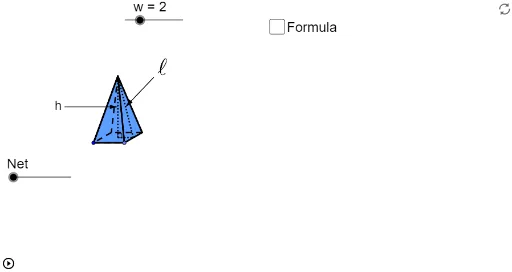
This example demonstrates the animated net of a square pyramid, illustrating geometric transformations and properties of polyhedra. It involves core math concepts like polygons, solid geometry, and transformations. Construction highlights include commands like Point, Segment, Rotate, Polygon, etc., from GeoGebra. Suitable for high school students to learn about polyhedron nets and geometry visualization in teaching.
GeoGebra Commands & Parameters
Point(Circle[A, w]) → BSegment(A, B) → aLine(A, B) → b_2Circle(B, (3 * w / 4.5)) → cIntersect(c, b_2, 2) → CRotate(C, 30°, B) → C'Line(C', b_2) → dSegment(B, C') → eLine(A, e) → fIntersect(d, f) → DPolygon(A, B, C', D) → poly1, a_1, b_1, c', d_1Segment(A, C') → gSegment(D, B) → h_1Intersect(g, h_1) → EOrthogonalLine(E, a_1) → iCircle(E, h) → kIntersect(k, i, 2) → FSegment(B, F) → jSegment(C', F) → l_5Segment(F, D) → mSegment(F, A) → nSegment(E, F) → pSegment(A, D) → qMidpoint(b_1) → GSegment(G, F) → rAngle(G, E, F) → αSegment(E, G) → tLine(E, G) → c_1Circle(G, F) → f_1Intersect(f_1, c_1, 2) → HIntersect(c_1, d_1) → ICircle(I, F) → g_1Intersect(g_1, c_1, 1) → JVector(F, J) → uPoint(c') → LCircle(L, F) → q_1Vector(F, H) → w_3Midpoint(A, B) → KLine(K, E) → e_1Circle(K, h) → p_1Intersect(e_1, c') → MCircle(M, h) → r_1Intersect(r_1, e_1, 2) → NIntersect(p_1, e_1, 1) → OVector(F, N) → vVector(F, O) → zTranslate(F, Vector[(z * o)]) → F'_1Translate(F, Vector[(u * (o - 1))]) → F'_2Translate(F, Vector[(v * (o - 2))]) → F'_3Translate(F, Vector[(w_3 * (o - 3))]) → F'Segment(F, N) → sLineBisector(s) → a_2Intersect(a_2, c') → PCircleArc(P, N, F) → c_2Ray(P, F'_3) → d_2Intersect(c_2, d_2, 1) → QSegment(F, O) → e_2LineBisector(e_2) → f_2Intersect(f_2, a_1) → RCircleArc(R, F, O) → g_2Ray(R, F'_1) → h_2Intersect(g_2, h_2, 1) → SCircleArc(I, F, J) → k_2CircleArc(G, H, F) → p_2Ray(I, F'_2) → i_2Intersect(k_2, i_2, 1) → TRay(G, F') → j_2Intersect(p_2, j_2, 1) → UCircle(I, E) → s_1OrthogonalLine(I, a_1) → i_1Intersect(s_1, i_1, 2) → VIntersect(s_1, i_1, 1) → WOrthogonalLine(V, i_1) → j_1OrthogonalLine(W, i_1) → k_1OrthogonalLine(G, k_1) → l_1Intersect(j_1, l_1) → ZIntersect(k_1, l_1) → A_1Midpoint(V, Z) → B_1Midpoint(A_1, W) → C_1Circle(B_1, r) → t_1Circle(C_1, r) → q_2OrthogonalLine(B_1, k_1) → m_1Intersect(t_1, m_1, 1) → D_1Intersect(q_2, m_1, 2) → E_1Vector(C', Z) → u_1Vector(B, A_1) → v_1Vector(N, D_1) → w_1Vector(O, E_1) → z_1Translate(N, Vector[(w_1 * (o - 4))]) → N'Translate(O, Vector[(z_1 * (o - 4))]) → O'Translate(B, Vector[(v_1 * (o - 4))]) → B'Translate(A, Vector[(v_1 * (o - 4))]) → A'Translate(C', Vector[(u_1 * (o - 4))]) → C''Translate(D, Vector[(u_1 * (o - 4))]) → D'If(o < 1, S, If[o < 4, O, If[o < 5, O', E_1]]) → F_1If(o < 1, F, If[o < 2, T, J]) → G_1If(o < 3, F, If[o < 4, U, H]) → H_1If(o < 2, F, If[o < 3, Q, If[o < 4, N, If[o < 5, N', D_1]]]) → I_1If(o < 4, A, If[o < 5, A', W]) → J_1If(o < 4, B, If[o < 5, B', A_1]) → K_1If(o < 4, C', If[o < 5, C'', Z]) → L_1If(o < 4, D, If[o < 5, D', V]) → M_1Polygon(F_1, J_1, K_1) → poly2, k_3, f_3, j_3Polygon(L_1, H_1, K_1) → poly3, k_4, l_2, h_3Polygon(L_1, I_1, M_1) → poly4, m_2, l_3, i_3Polygon(M_1, G_1, J_1) → poly5, j_4, m_3, g_3Intersect(m, j_3) → N_1Segment(I_1, N_1) → n_1Intersect(j_3, i_3) → O_1Intersect(c', i_3) → Q_1Intersect(c', i_3) → R_1Intersect(c', i_3) → S_1Intersect(c', i_3) → U_1Intersect(c', i_3) → A_2Intersect(l_2, i_3) → B_2Segment(B_2, O_1) → n_2Segment(B_2, M_1) → r_2Midpoint(M_1, L_1) → C_2Midpoint(L_1, K_1) → D_2Midpoint(K_1, J_1) → E_2Midpoint(J_1, M_1) → F_2Segment(G_1, F_2) → s_2Segment(C_2, I_1) → t_2Segment(D_2, H_1) → a_3Segment(E_2, F_1) → b_3Polygon(J_1, M_1, L_1, K_1) → poly6, j_5, m_4, l_4, k_5Intersect(j_3, d_1) → P_1Segment(P_1, M_1) → c_3Midpoint(p) → V_1OrthogonalLine(V_1, p) → d_3Point(d_3) → W_1Vector(W_1, V_1) → u_2Midpoint(r) → T_1Midpoint(a_3) → Z_1Point(a_2) → G_2Vector(G_2, T_1) → v_2Vector(G_2, Z_1) → w_2Point(Circle[H_2, w]) → I_2Segment(H_2, I_2) → e_3Line(H_2, I_2) → bCircle(I_2, (3 * w / 4.5)) → p_3Intersect(p_3, b, 2) → J_2Rotate(J_2, 30°, I_2) → K_2Segment(I_2, K_2) → n_3Line(K_2, b) → q_3Line(H_2, n_3) → r_3Intersect(q_3, r_3) → L_2Segment(H_2, K_2) → s_3Segment(I_2, L_2) → t_3Intersect(s_3, t_3) → M_2Circle(M_2, h) → c_4OrthogonalLine(M_2, b) → a_4Intersect(c_4, a_4, 2) → N_2Polygon(H_2, N_2, I_2) → poly7, i_4, h_4, n_4Polygon(I_2, N_2, K_2) → poly8, k_6, i_5, n_5Polygon(H_2, L_2, K_2, I_2) → poly9, h_5, l_6, k_7, i_6Polygon(H_2, N_2, L_2) → poly10, l_7, h_6, n_6Polygon(L_2, N_2, K_2) → poly11, k_8, l_8, n_7Midpoint(k_7) → O_2Segment(M_2, O_2) → b_4Segment(M_2, N_2) → d_4Segment(N_2, O_2) → e_4Angle(O_2, M_2, N_2) → βMidpoint(N_2, M_2) → P_2Midpoint(O_2, N_2) → Q_2Line(P_2, Q_2) → f_4Circle(P_2, w) → g_4Intersect(g_4, f_4, 1) → R_2Intersect(g_4, f_4, 2) → S_2Vector(R_2, P_2) → z_2Vector(S_2, Q_2) → u_3Midpoint(b_3) → V_2