
Net of a Square Pyramid (Formula Hidden)
Loading the math board and drawing, please wait…
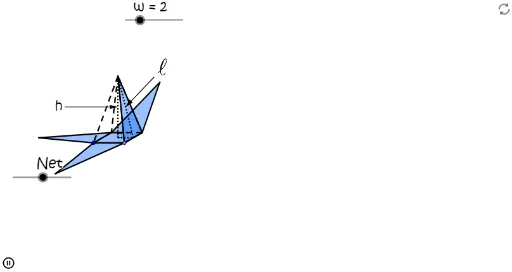
This example demonstrates the net of a square pyramid, visually representing how its surface consists of a base and four triangular faces. Core math concepts include polygons, solid geometry, angle calculations, and vector operations. GeoGebra commands like Point, Line, Circle, Rotate, Polygon, Vector, and Translate are used in construction. Suitable for high school mathematics education, helping students understand the unfolding and reconstruction of geometric solids and enhancing spatial reasoning skills.
GeoGebra Commands & Parameters
Point(Circle[A, w]) → BSegment(A, B) → aLine(A, B) → b_2Circle(B, (3 * w / 4.5)) → cIntersect(c, b_2, 2) → CRotate(C, 30°, B) → C'Line(C', b_2) → dSegment(B, C') → eLine(A, e) → fIntersect(d, f) → DPolygon(A, B, C', D) → poly1, a_1, b_1, c', d_1Segment(A, C') → gSegment(D, B) → h_1Intersect(g, h_1) → EOrthogonalLine(E, a_1) → iCircle(E, h) → kIntersect(k, i, 2) → FSegment(B, F) → jSegment(C', F) → l_5Segment(F, D) → mSegment(F, A) → nSegment(E, F) → pSegment(A, D) → qMidpoint(b_1) → GSegment(G, F) → rAngle(G, E, F) → αSegment(E, G) → tLine(E, G) → c_1Circle(G, F) → f_1Intersect(f_1, c_1, 2) → HIntersect(c_1, d_1) → ICircle(I, F) → g_1Intersect(g_1, c_1, 1) → JVector(F, J) → uPoint(c') → LCircle(L, F) → q_1Vector(F, H) → w_3Midpoint(A, B) → KLine(K, E) → e_1Circle(K, h) → p_1Intersect(e_1, c') → MCircle(M, h) → r_1Intersect(r_1, e_1, 2) → NIntersect(p_1, e_1, 1) → OVector(F, N) → vVector(F, O) → zTranslate(F, Vector[(z * o)]) → F'_1Translate(F, Vector[(u * (o - 1))]) → F'_2Translate(F, Vector[(v * (o - 2))]) → F'_3Translate(F, Vector[(w_3 * (o - 3))]) → F'Segment(F, N) → sLineBisector(s) → a_2Intersect(a_2, c') → PCircleArc(P, N, F) → c_2Ray(P, F'_3) → d_2Intersect(c_2, d_2, 1) → QSegment(F, O) → e_2LineBisector(e_2) → f_2Intersect(f_2, a_1) → RCircleArc(R, F, O) → g_2Ray(R, F'_1) → h_2Intersect(g_2, h_2, 1) → SCircleArc(I, F, J) → k_2CircleArc(G, H, F) → p_2Ray(I, F'_2) → i_2Intersect(k_2, i_2, 1) → TRay(G, F') → j_2Intersect(p_2, j_2, 1) → UCircle(I, E) → s_1OrthogonalLine(I, a_1) → i_1Intersect(s_1, i_1, 2) → VIntersect(s_1, i_1, 1) → WOrthogonalLine(V, i_1) → j_1OrthogonalLine(W, i_1) → k_1OrthogonalLine(G, k_1) → l_1Intersect(j_1, l_1) → ZIntersect(k_1, l_1) → A_1Midpoint(V, Z) → B_1Midpoint(A_1, W) → C_1Circle(B_1, r) → t_1Circle(C_1, r) → q_2OrthogonalLine(B_1, k_1) → m_1Intersect(t_1, m_1, 1) → D_1Intersect(q_2, m_1, 2) → E_1Vector(C', Z) → u_1Vector(B, A_1) → v_1Vector(N, D_1) → w_1Vector(O, E_1) → z_1Translate(N, Vector[(w_1 * (o - 4))]) → N'Translate(O, Vector[(z_1 * (o - 4))]) → O'Translate(B, Vector[(v_1 * (o - 4))]) → B'Translate(A, Vector[(v_1 * (o - 4))]) → A'Translate(C', Vector[(u_1 * (o - 4))]) → C''Translate(D, Vector[(u_1 * (o - 4))]) → D'If(o < 1, S, If[o < 4, O, If[o < 5, O', E_1]]) → F_1If(o < 1, F, If[o < 2, T, J]) → G_1If(o < 3, F, If[o < 4, U, H]) → H_1If(o < 2, F, If[o < 3, Q, If[o < 4, N, If[o < 5, N', D_1]]]) → I_1If(o < 4, A, If[o < 5, A', W]) → J_1If(o < 4, B, If[o < 5, B', A_1]) → K_1If(o < 4, C', If[o < 5, C'', Z]) → L_1If(o < 4, D, If[o < 5, D', V]) → M_1Polygon(F_1, J_1, K_1) → poly2, k_3, f_3, j_3Polygon(L_1, H_1, K_1) → poly3, k_4, l_2, h_3Polygon(L_1, I_1, M_1) → poly4, m_2, l_3, i_3Polygon(M_1, G_1, J_1) → poly5, j_4, m_3, g_3Intersect(m, j_3) → N_1Segment(I_1, N_1) → n_1Intersect(j_3, i_3) → O_1Intersect(c', i_3) → Q_1Intersect(c', i_3) → R_1Intersect(c', i_3) → S_1Intersect(c', i_3) → U_1Intersect(c', i_3) → A_2Intersect(l_2, i_3) → B_2Segment(B_2, O_1) → n_2Segment(B_2, M_1) → r_2Midpoint(M_1, L_1) → C_2Midpoint(L_1, K_1) → D_2Midpoint(K_1, J_1) → E_2Midpoint(J_1, M_1) → F_2Segment(G_1, F_2) → s_2Segment(C_2, I_1) → t_2Segment(D_2, H_1) → a_3Segment(E_2, F_1) → b_3Polygon(J_1, M_1, L_1, K_1) → poly6, j_5, m_4, l_4, k_5Intersect(j_3, d_1) → P_1Segment(P_1, M_1) → c_3Midpoint(p) → V_1OrthogonalLine(V_1, p) → d_3Point(d_3) → W_1Vector(W_1, V_1) → u_2Midpoint(r) → T_1Midpoint(a_3) → Z_1Point(a_2) → G_2Vector(G_2, T_1) → v_2Vector(G_2, Z_1) → w_2Point(Circle[H_2, w]) → I_2Segment(H_2, I_2) → e_3Line(H_2, I_2) → bCircle(I_2, (3 * w / 4.5)) → p_3Intersect(p_3, b, 2) → J_2Rotate(J_2, 30°, I_2) → K_2Segment(I_2, K_2) → n_3Line(K_2, b) → q_3Line(H_2, n_3) → r_3Intersect(q_3, r_3) → L_2Segment(H_2, K_2) → s_3Segment(I_2, L_2) → t_3Intersect(s_3, t_3) → M_2Circle(M_2, h) → c_4OrthogonalLine(M_2, b) → a_4Intersect(c_4, a_4, 2) → N_2Polygon(H_2, N_2, I_2) → poly7, i_4, h_4, n_4Polygon(I_2, N_2, K_2) → poly8, k_6, i_5, n_5Polygon(H_2, L_2, K_2, I_2) → poly9, h_5, l_6, k_7, i_6Polygon(H_2, N_2, L_2) → poly10, l_7, h_6, n_6Polygon(L_2, N_2, K_2) → poly11, k_8, l_8, n_7Midpoint(k_7) → O_2Segment(M_2, O_2) → b_4Segment(M_2, N_2) → d_4Segment(N_2, O_2) → e_4Angle(O_2, M_2, N_2) → βMidpoint(N_2, M_2) → P_2Midpoint(O_2, N_2) → Q_2Line(P_2, Q_2) → f_4Circle(P_2, w) → g_4Intersect(g_4, f_4, 1) → R_2Intersect(g_4, f_4, 2) → S_2Vector(R_2, P_2) → z_2Vector(S_2, Q_2) → u_3Midpoint(b_3) → V_2
AI Drawing Prompt Reference
Draw the net of a square pyramid, consisting of a square base and four triangular faces. Start by drawing a square, then draw a circle centered at one vertex of the square. Mark a point on the circle, connect this point to an adjacent vertex of the square, and extend the line to intersect the circle at another point. Draw a smaller circle centered at this new point, intersecting the previous line at two points. Connect these points to the opposite vertex of the square to form four triangles. Finally, connect all the points to complete the net.
The prompt above was compiled from the original drawing commands and is for reference only.