
Angles Related to Parallel Lines
Loading the math board and drawing, please wait…
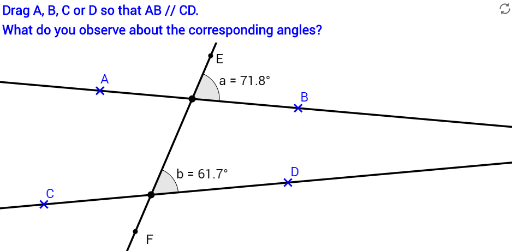
This example demonstrates corresponding angles, alternate interior angles, and consecutive interior angles formed by parallel lines. It covers key math concepts like properties of parallel lines and angle relationships. Constructed using GeoGebra commands such as Point, Line, Intersect, Segment, Angle, Ray, and If. Suitable for middle school and above students to visually understand and explore geometric relationships involving parallel lines and angles.
GeoGebra Commands & Parameters
Point(Segment[C, D]) → YPoint(Segment[A, B]) → XLine(X, Y) → c_1Intersect(Line[A, Line[C, D]], OrthogonalLine[B, Line[A, Line[C, D]]]) → B'Intersect(Line[B, Line[C, D]], OrthogonalLine[A, Line[B, Line[C, D]]]) → A'Intersect(Line[C, Line[A, B]], OrthogonalLine[D, Line[C, Line[A, B]]]) → D'Intersect(Line[D, Line[A, B]], OrthogonalLine[C, Line[D, Line[A, B]]]) → C'Line(A, B) → a_1Line(C, D) → b_1Segment(A, B) → s1Segment(C, D) → s2Point(c_1) → EPoint(c_1) → FPoint(Segment[X, Y]) → HAngle(H + (5 * UnitVector[Segment[C, D]]), H, H + (5 * UnitVector[Segment[F, E]])) → bRay(H, Vector[UnitVector[Segment[C, D]]]) → f_1Point(Segment[X, Y]) → IAngle(I + (5 * UnitVector[Segment[F, E]]), I, I + (5 * UnitVector[Segment[B, A]])) → cRay(I, Vector[UnitVector[Segment[B, A]]]) → g_1Point(Segment[X, Y]) → JAngle(J + (5 * UnitVector[Segment[F, E]]), J, J + (5 * UnitVector[Segment[D, C]])) → dPoint(Segment[X, Y]) → KRay(J, Vector[UnitVector[Segment[D, C]]]) → h_1Angle(K + (5 * UnitVector[Segment[E, F]]), K, K + (5 * UnitVector[Segment[A, B]])) → eRay(K, Vector[UnitVector[Segment[A, B]]]) → iPoint(Segment[X, Y]) → LAngle(L + (5 * UnitVector[Segment[E, F]]), L, L + (5 * UnitVector[Segment[C, D]])) → fRay(L, Vector[UnitVector[Segment[C, D]]]) → jPoint(Segment[X, Y]) → MAngle(M + (5 * UnitVector[Segment[B, A]]), M, M + (5 * UnitVector[Segment[E, F]])) → gRay(M, Vector[UnitVector[Segment[B, A]]]) → kPoint(Segment[X, Y]) → NAngle(N + (5 * UnitVector[Segment[D, C]]), N, N + (5 * UnitVector[Segment[E, F]])) → hRay(N, Vector[UnitVector[Segment[D, C]]]) → lPoint(Segment[X, Y]) → GAngle(G + (5 * UnitVector[Segment[A, B]]), G, G + (5 * UnitVector[Segment[F, E]])) → aRay(G, Vector[UnitVector[Segment[A, B]]]) → nCorner(1) → C1Corner(2) → C2Corner(3) → C3Corner(4) → C4If(Slope[Line[A, B]] ≟ Slope[Line[C, D]], true, false) → parallel