
Angles in Parallel Lines
Loading the math board and drawing, please wait…
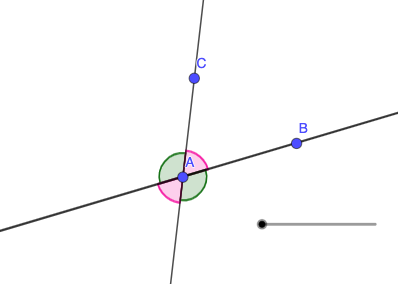
This example demonstrates the relationships between corresponding, alternate interior, and consecutive interior angles formed by parallel lines. Key mathematical concepts include properties of parallel lines, angle measurement, and geometric transformations. It utilizes GeoGebra commands and objects such as Line, Point, CircleSector, Mirror, Dilate, Vector, and Translate to construct the visual representation. Suitable for middle school and above, it helps students intuitively understand parallel line properties and angles, fostering spatial reasoning skills.
GeoGebra Commands & Parameters
Line(A, B) → fLine(A, C) → gPoint(f) → DPoint(g) → ECircleSector(A, D, E) → cPoint(g) → FPoint(f) → GCircleSector(A, F, G) → dMirror(d, A) → d'Mirror(c, A) → c'Dilate(C, a, A) → C'Line(C', f) → hVector(A, C') → uTranslate(d, u) → d'_{1}Translate(c, u) → c'_{1}Translate(d', u) → d''Translate(c', u) → c''
AI Drawing Prompt Reference
Draw two intersecting lines sharing a common point. On one line, mark two points; on the other, mark one point. Using the intersection as center, create two circular arcs, each passing through one of the marked points on the first line and the marked point on the second line. Reflect both arcs about the intersection point to get their mirror images. Then, choose a point on one line, define a vector from the intersection to that point, and translate all four arcs by this vector, producing a set of parallel, congruent arcs. Finally, through a point on the second line, draw a line parallel to the first line, forming a parallel-line configuration that illustrates corresponding, alternate interior, and consecutive interior angles.
The prompt above was compiled from the original drawing commands and is for reference only.