
Angles Formed by Secants and Tangents
Loading the math board and drawing, please wait…
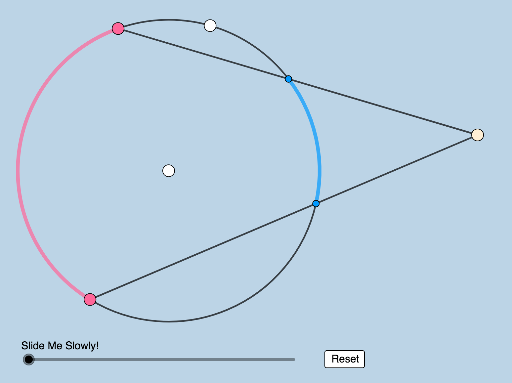
This GeoGebra example demonstrates angles formed outside a circle by two secants, a secant and a tangent, or two tangents. It explores circle geometry, intercepted arcs, angle measures, and relationships among secants and tangents. The construction uses Circle, Semicircle, PointIn, Intersect, Segment, Line, CircleArc, CircleSector, Angle, Rotate, Translate, Dilate, Vector, and Min to create points, arcs, segments, tangent and secant lines, angle labels, and dynamic transformations. It is suitable for middle school or high school geometry discovery activities, teacher demonstrations, and student investigations of secant-tangent angle theorems.
GeoGebra Commands & Parameters
Circle(A, B) → cPointIn(a) → CSemicircle(A, C) → dIntersect(c, d, 1) → DSemicircle(C, A) → eIntersect(c, e, 1) → ECircleArc(A, D, E) → fCircleArc(A, E, D) → gPoint(f) → FCircleArc(A, F, E) → hPoint(h) → GSegment(C, F) → iSegment(C, G) → jAngle(F, A, G) → αRotate(F, α / 2, A) → F'Angle(F, A, F') → γIntersect(g, i, 1) → HIntersect(g, j, 1) → IMin({Distance[A, B], Distance[C, H], Distance[C, I]}) → kCircle(A, (0.4 * k)) → pSegment(A, F) → lSegment(A, G) → mIntersect(p, l, 1) → JSegment(A, I) → nSegment(A, H) → qIntersect(p, n, 1) → KIntersect(p, q, 1) → LSegment(A, F') → rAngle(I, A, H) → βDilate(A, If[0 < b ≤ 1, 1 - b, 0], F) → A'Dilate(A, If[0 < b ≤ 1, 1 - b, 0], G) → A'_1Segment(A, A') → sSegment(A, A'_1) → tDilate(A, If[0 < b ≤ 1, 1 - b, 0], H) → A'_2Dilate(A, If[0 < b ≤ 1, 1 - b, 0], I) → A'_3Segment(A, A'_2) → f_1Segment(A, A'_3) → g_1Dilate(A, If[1 < b ≤ 2, 2 - b, 0], F') → A'_4Segment(A, A'_4) → h_1Rotate(J, If[1 < b ≤ 2, ((b - 1) * γ), γ], A) → J'CircleSector(A, J, J') → c_1Rotate(I, β / 2, A) → I'Dilate(A, If[2 < b ≤ 3, 3 - b, 0], I') → A'_5Segment(A, A'_5) → i_1Rotate(K, If[2 < b ≤ 3, ((b - 2) * β / 2), β / 2], A) → K'CircleSector(A, K, K') → d_1Rotate(c_1, If[3 < b ≤ 4, ((b - 3) * γ), γ], A) → e_1Rotate(d_1, If[4 < b ≤ 5, ((b - 4) * β / 2), β / 2], A) → k_1Segment(A, F') → j_1Intersect(p, j_1) → M,Segment(A, I') → l_1Intersect(p, l_1) → N,Angle(L, A, M) → δRotate(A, If[6 < b ≤ 7, ((b - 6) * δ), δ], A) → A'_6Rotate(A'_5, If[7 < b ≤ 8, ((b - 7) * δ), δ], A) → OSegment(A'_6, O) → m_1Rotate(k_1, If[7 < b ≤ 8, ((b - 7) * δ), δ], A) → p_1Angle(F, C, G) → εRotate(J, If[8 < b ≤ 9, ((b - 8) * ε), ε], A) → J'_1CircleSector(A, J, J'_1) → q_1Dilate(A, If[10 < b ≤ 11, 11 - b, 0], C) → A'_7Vector(A, A'_7) → uTranslate(q_1, u) → r_1Line(C, s) → n_1Point(n_1) → PAngle(P, C, H) → ζRotate(r_1, If[11 < b ≤ 12, ((b - 11) * ζ), ζ], C) → s_1Angle(A, D, C) → ηAngle(C, E, A) → θCircleArc(A, F, G) → t_1CircleArc(A, I, H) → c_2CircleArc(A, H, F) → d_2CircleArc(A, G, I) → e_2
AI Drawing Prompt Reference
Please draw a diagram that demonstrates angles formed outside a circle by two secants, a secant and a tangent, or two tangents. The diagram should include a circle, several points, arcs, segments, tangent and secant lines, angle labels, and dynamic transformations. First, draw a circle, then select several points inside the circle and connect these points to form secants and tangents. Calculate and label the angles formed by these line segments. Finally, perform rotations, translations, and dilations to show the relationships among the angles.
The prompt above was compiled from the original drawing commands and is for reference only.