
Kite Geometric Construction and Transformation
Loading the math board and drawing, please wait…
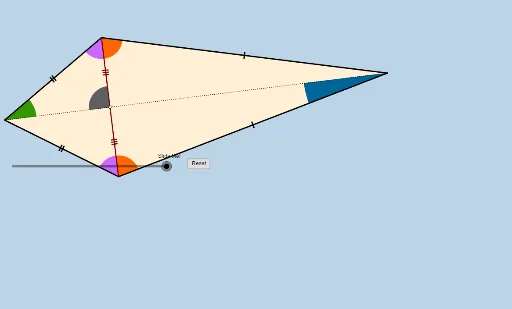
This example demonstrates the dynamic construction of a kite shape using GeoGebra commands, illustrating its geometric properties. Core mathematical concepts include axial symmetry, midpoints, perpendicular bisectors, circles and arcs, rotation and dilation transformations, as well as polygon area and angle relationships. The construction uses commands such as Segment, Midpoint, OrthogonalLine, Point, Ray, Circle, Intersect, CircleSector, Angle, Dilate, Rotate, Polygon, Vector, Translate, and Line to build vertices, edges, auxiliary circles, and angle labels, and applies transformations to generate symmetric or scaled versions. Suitable for middle and high school geometry lessons to explore the definition of a kite, its symmetry, and geometric transformations.
GeoGebra Commands & Parameters
Segment(A, B) → aMidpoint(a) → COrthogonalLine(C, a) → bPoint(b) → EPoint(b) → G_1Ray(E, G_1) → h_2Point(h_2) → DSegment(C, D) → iCircle(D, (0.3 * i)) → qIntersect(q, h_2, 1) → H_1Segment(A, D) → cIntersect(q, c, 1) → KSegment(D, B) → dSegment(B, E) → eSegment(E, A) → fSegment(A, C) → gCircle(A, (0.3 * g)) → hCircle(B, (0.3 * g)) → kSegment(C, E) → jCircle(E, (0.3 * j)) → pCircle(C, (0.3 * g)) → rIntersect(h, f, 1) → FIntersect(h, c, 1) → GIntersect(k, e, 1) → HIntersect(k, d, 1) → IIntersect(q, d, 1) → JIntersect(p, e, 1) → LIntersect(b, j) → MIntersect(b, j) → NIntersect(b, j) → OIntersect(b, j) → PIntersect(b, j) → QIntersect(p, b, 2) → RIntersect(b, i) → SIntersect(q, b, 1) → TIntersect(p, f, 1) → UCircleSector(B, I, H) → sAngle(A, D, B) → αAngle(U, E, L) → βCircleSector(B, H, I) → tDilate(D, If[0 < l ≤ 1, 1 - l, 0], A) → D'Segment(D, D') → mRotate(D, If[1 < l ≤ 2, ((l - 1) * α), α], D) → D'_1Rotate(D', If[1 < l ≤ 2, ((l - 1) * α), α], D) → D''Segment(D'_1, D'') → m'Dilate(A, If[2 < l ≤ 3, 3 - l, 0], E) → A'Segment(A, A') → nRotate(A, If[3 < l ≤ 4, ((-(l - 3)) * ((2 * π) - β)), (-((2 * π) - β))], E) → A'_1Rotate(A', If[3 < l ≤ 4, ((-(l - 3)) * ((2 * π) - β)), (-((2 * π) - β))], E) → A''Segment(A'_1, A'') → n'Polygon(E, B, D, A) → poly1, e_1, b_1, d_1, a_1CircleSector(E, L, R) → f_1Dilate(D, If[4 < l ≤ 5, 5 - l, 0], E) → D'_2Segment(D, D'_2) → g_1Dilate(B, If[5 < l ≤ 6, 6 - l, 0], A) → B'Vector(B, B') → uTranslate(s, u) → s'Line(A, e) → h_1Intersect(h, h_1, 2) → VIntersect(h, g, 1) → WAngle(V, A, G) → γRotate(s', If[6 < l ≤ 7, ((l - 6) * γ), γ], A) → s''CircleSector(D, K, H_1) → c_1Rotate(f_1, If[8 < l ≤ 9, ((l - 8) * ((2 * π) - β) / 2), ((2 * π) - β) / 2], E) → p_1Dilate(A, If[9 < l ≤ 10, 10 - l, 0], C) → A'_2Segment(A, A'_2) → i_1Dilate(C, If[10 < l ≤ 11, 11 - l, 0], B) → D'_3Segment(C, D'_3) → j_1Segment(B, C) → l_1Intersect(k, l_1, 1) → ZCircleSector(B, I, Z) → q_1CircleSector(A, F, W) → r_1Rotate(C, If[11.5 < l ≤ 12.5, ((l - 11.5) * π), 3.141592653589793], C) → C'Rotate(D'_3, If[11.5 < l ≤ 12.5, ((l - 11.5) * π), 3.141592653589793], C) → A_1Segment(C', A_1) → m_1Dilate(A, If[12.5 < l ≤ 13.5, 13.5 - l, 0], B) → A'_3Vector(A, A'_3) → vTranslate(r_1, v) → s_1Line(B, n) → n_1Point(n_1) → B_1Ray(B, B_1) → t_1Point(t_1) → C_1Angle(H, B, C_1) → δAngle(Z, B, H) → εRotate(s_1, If[13.5 < l ≤ 14.5, ((-(l - 13.5)) * (ε + δ)), (-(ε + δ))], B) → c_2Dilate(B, If[14.5 < l ≤ 15.5, 15.5 - l, 0], A) → B'_1Vector(B, B'_1) → wTranslate(q_1, w) → d_2Translate(I, w) → I'Angle(G, A, I') → ζAngle(D, B, C) → ηRotate(d_2, If[15.5 < l ≤ 16.5, ((-(l - 15.5)) * (ζ + η)), (-(ζ + η))], A) → e_2Midpoint(A, B) → D_1Segment(D, E) → a_2Segment(A, B) → b_2Intersect(r, a_2, 2) → E_1Intersect(r, b_2, 2) → F_1CircleSector(C, E_1, F_1) → f_2Rotate(f_2, If[16.5 < l ≤ 17.5, ((-(l - 16.5)) * π / 2), -1.5707963267948966], D_1) → g_2Rotate(c_1, If[7 < l ≤ 8, ((l - 7) * α / 2), α / 2], D) → k_1