
Angles Formed by Parallel Lines and a Transversal by Mathguru
Loading the math board and drawing, please wait…
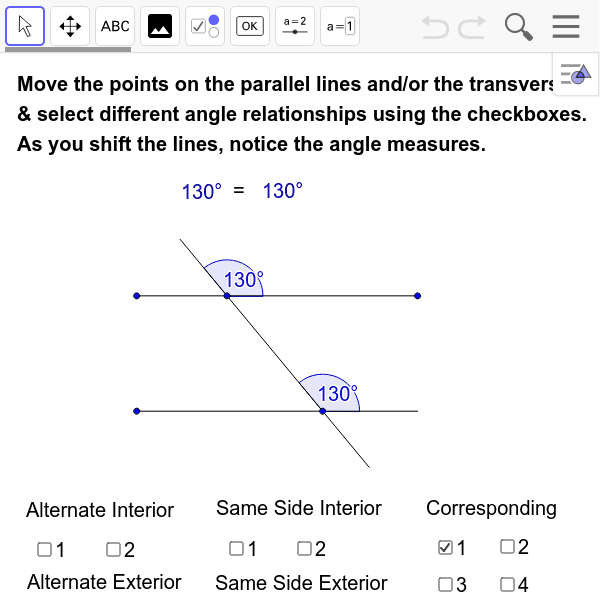
This applet demonstrates the relationships between angles formed by a pair of parallel lines and a transversal. Key concepts include corresponding angles, alternate interior angles, and same-side interior angles. Using GeoGebra commands such as Line, Intersect, and Angle, the applet dynamically illustrates these relationships. Suitable for students in middle school and above.
GeoGebra Commands & Parameters
Line(A, B) → aLine(C, a) → bSegment(A, C) → cLine(B, c) → dIntersect(b, d) → DSegment(A, B) → eSegment(C, D) → fPoint(e) → EPoint(e) → FPoint(f) → HPoint(f) → GSegment(E, F) → gSegment(G, H) → hPoint(g) → IPoint(h) → JLine(I, J) → iPoint(i) → KPoint(i) → LSegment(K, L) → jAngle(K, I, B) → αAngle(D, J, L) → δAngle(L, J, C) → εAngle(A, I, K) → θMidpoint(I, J) → MAngle(B, I, M) → βAngle(M, J, D) → γAngle(C, J, M) → ζAngle(A, I, M) → η
AI Drawing Prompt Reference
Draw two parallel lines intersected by a transversal to demonstrate corresponding, alternate interior, and same-side interior angles. First, sketch the parallel lines and the transversal, identifying their intersection points. Then, connect these points to form triangles. Next, highlight key angles, showing that corresponding angles are equal, alternate interior angles are equal, and same-side interior angles are supplementary. Finally, mark the midpoints of these angles and draw lines from the midpoints to further illustrate the relationships between the angles.
The prompt above was compiled from the original drawing commands and is for reference only.