
Angle Sum of a Quadrilateral
Loading the math board and drawing, please wait…
In collections
Y7 Polygons
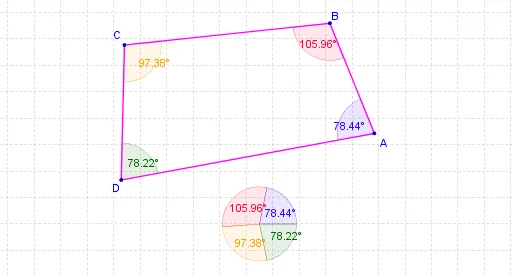
This example demonstrates the geometric property of the angle sum of a quadrilateral, proving that the sum of interior angles of any quadrilateral is always 360 degrees through dynamic visualization. Key math concepts include polygons, angle measurement, and geometric construction. It utilizes commands and objects such as Polygon, Angle, Segment, Midpoint, and Rotate in GeoGebra. Suitable for middle school and above students to intuitively understand the angle sum theorem for quadrilaterals, fostering spatial reasoning and geometric proof skills.
GeoGebra Commands & Parameters
Polygon(A, B, C, D) → poly1, a, b, c, dAngle(poly1) → α, β, γ, δSegment(E, F) → eMidpoint(e) → GRotate(F, α, G) → F'Angle(F, G, F') → εRotate(F', β, G) → F''Angle(F', G, F'') → ζRotate(F'', γ, G) → F'''Angle(F'', G, F''') → ηAngle(F''', G, F) → θ
AI Drawing Prompt Reference
Draw a quadrilateral and measure its four interior angles to prove that their sum is 360 degrees. First, construct the quadrilateral and measure the size of each interior angle. Then, connect the midpoints of adjacent sides and the vertices to form a line segment. Use this segment and midpoint to rotate each vertex of the quadrilateral by the corresponding angle, observing the positions of the rotated vertices to demonstrate that the sum of the interior angles is 360 degrees.
The prompt above was compiled from the original drawing commands and is for reference only.