
Quadrilaterals and Their Sides and Angles
Loading the math board and drawing, please wait…
In collections
Y7 Polygons
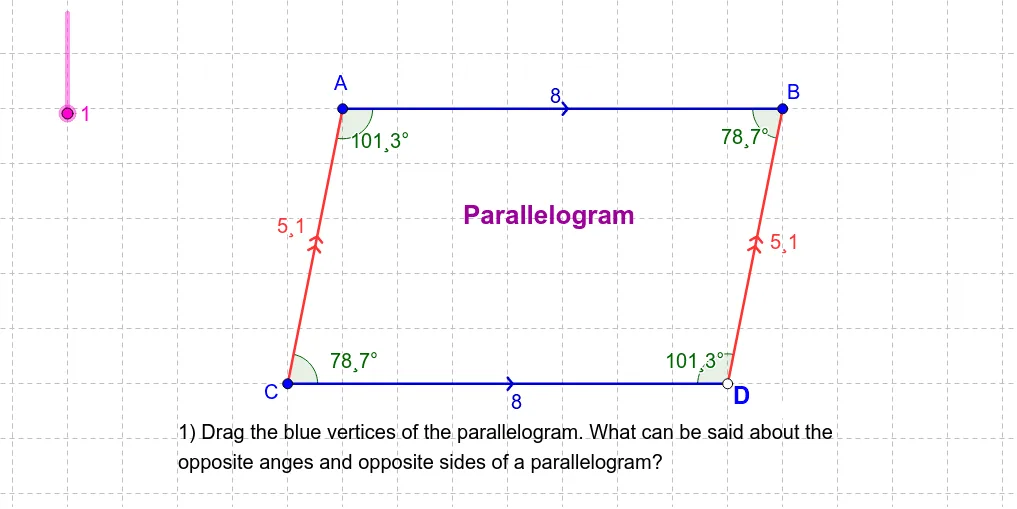
This example demonstrates the fundamental properties and relationships of quadrilaterals, focusing on their sides and angles. Key math concepts include quadrilateral classification, side lengths, angle measurement, and geometric construction. It utilizes commands like Line, Segment, Intersect, Distance, Angle, Circle, Point, OrthogonalLine, and Mirror in GeoGebra for construction. Suitable for middle school students and above for learning geometric properties and high school geometry teaching demonstrations.
GeoGebra Commands & Parameters
Line(A, B) → aLine(C, a) → bSegment(C, A) → cLine(B, c) → dSegment(A, B) → eIntersect(b, d) → DSegment(C, D) → fSegment(D, B) → gDistance(A, B) → distanceABAngle(A, B, D) → αAngle(B, D, C) → βAngle(D, C, A) → γAngle(C, A, B) → δSegment(C, B) → iSegment(A, D) → jIntersect(i, j) → ECircle(G, F) → kSegment(G, F) → lPoint(k) → HSegment(G, H) → mLine(H, l) → nLine(F, m) → pIntersect(n, p) → ISegment(H, I) → qSegment(F, I) → rAngle(G, H, I) → εAngle(H, I, F) → ζAngle(I, F, G) → ηAngle(F, G, H) → θSegment(G, I) → sSegment(H, F) → tIntersect(s, t) → JSegment(K, L) → a_1OrthogonalLine(L, a_1) → b_1Point(b_1) → MOrthogonalLine(M, b_1) → c_1OrthogonalLine(K, a_1) → d_1Intersect(c_1, d_1) → NSegment(L, M) → e_1Segment(K, N) → g_1Segment(N, M) → f_1Angle(L, M, N) → ιAngle(M, N, K) → κAngle(N, K, L) → λAngle(K, L, M) → μSegment(K, M) → h_1Segment(L, N) → i_1Intersect(h_1, i_1) → OCircle(P, Q) → k_1Segment(P, Q) → j_1OrthogonalLine(P, j_1) → l_1OrthogonalLine(Q, j_1) → m_1Intersect(k_1, l_1, 2) → SLine(S, j_1) → n_1Intersect(m_1, n_1) → RSegment(P, S) → p_1Segment(S, R) → q_1Angle(Q, P, S) → νAngle(P, S, R) → ξAngle(S, R, Q) → οAngle(R, Q, P) → ρSegment(P, R) → s_1Segment(Q, S) → t_1Intersect(s_1, t_1) → TSegment(Q, R) → r_1Segment(W, U) → a_2Segment(U, V) → b_2Segment(V, W) → c_2Mirror(V, a_2) → XSegment(W, X) → d_2Segment(X, U) → e_2Angle(V, W, X) → σAngle(W, X, U) → τAngle(X, U, V) → υAngle(U, V, W) → φSegment(V, X) → f_2Intersect(a_2, f_2) → ZSegment(A_1, B_1) → g_2Segment(A_1, C_1) → h_2Line(C_1, g_2) → i_2Point(i_2) → D_1Segment(B_1, D_1) → j_2Segment(C_1, D_1) → k_2Angle(A_1, B_1, D_1) → χAngle(B_1, D_1, C_1) → ψAngle(D_1, C_1, A_1) → ωAngle(C_1, A_1, B_1) → α_1Segment(C_1, B_1) → l_2Segment(A_1, D_1) → m_2Intersect(l_2, m_2) → E_1
AI Drawing Prompt Reference
Draw a quadrilateral, labeling its sides and angles. Start by constructing four line segments to form the quadrilateral, then find the intersection points of opposite sides. Measure and label the lengths of the four sides and the measures of the four interior angles. Next, draw a circle with one side of the quadrilateral as the diameter, and connect the intersection points of the circle with the other two sides to form a new quadrilateral. Finally, find the intersection point of the diagonals in the new quadrilateral and measure and label the four interior angles.
The prompt above was compiled from the original drawing commands and is for reference only.