
Angle Formed by 2 Chords (Dynamic)
Loading the math board and drawing, please wait…
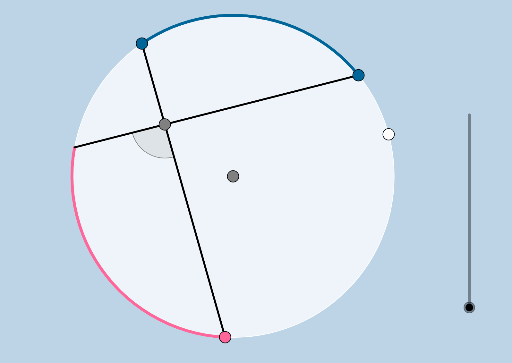
This GeoGebra example dynamically illustrates the geometric property of the angle formed by two intersecting chords inside a circle. The core mathematical concept is the corollary of the inscribed angle theorem: the measure of the angle formed by two chords intersecting inside a circle equals half the sum of the measures of the intercepted arcs. The construction uses commands such as Circle, Segment, Point, Intersect, Angle, Rotate, Dilate, Translate, and CircleSector to build the circle, chords, and their intersection, with sliders enabling interactive manipulation. This resource is ideal for middle and high school geometry classes, helping students visualize and explore the relationship between angles and arcs in a circle through dynamic dragging and observation.
GeoGebra Commands & Parameters
Circle(A, B) → cSegment(A, B) → aPoint(c) → CPoint(c) → DSegment(C, D) → dPoint(d) → ECircleArc(A, C, D) → ePoint(e) → FCircleArc(A, D, C) → fRay(F, E) → bIntersect(f, b, 1) → GSegment(F, E) → gSegment(E, G) → hSegment(C, E) → iSegment(E, D) → jMin(list1) → kCircle(E, (0.4 * k)) → pSegment(A, G) → lSegment(A, C) → mSegment(A, F) → nSegment(A, D) → qCircle(A, (0.4 * k)) → rIntersect(r, l, 1) → HIntersect(r, m, 1) → IIntersect(p, h, 1) → JIntersect(p, i, 1) → KIntersect(p, g, 1) → LIntersect(p, j, 1) → MIntersect(r, n, 1) → NIntersect(r, q, 1) → OAngle(G, A, C) → αAngle(F, A, D) → βRotate(G, (-(α / 2)), A) → G'Rotate(G, α / 2, A) → G'_1Angle(G, A, G'_1) → γRotate(F, β / 2, A) → F'Angle(F, A, F') → δSegment(A, F') → sSegment(A, G'_1) → tIntersect(r, t, 1) → PIntersect(r, s, 1) → QDilate(A, If[0 < o ≤ 1, 1 - o, 0], G) → A'Dilate(A, If[0 < o ≤ 1, 1 - o, 0], C) → A'_1Dilate(A, If[0 < o ≤ 1, 1 - o, 0], F) → A'_2Dilate(A, If[0 < o ≤ 1, 1 - o, 0], D) → A'_3Segment(A, A') → a_1Segment(A, A'_1) → b_1Segment(A, A'_2) → c_1Segment(A, A'_3) → d_1Dilate(A, If[1 < o ≤ 2, 2 - o, 0], G'_1) → A'_4Dilate(A, If[1 < o ≤ 2, 2 - o, 0], F') → A'_5Segment(A, A'_4) → e_1Segment(A, A'_5) → f_1CircleSector(A, H, P) → g_1CircleSector(A, N, Q) → h_1Rotate(g_1, If[2 < o ≤ 3, ((o - 2) * γ), γ], A) → k_1Rotate(h_1, If[3 < o ≤ 4, ((o - 3) * δ), δ], A) → q_1Dilate(A, If[4 < o ≤ 5, 5 - o, 0], E) → A'_6Vector(A, A'_6) → uTranslate(k_1, u) → s_1Translate(I, u) → I'Angle(I', E, K) → εRotate(s_1, If[5 < o ≤ 6, ((o - 5) * ε), ε], E) → t_1Dilate(A, If[6 < o ≤ 7, 7 - o, 0], E) → A'_7Vector(A, A'_7) → vTranslate(q_1, v) → c_2Angle(J, E, K) → ζTranslate(P, v) → P'Rotate(P', ε, E) → P''Translate(O, v) → O'Angle(O', E, P'') → ηRotate(c_2, If[7 < o ≤ 8, ((o - 7) * η), η], E) → d_2CircleArc(A, F, D) → e_2CircleArc(A, G, C) → f_2Intersect(p, h, 1) → RCircleSector(E, R, K) → g_2