
Angle Bisector Theorem (Part 1) – Interactive Discovery
Loading the math board and drawing, please wait…
In collections
Congruence (CO) Cluster
Congruence (Vol 2)
CCSS High School: Geometry (Congruence) Volume 2
CCSS High School: Geometry (Congruence) Volume 2
CCSS High School: Geometry (Congruence) Volume 2
Geometry (Congruence) Volume 2
CCSS High School: Geometry (Congruence) Volume 2
CCSS High School: Geometry (Congruence) Volume 2
CCSS High School: Geometry (Congruence) Volume 2
CCSS High School: Geometry (Congruence) Volume 2
CCSS High School: Geometry (Congruence) Volume 2
CCSS High School: Geometry (Congruence) Volume 2
CCSS High School: Geometry (Congruence) Volume 2
Gail LeBlancCCSS High School: Geometry (Congruence) Volume 2
Honors Geometry
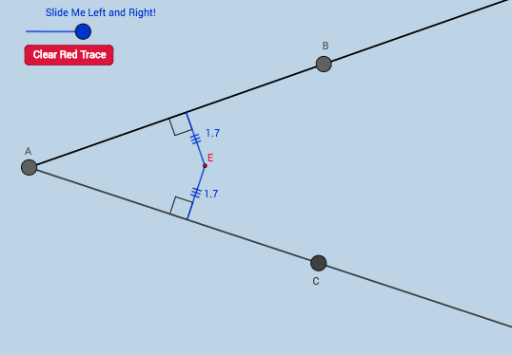
① This interactive GeoGebra example demonstrates the Angle Bisector Theorem: in a triangle, the angle bisector divides the opposite side into two segments proportional to the adjacent sides. ② Core mathematical concepts include angle bisectors, segment ratios, similar triangles, and theorem verification through dynamic measurement. ③ Construction highlights: using commands such as Ray, Point, Segment, Length, OrthogonalLine, Circle, Intersect, AngularBisector, Line, Distance, and Angle, the applet builds triangle ABC, its angle bisector, and the intersection point on the opposite side. Distances (distanceEb, distanceEa) and angles (α, β) are measured to dynamically show the proportional relationship, with a button (button1) for interactive control. ④ Suitable for middle or high school geometry classes, this resource supports student-led discovery, classroom demonstration, and deeper understanding of the theorem's geometric meaning and proof.
GeoGebra Commands & Parameters
Ray(G, H) → pPoint(p) → ISegment(G, I) → qLength(q) → rRay(A, B) → aRay(A, C) → bOrthogonalLine(A, a) → dCircle(A, r) → eIntersect(e, d) → F_1, G_1OrthogonalLine(A, b) → gAngularBisector(C, A, B) → sIntersect(e, g, 2) → DLine(C, g) → fLine(D, b) → iIntersect(s, i) → EDistance(E, b) → distanceEbDistance(E, a) → distanceEaRay(A, E) → cOrthogonalLine(E, a) → hOrthogonalLine(E, b) → jIntersect(h, a) → FIntersect(j, b) → JSegment(E, F) → kSegment(E, J) → lAngle(E, J, A) → αAngle(A, F, E) → β