
Andromeda: A 3D Cube and Polyhedral Geometry Construction
Loading the math board and drawing, please wait…
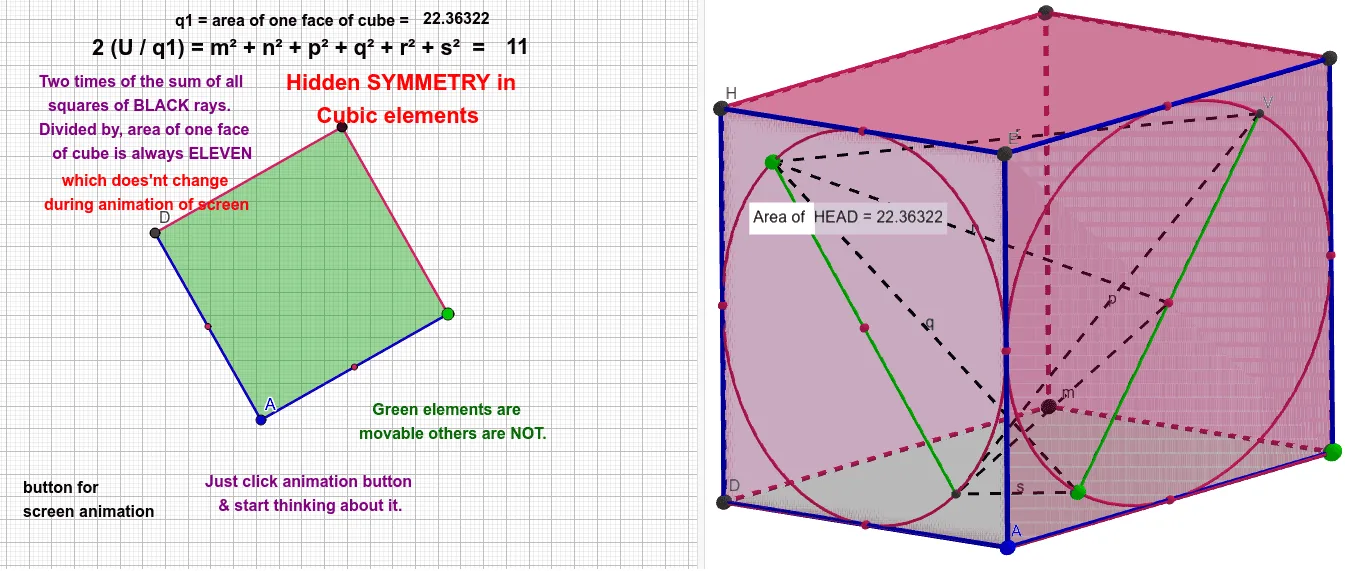
This example, named 'Andromeda', demonstrates a three-dimensional geometric construction centered on a cube, highlighting the spatial relationships among its faces, edges, and vertices, while integrating planar and solid geometry elements such as centroids, midpoints, circles, and intersections. The core mathematical concepts include the structure of cube faces and edges, computation of centroids (barycenters), circumscribed and inscribed circles, properties of general quadrilaterals, symmetry, as well as power functions and geometric distributions. In terms of construction, the GeoGebra commands used include Point, Cube, Polygon, Centroid, Midpoint, Circle, Intersect, Line, Segment, and PointIn, which build the six faces (e.g., faceABCD, faceADHE) and twelve edges (e.g., edgeAD, edgeAB) of the cube, and generate auxiliary figures q1, q2 and points J, K, L through intersections and segments. This example is suitable for upper secondary to early university students, aiding in understanding polyhedral construction, centroid, and symmetry in solid geometry, and can serve as a reference for mathematical modeling or geometry visualization teaching.
GeoGebra Commands & Parameters
Point(Circle[B, Distance[A, B], Segment[A, B]]) → CCube(A, B, C) → a, D, faceCDHG, faceEFGH, edgeAD, edgeAB, edgeBC, edgeCD, edgeAE, edgeDH, edgeEH, edgeEF, E, edgeBF, edgeFG, edgeCG, edgeGH, F, G, H, faceABCD, faceADHE, faceABFE, faceBCGFPolygon(E, F, B, A) → q1, e, f_1, b, a_1Polygon(H, E, A, D) → q2, h, e_1, a_2, dCentroid(q1) → JCentroid(q2) → KMidpoint(E, A) → LMidpoint(E, F) → MMidpoint(F, B) → NCircle(L, M, N) → cMidpoint(D, A) → OMidpoint(H, D) → PMidpoint(H, E) → QCircle(P, Q, L) → kIntersect(b, c) → R, SPoint(k) → ILine(I, K) → gIntersect(g, k, 1) → TSegment(I, T) → iSegment(I, T) → jPoint(c) → ULine(U, J) → fIntersect(f, c, 1) → VSegment(U, V) → lSegment(T, J) → mSegment(I, J) → nSegment(T, V) → pSegment(I, U) → qSegment(I, V) → rSegment(T, U) → sPointIn(q2) → Pointq2_1PointIn(q2) → Pointq2_2PointIn(q2) → Pointq2_3PointIn(q2) → Pointq2