
Analysis of Odd and Even Terms in a Sequence
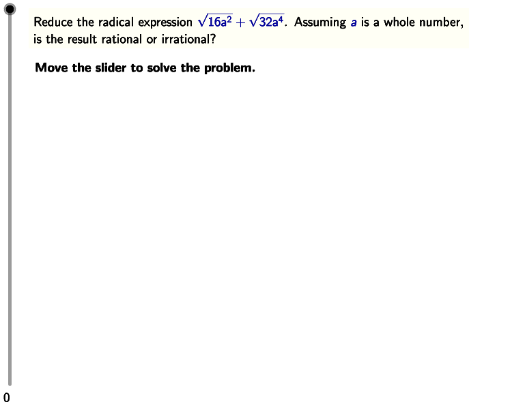
Loading the math board and drawing, please wait…
This example demonstrates the analysis of odd and even terms in a sequence. Using commands like LaTeX, Zip, PrimeFactors, etc., the generation process of the sequence can be observed. Key mathematical concepts include sequences and odd/even analysis. Suitable for high school mathematics education and learning.
GeoGebra Commands & Parameters
LaTeX(steps) → counterCorner(1) → ACorner(3) → BZip((2 * a), a, apowers) → a2powersPrimeFactors(coeff1) → c1pUnique(c1p) → c1pvalFrequency(c1p) → c1pcountZip(If[a / 2 ≟ floor(a / 2), a, a - 1], a, c1pcount) → c1pevenZip(If[a / 2 ≟ floor(a / 2), 0, 1], a, c1pcount) → c1poddIf(Sum[c1podd] ≟ 0, "y", "n") → c1perfectPrimeFactors(coeff2) → c2pUnique(c2p) → c2pvalFrequency(c2p) → c2pcountZip(If[a / 2 ≟ floor(a / 2), a, a - 1], a, c2pcount) → c2pevenZip(If[a / 2 ≟ floor(a / 2), 0, 1], a, c2pcount) → c2poddIf(Sum[c2podd] ≟ 0, "y", "n") → c2perfectLaTeX((((((((("\sqrt{" * coeff1) * "a^{") * Element[a2powers, 1]) * "}}+\sqrt{") * coeff2) * "a^{") * Element[a2powers, 2]) * "}}")) → originalLaTeX("\text{Use the properties of radicals to rewrite the expression.}") → text1LaTeX("\text{Rewrite each radical in the expression as a product of radicals, and evaluate}\cr\text{where possible.}") → text2LaTeX("\text{Rewrite using the product property of radicals.}") → text5LaTeX("\text{Evaluate the radicals of perfect squares.}") → text7If(c1perfect ≟ "y", LaTeX[sqrt(coeff1)], LaTeX[(("\sqrt{" * coeff1) * "}")]) → c1evalperfIf(c2perfect ≟ "y", LaTeX[sqrt(coeff2)], LaTeX[(("\sqrt{" * coeff2) * "}")]) → c2evalperfIf(Element[apowers, 1] ≟ 1, LaTeX["a"], LaTeX[("a^" * Element[apowers, 1])]) → a1evalperfIf(Element[apowers, 2] ≟ 1, LaTeX["a"], LaTeX[("a^" * Element[apowers, 2])]) → a2evalperfLaTeX(((((c1evalperf * a1evalperf) * " +") * c2evalperf) * a2evalperf)) → text8LaTeX((((("\text{The radical expression }\textcolor{#000099}{" * original) * "}\text{ can be rewritten as }\textcolor{#000099}{") * text8) * "}.")) → text9LaTeX("\text{Reduce any remaining radicals.}") → text10LaTeX("\text{Factor out perfect squares within the radicand(s).}") → text13Product(Zip[a^(b / 2), a, c1pval, b, c1peven]) → c1perfProduct(Zip[a^(b), a, c1pval, b, c1podd]) → c1restIf(c1perfect ≟ "y", LaTeX[c1perf], If[c1perf ≟ 1, LaTeX[(("\sqrt{" * c1rest) * "}")], LaTeX[(((("\sqrt{" * c1perf^(2)) * "\cdot") * c1rest) * "}")]]) → writec1perfProduct(Zip[a^(b / 2), a, c2pval, b, c2peven]) → c2perfProduct(Zip[a^(b), a, c2pval, b, c2podd]) → c2restIf(c2perfect ≟ "y", LaTeX[c2perf], If[c2perf ≟ 1, LaTeX[(("\sqrt{" * c2rest) * "}")], LaTeX[(((("\sqrt{" * c2perf^(2)) * "\cdot") * c2rest) * "}")]]) → writec2perfLaTeX(((((writec1perf * a1evalperf) * " +") * writec2perf) * a2evalperf)) → text14LaTeX("\text{Rewrite using the product property of radicals.}") → text15If(c1perfect ≟ "y", LaTeX[c1perf], If[c1perf ≟ 1, LaTeX[(("\sqrt{" * c1rest) * "}")], LaTeX[(((("\sqrt{" * c1perf^(2)) * "}\cdot\sqrt{") * c1rest) * "}")]]) → writec1perfsplitIf(c2perfect ≟ "y", LaTeX[c2perf], If[c2perf ≟ 1, LaTeX[(("\sqrt{" * c2rest) * "}")], LaTeX[(((("\sqrt{" * c2perf^(2)) * "}\cdot\sqrt{") * c2rest) * "}")]]) → writec2perfsplitLaTeX(((((writec1perfsplit * a1evalperf) * " +") * writec2perfsplit) * a2evalperf)) → text16LaTeX("\text{Evaluate the radicals of perfect squares.}") → text17If(c1perfect ≟ "y", LaTeX[c1perf], If[c1perf ≟ 1, LaTeX[(("\sqrt{" * c1rest) * "}")], LaTeX[(((c1perf * "\cdot\sqrt{") * c1rest) * "}")]]) → writec1perfrootIf(c2perfect ≟ "y", LaTeX[c2perf], If[c2perf ≟ 1, LaTeX[(("\sqrt{" * c2rest) * "}")], LaTeX[(((c2perf * "\cdot\sqrt{") * c2rest) * "}")]]) → writec2perfrootLaTeX(((((writec1perfroot * a1evalperf) * " +") * writec2perfroot) * a2evalperf)) → text18LaTeX((("\text{The remaining radical(s) cannot be further reduced. The final reduced expression}\cr\text{is }\textcolor{000099}{" * text18) * "}.")) → text19LaTeX("\text{Determine whether the resulting expression is rational or irrational.}") → text20LaTeX((((((((("\sqrt{" * coeff1) * "}\sqrt{a^{") * Element[a2powers, 1]) * "}}+\sqrt{") * coeff2) * "}\sqrt{a^{") * Element[a2powers, 2]) * "}}")) → text6If(c1perfect ≟ "y" ∧ c2perfect ≟ "y", LaTeX[(("\text{The sum of two rational numbers is a rational number therefore }\cr\textcolor{#000099}{" * text18) * "}\text{ is rational.}")], LaTeX[(("\text{The sum of an irrational and either a rational or an irrational number is an}\cr\text{irrational number therefore }\textcolor{#000099}{" * text18) * "}\text{ is irrational.}")]) → text23LaTeX("\text{Original expression}") → text3LaTeX("\text{Move the slider to solve the problem.}") → text0LaTeX((("\text{Reduce the radical expression }\textcolor{#000099}{" * original) * "}\text{. Assuming }\textcolor{#000099}\textit{a}\text{ is a whole number,}\cr\text{is the result rational or irrational?}")) → ProblemLaTeX("\text{Expression from the previous step}") → text11If(c1perfect ≟ "y", LaTeX[((("\text{Because }\textcolor{#000099}\textit{a}\text{ is a whole number and }\textcolor{#000099}{" * writec1perfroot) * a1evalperf) * "}\text{ contains no radicals, the first part of the}\cr\text{expression is rational.}")], LaTeX[((("\text{Because }\textcolor{#000099}\textit{a}\text{ is a whole number and }\textcolor{#000099}{" * writec1perfroot) * a1evalperf) * "}\text{ contains an irreducible radical,}\cr\text{the first part of the expression is irrational.}")]) → text21If(c2perfect ≟ "y", LaTeX[((("\text{Because }\textcolor{#000099}\textit{a}\text{ is a whole number and }\textcolor{#000099}{" * writec2perfroot) * a2evalperf) * "}\text{ contains no radicals, the second part of}\cr\text{the expression is rational.}")], LaTeX[((("\text{Because }\textcolor{#000099}\textit{a}\text{ is a whole number and }\textcolor{#000099}{" * writec2perfroot) * a2evalperf) * "}\text{ contains an irreducible radical,}\cr\text{the second part of the expression is irrational.}")]) → text22LaTeX("\text{Use the buttons below to return to the original problem or}\cr\text{to randomly generate a similar practice problem.}") → RandomizationText
AI Drawing Prompt Reference
Draw a graph for the analysis of odd and even terms in a sequence, including the odd and even terms of the sequence, the factored odd and even term coefficients, and the final simplified expression. First, draw the odd and even terms of the sequence, then show the factored odd and even term coefficients, followed by calculating and displaying the factorization results of the odd and even term coefficients, and finally use these results to simplify the expression and display the final simplified expression.
The prompt above was compiled from the original drawing commands and is for reference only.