
Alternate Angles on Parallel Lines by Malin Christersson
Loading the math board and drawing, please wait…
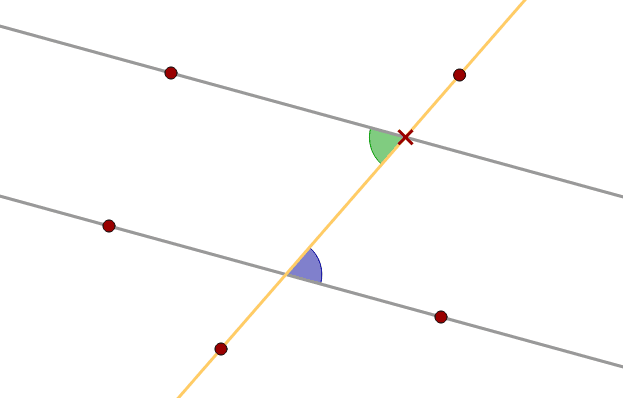
This example demonstrates alternate angles on parallel lines. Key mathematical concepts include angle properties and geometric construction. Using GeoGebra commands such as Line, Intersect, Angle, etc., you can construct parallel lines and their alternate angles. Suitable for middle school and above students to learn about angles and geometry.
GeoGebra Commands & Parameters
Line(A, B) → aLine(C, a) → bLine(D, E) → cIntersect(a, c) → FIntersect(b, c) → GCircle(F, 1) → dIntersect(d, a, 2) → HIntersect(d, c, 1) → ICircle(G, 1) → eSegment(G, F) → fPoint(f) → LCircle(L, 1) → gLine(H, c) → iVector(F, L) → uTranslate(I, u) → I'Translate(H, u) → H'Angle(H', L, I') → βIntersect(d, a, 1) → H''Intersect(d, c, 2) → I''Angle(I'', F, H'') → α
AI Drawing Prompt Reference
Draw two parallel lines a and b. Take point F on a and point G on b. Draw a unit circle d centered at F, intersecting a at H. Draw a unit circle e centered at G, intersecting c at I. Draw line segment FL and its midpoint L, then draw a unit circle g centered at L. Draw line i through H parallel to FL, and translate I and H to I' and H' along FL. Calculate the angles ∠H'LF and ∠I'LF as β and α respectively.
The prompt above was compiled from the original drawing commands and is for reference only.