
Additive Property of Vectors
Loading the math board and drawing, please wait…
In collections
Linear Algebra
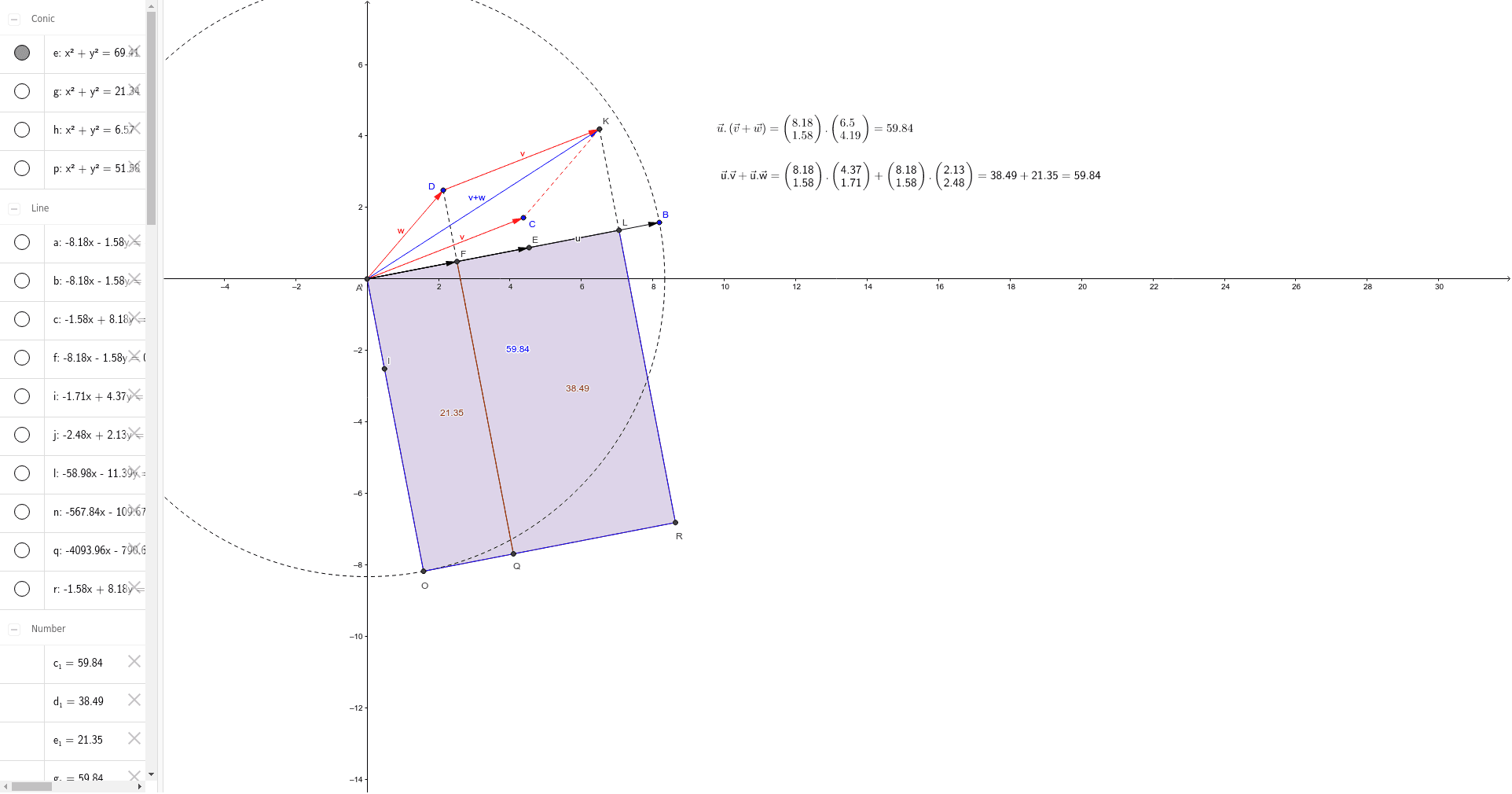
This example demonstrates the additive property of vectors, visually showing the relationship between the sum of two vectors and their components. Core math concepts include vectors, dot product, and geometric construction. It uses GeoGebra commands/objects like Intersect, Vector, OrthogonalLine, Line, Circle, Polygon, and Segment. Suitable for high school mathematics learning, helping students understand the geometric meaning of vector addition.
GeoGebra Commands & Parameters
Intersect(xAxis, yAxis) → AVector(A, B) → uVector(A, C) → vVector(A, D) → wOrthogonalLine(C, u) → aOrthogonalLine(D, u) → bLine(A, B) → cIntersect(a, c) → EIntersect(b, c) → FVector(A, E) → zVector(A, F) → dCircle(A, B) → eOrthogonalLine(A, u) → fCircle(A, E) → gCircle(A, F) → hIntersect(g, f) → G, HIntersect(h, f) → I, JLine(D, v) → iLine(C, w) → jIntersect(i, j) → KVector(A, K) → kOrthogonalLine(K, u) → lIntersect(l, c) → LCircle(A, L) → pIntersect(p, f) → M, NVector(D, K) → mLine(F, f) → nLine(L, f) → qIntersect(e, f) → O, PLine(O, u) → rIntersect(n, r) → QIntersect(q, r) → RPolygon(A, F, Q, O) → poly1, a_1, f_1, q_1, oPolygon(F, L, R, Q) → poly2, f_2, l_1, r_1, q_2Segment(D, F) → sSegment(K, L) → tSegment(C, K) → b_1Polygon(A, O, R, L) → poly3, a_2, o_1, r_2, l_2
AI Drawing Prompt Reference
Draw the sum of vector u and vector v starting from point A, using perpendicular lines and intersections to illustrate the geometric meaning of vector addition. First, plot point A at the intersection of the x-axis and y-axis, then draw vectors u and v, and construct perpendicular lines a and b for vector u. Use intersections E and F to represent the sum vector. Utilize circles and perpendicular lines to construct the sum of vectors w and v, and finally, through a series of intersections and line segments, construct polygons to demonstrate the geometric properties of vector addition.
The prompt above was compiled from the original drawing commands and is for reference only.