
Associative Property of Vector Addition
Loading the math board and drawing, please wait…
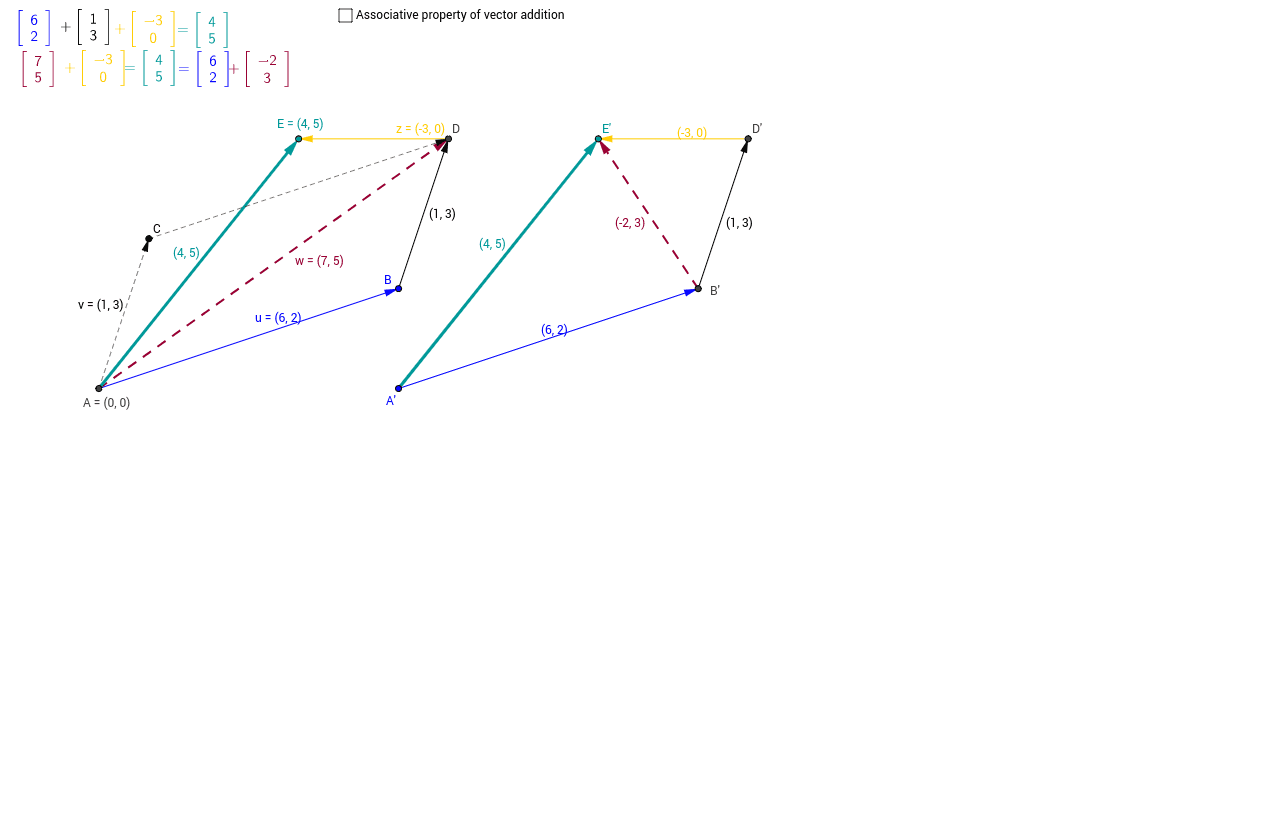
This GeoGebra example demonstrates the associative property of vector addition, showing that the grouping of vectors does not affect the sum. Key mathematical concepts include vectors, vector addition, and associativity. The construction utilizes commands such as Intersect, Vector, Line, and Translate to create points and vectors, forming geometric figures like trapezoids or symmetric shapes. It is suitable for high school or college-level mathematics education, particularly in vector geometry lessons.
GeoGebra Commands & Parameters
Intersect(xAxis, yAxis) → AVector(A, B) → uVector(A, C) → vLine(C, u) → aLine(B, v) → bIntersect(a, b) → DVector(A, D) → wVector(D, E) → zVector(A, E) → cVector(B, D) → dVector(C, D) → eVector(A, A') → fTranslate(B, f) → B'Translate(D, f) → D'Translate(E, f) → E'Vector(A', B') → gVector(B', D') → hVector(D', E') → iVector(B', E') → jVector(A', E') → k
AI Drawing Prompt Reference
Draw a geometric figure for vector addition, starting with vectors u and v from point A, intersecting at point D to form a parallelogram. Then translate points B, D, and E by the same vector f to get B', D', and E', and connect these points to form a new parallelogram.
The prompt above was compiled from the original drawing commands and is for reference only.