
Additional Fractions per Unit (Part 2)
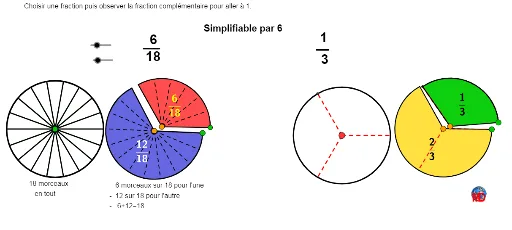
Loading the math board and drawing, please wait…
This example demonstrates the geometric construction and visualization of additional fractions per unit using GeoGebra, involving core concepts like fractions, binomial distribution, vectors, random experiments, spheres, and exponential functions. Key GeoGebra commands and objects used in the construction include Sequence, Rotate, CircleSector, GCD, Circle, Vector, Translate, Segment, Point, Midpoint, Mirror, and CircleArc. It is suitable for high school and advanced learners to explore complex mathematical ideas through dynamic geometry representations.
GeoGebra Commands & Parameters
Sequence(Rotate[B, ((i * 360) * ° / denom), A], i, 1, denom) → liste1Sequence(Segment[A, Element[liste1, i]], i, 1, denom) → liste3Rotate(B, ((num * 360) * ° / denom), A) → B'_1CircleSector(A, B, B'_1) → dGCD(num, denom) → PGCDCircle(A, B) → eCircle(A, B) → cSequence(Segment[A, Element[liste1, i]], i, 1, denom) → liste2Circle(A, B) → hVector(A, C) → uTranslate(h, u) → h'Translate(B, u) → DRotate(D, ((num * 360) * ° / denom), C) → D'Sequence(Rotate[D, (((PGCD * i) * 360) * ° / denom), C], i, 1, denom / PGCD) → liste4CircleSector(C, D, D') → kSequence(Segment[C, Element[liste4, i]], i, 1, denom / PGCD) → liste5CircleSector(C, D, D') → fSegment(E, F) → iSegment(G, H) → jCircle(I, R) → pPoint(p) → JRotate(J, ((num * 360) * ° / denom), I) → J'CircleSector(I, J, J') → qSequence(Rotate[J, ((i * 360) * ° / denom), I], i, 1, num) → liste1bSequence(Segment[I, Element[liste1b, i]], i, 1, num) → liste2bCircleSector(I, J, J') → rCircle(K, R) → sPoint(s) → LRotate(L, ((num * 360) * ° / denom), K) → L'CircleSector(K, L', L) → tSequence(Rotate[L', ((i * 360) * ° / denom), K], i, 1, denom) → liste1cSequence(Segment[K, Element[liste1c, i]], i, 1, denom - num) → liste2cCircleSector(K, L', L) → c_1Midpoint(I, J) → NRotate(N, (((0.5 * num) * 360) * ° / denom), I) → N'Midpoint(K, L) → ORotate(O, (((0.5 * num) * 360) * ° / denom), K) → L'_1Mirror(L'_1, K) → PCircle(M, R) → d_1Point(d_1) → QRotate(Q, ((num * 360) * ° / denom), M) → Q'CircleSector(M, Q, Q') → e_1CircleSector(M, Q, Q') → f_1Sequence(Rotate[Q, (((PGCD * i) * 360) * ° / denom), M], i, 1, num2) → liste4bSequence(Segment[M, Element[liste4b, i]], i, 1, num / PGCD) → liste5bSegment(M, Q) → lSegment(M, Q') → mCircleArc(M, Q, Q') → g_1Circle(R_1, R) → h_1Point(h_1) → SRotate(S, ((num * 360) * ° / denom), R_1) → S'CircleSector(R_1, S', S) → k_1CircleSector(R_1, S', S) → p_1Sequence(Rotate[S', ((i * 360) * ° / denom2), R_1], i, 1, denom2 - num2) → liste4cSequence(Segment[R_1, Element[liste4c, i]], i, 1, denom - num) → liste5cMidpoint(M, Q) → TRotate(T, (((0.5 * num) * 360) * ° / denom), M) → T'Midpoint(R_1, S) → URotate(U, (((0.5 * num) * 360) * ° / denom), R_1) → U'Mirror(U', R_1) → U''