
Addition Postulate Explore
Loading the math board and drawing, please wait…
In collections
Addition Postulate
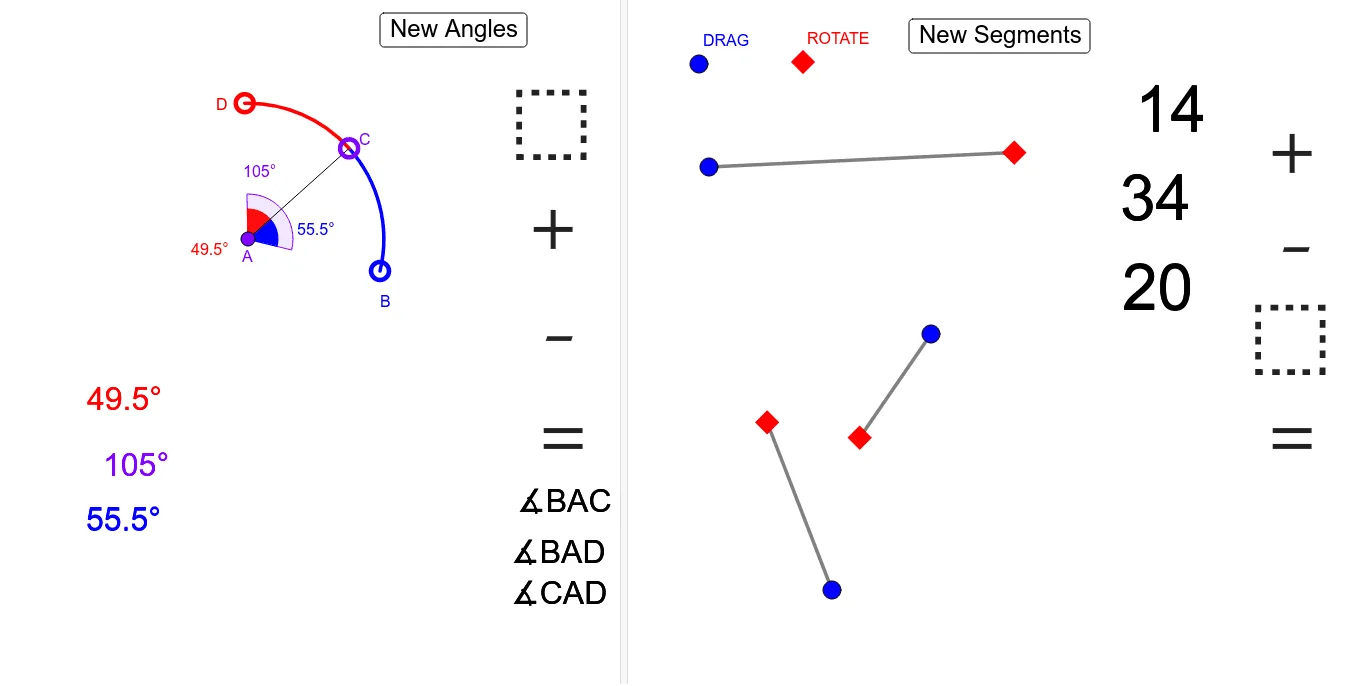
This example helps visualize the concept of segment addition and angle addition. It involves core mathematical concepts such as line segment addition, angle addition, and basic trigonometric functions. Construction uses GeoGebra commands like Random, Rotate, CircleArc, Point, Angle, and Segment. Suitable for middle or high school mathematics to intuitively understand geometric and trigonometric principles.
GeoGebra Commands & Parameters
Random(60, 270) → aRotate(B, a°, A) → DCircleArc(A, B, D) → cPoint(c) → CAngle(B, A, D) → αAngle(B, A, C) → βAngle(C, A, D) → γSegment(A, C) → bRandom(60, 270) → a_1Rotate(B_2, a_1°, A_2) → D_2CircleArc(A_2, B_2, D_2) → c_1Point(c_1) → C_2Angle(B_2, A_2, D_2) → α_1Angle(B_2, A_2, C_2) → β_1Angle(C_2, A_2, D_2) → γ_1Segment(A_2, C_2) → b_1Random(60, 270) → a_2Rotate(B_3, a_2°, A_3) → D_3CircleArc(A_3, B_3, D_3) → c_2Angle(B_3, A_3, D_3) → α_2Random(60, 270) → a_3Rotate(B_4, a_3°, A_4) → D_4CircleArc(A_4, B_4, D_4) → c_3Point(c_3) → C_3Angle(B_4, A_4, D_4) → α_3Angle(B_4, A_4, C_3) → β_2Angle(C_3, A_4, D_4) → γ_2Segment(A_4, C_3) → b_2Random(5, 20) → dPoint(Circle[E_1, abs(d)]) → F_1Segment(E_1, F_1) → eRandom(d + 5, d + 20) → fPoint(Circle[G_1, abs(f)]) → H_1Segment(G_1, H_1) → hPoint(Circle[J_1, abs(g)]) → K_1Segment(J_1, K_1) → iCircleArc(A, B, C) → kCircleArc(A, C, D) → pRandom(5, 20) → d_1Random(5, 20) → d_2Random(d_2 + 5, d_2 + 20) → f_1Random(5, 20) → d_3Random(d_3 + 5, d_3 + 20) → f_2
AI Drawing Prompt Reference
Draw a geometric diagram to illustrate the concept of segment and angle addition. Include three rotating triangles, each with two segments and three angles, represented by arcs and connecting vertices. Start with the first triangle, then rotate the second and third triangles by random angles. Finally, add two randomly lengthed segments and circles to demonstrate basic trigonometric functions and geometric constructions.
The prompt above was compiled from the original drawing commands and is for reference only.