
Addition of Fractions with the Same Denominator by Anthony OR 柯志明
Loading the math board and drawing, please wait…
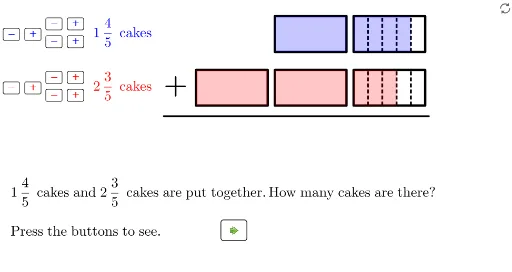
This example demonstrates the geometric representation of addition of fractions with the same denominator, visually showing the process of adding fractions through shapes. It involves core mathematical concepts such as fraction addition, geometric representation, and vector operations. The construction uses GeoGebra commands and objects like Point, Translate, Vector, Polygon, Sequence, Segment, If to create and manipulate geometric elements. Suitable for middle school mathematics teaching, helping students understand the geometric meaning of fraction addition and enhancing spatial reasoning skills.
GeoGebra Commands & Parameters
Point(yAxis) → CPoint(yAxis) → BTranslate(B, Vector[(t2 * Vector[B, D])]) → B'Vector((0, 0), (-2.2, 0)) → uPoint(yAxis) → APolygon({A, A + (2, 0), A + (2, 1), A + (0, 1)}) → q1Polygon({B, B + (2, 0), B + (2, 1), B + (0, 1)}) → q2Sequence(Translate[q1, Vector[(i * u)]], i, 1, m) → L_1Sequence(Translate[q2, Vector[(i * u)]], i, 1, n) → L_2Polygon({A, A + ((2 * b / a), 0), A + ((2 * b / a), 1), A + (0, 1)}) → q3Sequence(Translate[q1, Vector[(i * u)]], i, 1, m) → L_5Polygon({B, B + ((2 * c / a), 0), B + ((2 * c / a), 1), B + (0, 1)}) → q4Sequence(Translate[q2, Vector[(i * u)]], i, 1, n) → L_6Sequence(Segment[A + ((i * 2 / a), 0), A + ((i * 2 / a), 1)], i, 1, a - 1) → L_3Sequence(Segment[B + ((i * 2 / a), 0), B + ((i * 2 / a), 1)], i, 1, a - 1) → L_4Polygon({C, C + (2, 0), C + (2, 1), C + (0, 1)}) → q5Translate(q3, Vector[(t1 * Vector[A, C])]) → q3'Translate(A, Vector[(t1 * Vector[A, C])]) → A'Sequence(Segment[A' + ((i * 2 / a), 0), A' + ((i * 2 / a), 1)], i, 0, b) → L_7Translate(q5, Vector[(-u)]) → q5'Sequence(Segment[A' + (0, i), A' + ((2 * b / a), i)], i, 0, 1) → L_9Polygon({B'', B'' + ((If[b + c > a, b + c - a, 0] * 2 / a), 0), B'' + ((If[b + c > a, b + c - a, 0] * 2 / a), 1), B'' + (0, 1)}) → q9Polygon({B', B' + ((If[b + c > a, a - b, c] * 2 / a), 0), B' + ((If[b + c > a, a - b, c] * 2 / a), 1), B' + (0, 1)}) → q8Sequence(Segment[B'' + ((i * 2 / a), 0), B'' + ((i * 2 / a), 1)], i, 0, If[b + c > a, b + c - a, 0]) → L_{11}Sequence(Segment[B' + (0, i), B' + ((If[b + c > a, a - b, c] * 2 / a), i)], i, 0, 1) → L_{12}Sequence(Segment[B'' + (0, i), B'' + ((If[b + c > a, b + c - a, 0] * 2 / a), i)], i, 0, 1) → L_{13}Translate(L_5, Vector[(t4 * Vector[A, C])]) → L_{14}Translate(L_1, Vector[(t4 * Vector[A, C])]) → L_{15}Translate(C, Vector[(m * u)]) → C'Translate(L_6, Vector[(t5 * Vector[B, C'])]) → L_{16}Translate(L_2, Vector[(t5 * Vector[B, C'])]) → L_{17}Sequence(Segment[B' + ((i * 2 / a), 0), B' + ((i * 2 / a), 1)], i, 0, If[b + c > a, a - b, c]) → L_{10}Sequence(Segment[C + ((i * 2 / a), 0), C + ((i * 2 / a), 1)], i, 1, a - 1) → L_{18}Sequence(Segment[E + ((i * 2 / a), 0), E + ((i * 2 / a), 1)], i, 1, a - 1) → L_8Segment(H, I) → fIf(b > 0, 1, 0) → s1If(c > 0, 1, 0) → s2If(b + c > a, 1, 0) → s3If(m > 0, 1, 0) → s4If(n > 0, 1, 0) → s5If(s1 + s2 + s3 + s4 + s5 ≤ t1 + t2 + t3 + t4 + t5, true, false) → finished