
Addition of Fractions (with Hints)
Loading the math board and drawing, please wait…
In collections
Introduction to Fractions
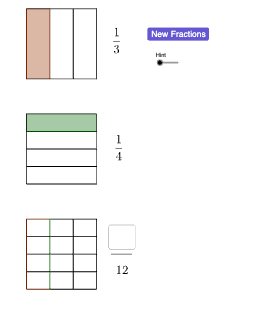
This GeoGebra example demonstrates the process of adding fractions through an interactive interface, helping students understand how to add fractions with different denominators by finding common denominators. Key mathematical concepts include fraction properties, least common multiple (LCM) computation using the GCD command, and fraction simplification. Construction details: Uses GCD command to calculate LCM for denominators, Textfield for user input, Random command to generate randomized fraction problems, with step-by-step hints and instant feedback. Suitable for upper elementary to early middle school students, ideal for classroom demonstration or self-paced practice.
GeoGebra Commands & Parameters
Random(3, 8) → d1Random(1, d1 - 2) → n1Intersect(xAxis, yAxis) → APoint(yAxis) → BPoint(xAxis) → DSequence(Segment[(i / d1, 0), (i / d1, 1)], i, 0, d1, 1) → l1Polygon(B, F, E, A) → q1, b, f, e, aSegment(B, C) → gSegment(A, D) → hRandom(1, d1 - n1) → n2Random(d1, 8) → d2Point(yAxis) → GPoint(yAxis) → JSequence(Segment[(0, (-(i / d2)) - 0.5), (1, (-(i / d2)) - 0.5)], i, 0, d2, 1) → l2Polygon(G, H, L, K) → q2, g_1, h_1, l, kSegment(G, J) → iSegment(H, I) → jSegment(G, H) → mSegment(J, I) → nSequence(Segment[(i / d1, -2), (i / d1, -3)], i, 0, d1, 1) → l3Sequence(Segment[(0, (-(i / d2)) - 2), (1, (-(i / d2)) - 2)], i, 0, d2, 1) → l4Point(yAxis) → MVector(B, M) → uTranslate(B, u) → B'Translate(F, u) → F'Translate(E, u) → E'Translate(A, u) → A'Polygon(B', F', E', A') → q1', b', f', e', a'Polygon(F', E', O, N) → q3, p, q, o, n_1Polygon(N, R, S, Q) → q4, n_2, r, s, q_1Textfield(numans) → InputBox1Segment(T, U) → tSegment(V, W) → f_1Textfield(ltnum) → InputBox2Textfield(ltden) → InputBox3GCD(n3, d3) → gcdansSequence(Segment[(0, (-(i / d2)) + 1), (1, (-(i / d2)) + 1)], i, 0, d2, 1) → l5Sequence(Segment[(i / d1, -1.5), (i / d1, -0.5)], i, 0, d1, 1) → l6Intersect(e, a) → F_1Vector(F_1, G_1) → wTranslate(B', w) → B''Translate(F', w) → F''Translate(E', w) → E''Translate(A', w) → A''Translate(F', w) → F''_{1}Translate(E', w) → E''_{1}Translate(O, w) → O'Translate(N, w) → N'Translate(N, w) → N'_{1}Translate(R, w) → R'Translate(S, w) → S'Translate(Q, w) → Q'Polygon(N'_{1}, R', S', Q') → q4', n'_{1}, r', s', q'
AI Drawing Prompt Reference
Draw a coordinate-plane diagram for adding fractions: include two perpendicular axes and a set of evenly spaced vertical subdivision lines forming multiple rectangular/polygon regions. Construct one group of step-like polygon partitions positioned relative to the intersection of the axes, representing numerator/denominator partitioning, then translate a matching copy of the same shape along one common direction to create a side-by-side comparison. Ensure the two partition groups connect so the layout visually suggests combining like denominators. Leave space for user input related to numerators, denominators, and the common-denominator (LCM) step hints, without relying on any external diagrams.
The prompt above was compiled from the original drawing commands and is for reference only.