
A5: Dynamic Geometry Locus and Quadratic Equation Exploration
Loading the math board and drawing, please wait…
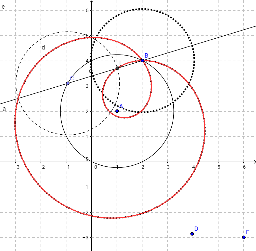
①This GeoGebra example demonstrates a dynamic geometric construction where points, circles, lines, and their intersections generate a locus curve, with the LocusEquation command revealing its algebraic nature. ②Core mathematical concepts include quadratic equations, loci, geometric construction, and random experiments, involving the positional relationships between circles and lines, the motion of intersection points, and the equation of the resulting curve. ③Construction highlights: from the summary, commands such as Circle, Point, Line, Intersect are used to create basic elements, Locus tracks the moving point's path, and LocusEquation outputs the algebraic equation directly; objects include A, B, c, C, a, D, E, d, F, loc1, e, where loc1 is the locus object and e likely the equation. ④Suitable for high school or early college students to understand the correspondence between geometry and algebra, as a dynamic tool for exploring how quadratic curves (e.g., parabolas, ellipses) are generated, and with random experiment elements it can extend to geometric probability in statistics.
GeoGebra Commands & Parameters
Circle(A, B) → cPoint(c) → CLine(C, B) → aCircle(C, Segment[D, E]) → dIntersect(d, a, 2) → FLocus(F, C) → loc1LocusEquation(F, C) → e