
Classical Construction of Pascal’s Limaçon and Cardioid as a Locus
Loading the math board and drawing, please wait…
In collections
History of Maths
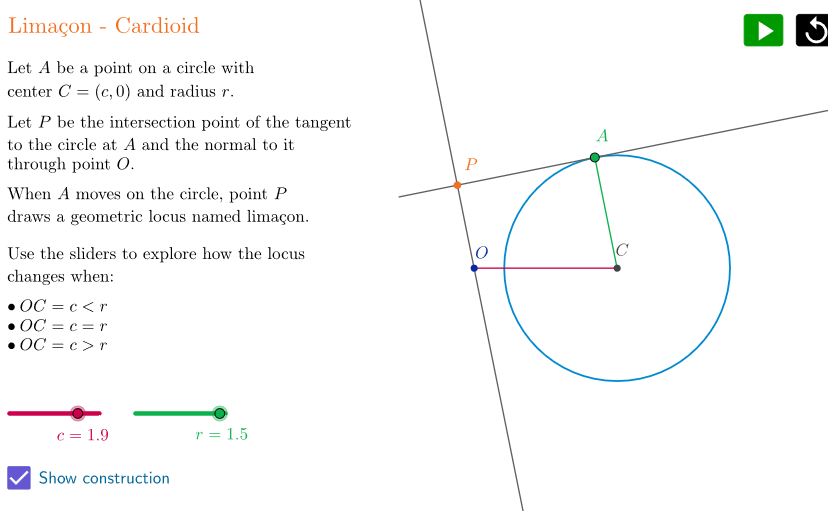
This example demonstrates how Pascal’s limaçon and the cardioid arise as the locus of a moving point via a classical geometric construction. It highlights the idea of generating a curve from constrained motion: the locus is determined using circle geometry with tangency and orthogonality conditions. Key concepts include locus (locus of a point), tangent lines to circles, constructing perpendicular lines, and locating points through intersections. In GeoGebra, the construction uses Circle to define the base and auxiliary circles, Point to place essential defining points, Tangent to create the tangent line, OrthogonalLine to enforce the perpendicular constraint, and Intersect to compute the resulting key point that traces the curve; Segment is used to reveal the constructed geometry. The setup is intended for secondary-level advanced learning, contest preparation, and early university geometry courses focusing on construction methods and locus concepts.
GeoGebra Commands & Parameters
Circle(C, r) → c_1Point(c_1) → ATangent(A, c_1) → d,OrthogonalLine(O, d) → eIntersect(d, e) → PSegment(C, O) → gSegment(C, A) → h
AI Drawing Prompt Reference
Draw a geometric figure made of circles and lines. Start with a circle, place a point on it, draw a tangent line from that point, then draw a line perpendicular to the tangent. The intersection of these lines forms a curve. Show the circle, tangent line, perpendicular line, intersection point, and the resulting curve.
The prompt above was compiled from the original drawing commands and is for reference only.