
A4 Paper Halving and Doubling: Exploring Powers of 2
Loading the math board and drawing, please wait…
In collections
About Exponents
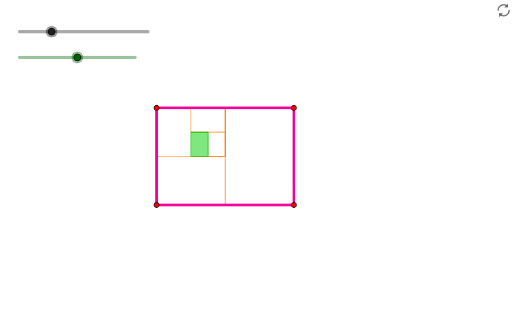
This GeoGebra example demonstrates the iterative halving and doubling of an A4 sheet of paper, visually illustrating how the paper's area changes by powers of 2 with each fold. The core mathematical concepts include exponential growth and decay, powers of 2, geometric sequences, polygon area, and planar symmetry. Construction is carried out using GeoGebra commands Midpoint, Segment, Intersect, Polygon, Sequence, and Rotate, together with objects such as points A–F, segments e, f, a–d, the paper polygon, parameters r, t, n, lists list1 and list2, and the fold object. It is suitable for middle school and high school mathematics instruction, serving as a dynamic classroom demonstration for exponents and geometric construction, or as an independent exploration activity linking paper-folding phenomena to algebraic powers.
GeoGebra Commands & Parameters
Midpoint(B, C) → ESegment(E, A) → eSegment(B, D) → fIntersect(e, f) → FPolygon(A, B, C, D) → paper, a, b, c, dSequence(Rotate[Polygon[Dilate[A, r^((-k)), F], Dilate[B, r^((-k)), F], Dilate[C, r^((-k)), F], Dilate[D, r^((-k)), F]], ((-t) * k), F], k, 0, abs(n)) → list2Sequence(Rotate[Polygon[Dilate[A, r^(k), F], Dilate[B, r^(k), F], Dilate[C, r^(k), F], Dilate[D, r^(k), F]], (t * k), F], k, 0, abs(n)) → list1Rotate(Polygon[Dilate[A, r^(n), F], Dilate[B, r^(n), F], Dilate[C, r^(n), F], Dilate[D, r^(n), F]], (t * n), F) → fold