
A Counterexample: Partial Derivatives Exist but Differentiability Fails
Loading the math board and drawing, please wait…
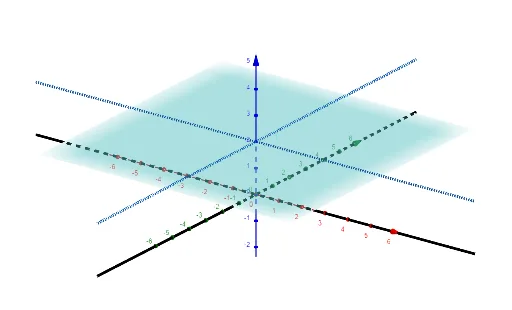
This GeoGebra example uses geometric construction to illustrate the phenomenon that partial derivatives can exist at a point while the function is not differentiable there. The key concepts are partial derivatives, differentiability, and how local “smoothness” properties may differ across coordinate directions. Construction focus: employing the IntersectPath command to compute intersections among the paths/objects f, h, g, p, i, j, thereby identifying the crucial points or curve relations used to visualize the counterexample’s geometry. Suitable for calculus instruction and for learners studying the distinction between existence of partial derivatives and overall differentiability, including teaching with counterexamples.
GeoGebra Commands & Parameters
IntersectPath(f, y = 0) → hIntersectPath(f, x = 0) → gIntersectPath(p, x = 0) → iIntersectPath(p, y = 0) → j
AI Drawing Prompt Reference
In the same coordinate plane, draw the graph of a function as the base curve, then find its intersections with the coordinate axes: compute the intersection of the curve with the horizontal line y=0 to obtain a key point, and compute the intersection with the vertical line x=0 to obtain another key point. Next, draw a second related curve and find its intersections with x=0 and y=0, producing two additional key points. Arrange these intersection points to visually support the idea that partial derivatives can exist at a point even though differentiability fails there, highlighting potentially different behavior across coordinate directions.
The prompt above was compiled from the original drawing commands and is for reference only.