
9-Point Circle Construction and Properties
Loading the math board and drawing, please wait…
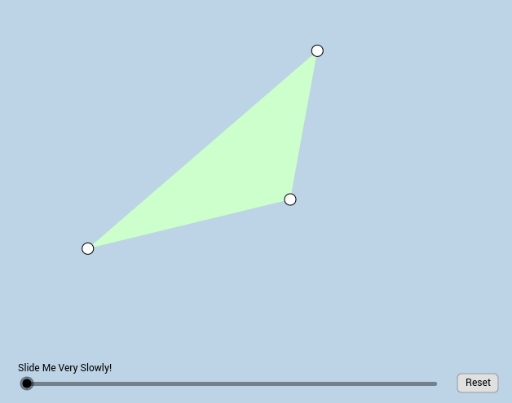
This example demonstrates how to construct the nine-point circle of a triangle by plotting the midpoints of the three altitudes, the midpoints of each side, and the midpoints of the segments connecting each vertex to the orthocenter. It illustrates the relationship between the nine-point circle and the circumcircle of the triangle. Key mathematical concepts include triangle, orthocenter, midpoint, circle, geometric construction, and limits. The construction uses GeoGebra commands such as Segment, Midpoint, Circle, Intersect, Dilate, Rotate, Polygon, Line, Point, OrthogonalLine, Ray, CircleSector, and Angle. This is suitable for high school and above students to understand the construction method and applications of the nine-point circle in geometric proofs.
GeoGebra Commands & Parameters
Segment(A, B) → fSegment(B, C_1) → gSegment(C_1, A) → hMidpoint(f) → DMidpoint(h) → EMidpoint(g) → FMin(list1) → aCircle(D, (0.1 * a)) → cCircle(E, (0.1 * a)) → dCircle(F, (0.1 * a)) → eIntersect(c, f, 2) → HIntersect(d, h, 2) → KIntersect(e, g, 2) → MDilate(A, If[0 < b ≤ 1, 1 - b, 0], D) → A'Dilate(B, If[2 < b ≤ 3, 3 - b, 0], F) → B'Dilate(C_1, If[4 < b ≤ 5, 5 - b, 0], E) → C'Segment(A, A') → lSegment(B, B') → mSegment(C_1, C') → nRotate(A, If[1 < b ≤ 2, ((b - 1) * π), π], D) → A'_1Rotate(A', If[1 < b ≤ 2, ((b - 1) * π), π], D) → A''Segment(A'_1, A'') → l'Rotate(B, If[3 < b ≤ 4, ((b - 3) * π), π], F) → B'_1Rotate(B', If[3 < b ≤ 4, ((b - 3) * π), π], F) → B''Segment(B'_1, B'') → m'Rotate(C_1, If[5 < b ≤ 6, ((b - 5) * π), π], E) → C'_1Rotate(C', If[5 < b ≤ 6, ((b - 5) * π), π], E) → C''Segment(C'_1, C'') → n'Polygon(A, B, C_1) → poly1, c_1, a_1, b_1Line(A, B) → iPoint(i) → CPoint(i) → GOrthogonalLine(C_1, i) → jIntersect(i, j) → IRay(A, G) → kRay(B, C) → pPoint(k) → JPoint(p) → LRay(A, J) → qRay(B, L) → rCircle(I, (0.1 * a)) → sIntersect(s, i, 2) → NIntersect(s, j, 2) → OCircleSector(I, N, O) → tAngle(C_1, B, A) → αAngle(B, A, C_1) → βAngle(A, C_1, B) → γLine(A, C_1) → f_1Point(f_1) → PPoint(f_1) → QRay(A, P) → g_1Ray(C_1, Q) → h_1Point(g_1) → RRay(A, R) → i_1Point(h_1) → SRay(C_1, S) → j_1OrthogonalLine(B, f_1) → k_1Intersect(f_1, k_1) → TCircle(T, (0.1 * a)) → d_1Intersect(d_1, f_1, 1) → UIntersect(d_1, k_1, 1) → VCircleSector(T, U, V) → e_1Line(C_1, B) → l_1OrthogonalLine(A, l_1) → m_1Intersect(l_1, m_1) → WCircle(W, (0.1 * a)) → p_1Intersect(p_1, l_1, 1) → ZIntersect(p_1, m_1, 1) → A_1Point(l_1) → B_1Point(l_1) → D_1CircleSector(W, Z, A_1) → q_1Ray(C_1, B_1) → n_1Ray(B, D_1) → r_1Point(n_1) → E_1Point(r_1) → F_1Ray(C_1, E_1) → s_1Ray(B, F_1) → t_1Dilate(C_1, If[6 < b ≤ 7, 7 - b, 0], I) → G_1Segment(C_1, G_1) → f_2Dilate(B, If[7 < b ≤ 8, 8 - b, 0], T) → B'_2Segment(B, B'_2) → g_2Dilate(A, If[8 < b ≤ 9, 9 - b, 0], W) → A'_2Segment(A, A'_2) → h_2Intersect(k_1, m_1) → H_1Rotate(t, If[9 < b ≤ 10, ((b - 9) * π / 2), π / 2], I) → t'Rotate(e_1, If[10 < b ≤ 11, ((b - 10) * π / 2), π / 2], T) → c_2Rotate(q_1, If[11 < b ≤ 12, ((b - 11) * π / 2), π / 2], W) → d_2Dilate(I, If[12 < b ≤ 13, 13 - b, 0], H_1) → I'Dilate(A, If[12 < b ≤ 13, 13 - b, 0], H_1) → A'_3Dilate(T, If[12 < b ≤ 13, 13 - b, 0], H_1) → T'Segment(I, I') → i_2Segment(A, A'_3) → j_2Segment(T, T') → k_2Dilate(C_1, If[12 < b ≤ 13, 13 - b, 0], H_1) → I_1Dilate(W, If[12 < b ≤ 13, 13 - b, 0], H_1) → W'Dilate(T, If[12 < b ≤ 13, 13 - b, 0], H_1) → T'_1Segment(W, W') → l_2Segment(C_1, I_1) → m_2Segment(T, T'_1) → n_2Dilate(I, If[12 < b ≤ 13, 13 - b, 0], H_1) → I'_1Dilate(B, If[12 < b ≤ 13, 13 - b, 0], H_1) → B'_3Dilate(W, If[12 < b ≤ 13, 13 - b, 0], H_1) → W'_1Segment(B, B'_3) → p_2Segment(W, W'_1) → q_2Segment(I, I'_1) → r_2Midpoint(H_1, C_1) → J_1Midpoint(H_1, A) → K_1Midpoint(H_1, B) → L_1Dilate(H_1, If[14 < b ≤ 15, 15 - b, 0], J_1) → M_1Segment(H_1, M_1) → s_2Dilate(J_1, If[15 < b ≤ 16, 16 - b, 0], C_1) → N_1Segment(J_1, N_1) → t_2Rotate(H_1, If[16 < b ≤ 17, ((b - 16) * π), π], J_1) → O_1Rotate(M_1, If[16 < b ≤ 17, ((b - 16) * π), π], J_1) → P_1Segment(O_1, P_1) → a_2Dilate(H_1, If[17 < b ≤ 18, 18 - b, 0], L_1) → Q_1Segment(H_1, Q_1) → b_2Dilate(L_1, If[18 < b ≤ 19, 19 - b, 0], B) → R_1Segment(L_1, R_1) → e_2Rotate(H_1, If[19 < b ≤ 20, ((b - 19) * π), π], L_1) → S_1Rotate(Q_1, If[19 < b ≤ 20, ((b - 19) * π), π], L_1) → T_1Segment(S_1, T_1) → f_3Dilate(H_1, If[20 < b ≤ 21, 21 - b, 0], K_1) → U_1Segment(H_1, U_1) → g_3Dilate(K_1, If[21 < b ≤ 22, 22 - b, 0], A) → V_1Segment(K_1, V_1) → h_3Rotate(H_1, If[22 < b ≤ 23, ((b - 22) * π), π], K_1) → W_1Rotate(U_1, If[22 < b ≤ 23, ((b - 22) * π), π], K_1) → Z_1Segment(W_1, Z_1) → i_3Intersect(e, l_1) → A_2, B_2OrthogonalLine(F, l_1) → j_3Intersect(e, j_3) → C_2, D_2CircleSector(F, A_2, C_2) → c_3OrthogonalLine(E, f_1) → k_3Circle(E, (0.1 * a)) → d_3Intersect(d_3, k_3) → E_2, F_2Intersect(d_3, f_1) → G_2, H_2CircleSector(E, G_2, E_2) → e_3Rotate(c_3, If[25 < b ≤ 26, ((b - 25) * π / 2), π / 2], F) → p_3Rotate(e_3, If[26 < b ≤ 27, ((b - 26) * π / 2), π / 2], E) → q_3Intersect(k_3, j_3) → I_2Midpoint(H_1, I_2) → J_2Dilate(H_1, If[28 < b ≤ 29, 29 - b, 0], J_2) → K_2Segment(H_1, K_2) → l_3Dilate(J_2, If[29 < b ≤ 30, 30 - b, 0], I_2) → L_2Segment(J_2, L_2) → m_3Rotate(H_1, If[30 < b ≤ 31, ((b - 30) * π), π], J_2) → M_2Rotate(K_2, If[30 < b ≤ 31, ((b - 30) * π), π], J_2) → N_2Segment(M_2, N_2) → n_3Dilate(J_2, If[31 < b ≤ 32, 32 - b, 0], D) → O_2Segment(J_2, O_2) → r_3Rotate(J_2, If[32 < b ≤ 34, ((b - 32) * π), (2 * π)], J_2) → P_2Rotate(O_2, If[32 < b ≤ 34, ((b - 32) * π), (2 * π)], J_2) → Q_2Segment(P_2, Q_2) → s_3CircleArc(J_2, D, Q_2) → t_3Circle(J_2, D) → c_4Segment(B, T) → a_3Segment(I, C_1) → b_3Segment(A, W) → f_4Segment(H_1, I) → g_4Segment(H_1, T) → h_4Segment(H_1, W) → i_4Polygon(L_1, D, E, J_1) → poly2, l_4, d_4, e_4, j_4Angle(J_1, L_1, D) → δAngle(L_1, D, E) → εAngle(D, E, J_1) → ζAngle(E, J_1, L_1) → ηDilate(D, If[37 < b ≤ 38, 38 - b, 0], L_1) → D'Segment(D, D') → k_4Dilate(L_1, If[38 < b ≤ 39, 39 - b, 0], J_1) → R_2Segment(L_1, R_2) → m_4Dilate(J_1, If[39 < b ≤ 40, 40 - b, 0], E) → S_2Segment(J_1, S_2) → n_4Dilate(E, If[40 < b ≤ 41, 41 - b, 0], D) → E'Segment(E, E') → p_4Polygon(D, F, J_1, K_1) → poly3, d_5, f_5, j_5, k_5Angle(J_1, F, D) → θAngle(F, D, K_1) → ιAngle(D, K_1, J_1) → κAngle(K_1, J_1, F) → λDilate(F, If[42 < b ≤ 43, 43 - b, 0], D) → F'Segment(F, F') → q_4Dilate(D, If[43 < b ≤ 44, 44 - b, 0], K_1) → D'_1Segment(D, D'_1) → r_4Dilate(K_1, If[44 < b ≤ 45, 45 - b, 0], J_1) → T_2Segment(K_1, T_2) → s_4Dilate(J_1, If[45 < b ≤ 46, 46 - b, 0], F) → U_2Segment(J_1, U_2) → t_4Polygon(E, F, L_1, K_1) → poly4, e_5, f_6, l_5, k_6Dilate(L_1, If[47 < b ≤ 48, 48 - b, 0], F) → V_2Segment(L_1, V_2) → a_4Dilate(F, If[48 < b ≤ 49, 49 - b, 0], E) → F'_1Segment(F, F'_1) → b_4Dilate(E, If[49 < b ≤ 50, 50 - b, 0], K_1) → E'_1Segment(E, E'_1) → g_5Dilate(K_1, If[50 < b ≤ 51, 51 - b, 0], L_1) → W_2Segment(K_1, W_2) → h_5Angle(E, F, L_1) → μAngle(F, L_1, K_1) → νAngle(L_1, K_1, E) → ξAngle(K_1, E, F) → ο
AI Drawing Prompt Reference
Draw a triangle, mark the midpoints of its three sides, the midpoints of the three altitudes, and the midpoints of the segments connecting each vertex to the orthocenter. Construct and draw the nine-point circle using these points, showing its relationship with the circumcircle of the triangle. Label key geometric elements like the orthocenter, midpoints, and circles, following the construction sequence.
The prompt above was compiled from the original drawing commands and is for reference only.