
3D Theorem von Marion: a Pyramid Solid Demonstration
Loading the math board and drawing, please wait…
In collections
Besondere Punkte/Special Points
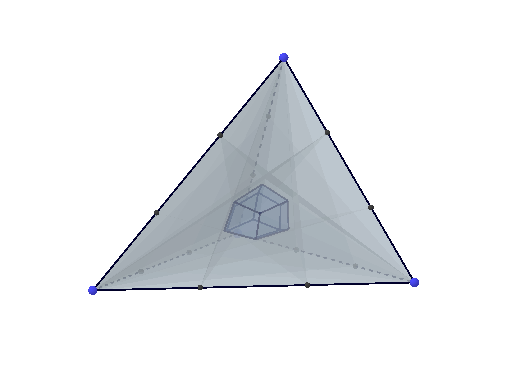
This GeoGebra example demonstrates a “Theorem von Marion” in 3D by constructing a pyramid/tetrahedron configuration and visualizing the geometric relationships suggested by its theorem (e.g., via corresponding triangular faces and their area/edge-dependent relations). The main mathematical ideas are solid geometry with tetrahedra, relationships among the triangular faces (and their intersections), symmetry-type constraints (often connected to isosceles triangle behavior in the setup), and the role of constructed intersection points and segment connections in determining the final geometry. Construction-wise, it uses Polygon and Pyramid to build the faces and the 3D solid, Intersect to compute key intersection points/constraints, and Segment to define the connecting edges used for measurements and verification. The model includes multiple face objects such as PlaneABC, PlaneABD, PlaneBCD, PlaneACD and the corresponding edges (KanteAB, KanteBC, KanteAC, KanteAD, KanteBD, KanteCD), together with auxiliary points (E–P) and parameters (e.g., d1, d2, d3, d4, a, b, p) to control the configuration. Suitable for late secondary school through early university geometry, especially for classroom demonstrations and exploratory learning of 3D theorem statements.
GeoGebra Commands & Parameters
Pyramid(A, B, C, D) → pyr, FlächeABC, KanteCD, FlächeABD, FlächeBCD, FlächeACD, KanteAB, KanteBC, KanteAC, KanteAD, KanteBDPolygon(A, P, B) → d1, b, a, pPolygon(A, M, B) → d2, b_1, a_1, mPolygon(A, O, C) → d3, c, a_2, oPolygon(A, J, C) → d4, c_1, a_3, jPolygon(B, F, D) → d5, d, b_2, fPolygon(B, K, D) → d6, d_1, b_3, kPolygon(B, N, C) → d7, c_2, b_4, nPolygon(B, G, C) → d8, c_3, b_5, gPolygon(D, L, A) → d9, a_4, d_2, lPolygon(D, I, A) → d10, a_5, d_3, iPolygon(D, E, C) → d11, c_4, d_4, ePolygon(D, H, C) → d12, c_5, d_5, hIntersect(a_2, a) → QSegment(Q, A) → qIntersect(a, a_3) → RSegment(R, A) → rIntersect(b_2, b) → SSegment(S, B) → sIntersect(s, q) → TIntersect(s, r) → UIntersect(b_3, b) → VSegment(V, B) → tIntersect(q, t) → WIntersect(r, t) → ZIntersect(b_4, b) → A_1Segment(A_1, B) → f_1Intersect(f_1, q) → B_1Intersect(f_1, r) → C_1Intersect(b_5, b) → D_1Segment(D_1, B) → g_1Intersect(q, g_1) → E_1Intersect(r, g_1) → F_1Intersect(a_4, a) → G_1Segment(G_1, A) → h_1Intersect(h_1, t) → H_1Intersect(h_1, f_1) → I_1Intersect(s, h_1) → J_1Intersect(g_1, h_1) → K_1Intersect(a_5, a) → L_1Segment(L_1, A) → i_1Intersect(t, i_1) → M_1Intersect(i_1, f_1) → N_1Intersect(s, i_1) → O_1Intersect(i_1, g_1) → P_1Segment(P, E) → j_1Intersect(r, j_1) → Q_1Intersect(t, j_1) → R_1Segment(P, H) → k_1Intersect(h_1, k_1) → S_1Intersect(g_1, k_1) → T_1Intersect(a_1, a_2) → U_1Segment(U_1, A) → l_1Intersect(a_1, a_3) → V_1Intersect(b_2, b_1) → Z_1Segment(Z_1, B) → n_1Intersect(l_1, n_1) → E_2Segment(V_1, A) → m_1Intersect(n_1, m_1) → W_1Intersect(b_1, b_3) → A_2Segment(A_2, B) → p_1Intersect(l_1, p_1) → B_2Intersect(m_1, p_1) → C_2Intersect(b_4, b_1) → D_2Segment(D_2, B) → q_1Intersect(l_1, q_1) → F_2Intersect(q_1, m_1) → G_2Intersect(b_1, b_5) → H_2Segment(H_2, B) → r_1Intersect(r_1, m_1) → I_2Intersect(l_1, r_1) → J_2Intersect(a_1, a_4) → K_2Segment(K_2, A) → s_1Intersect(q_1, s_1) → L_2Intersect(p_1, s_1) → M_2Intersect(s_1, r_1) → N_2Intersect(s_1, n_1) → O_2Intersect(a_5, d10) → P_2, Q_2Intersect(a_5, a_1) → R_2Segment(R_2, A) → t_1Intersect(t_1, n_1) → S_2Intersect(r_1, t_1) → T_2Intersect(t_1, q_1) → U_2Intersect(t_1, p_1) → V_2Intersect(a_4, d10) → W_2Segment(M, E) → e_1Intersect(q_1, e_1) → Z_2Intersect(e_1, t_1) → A_3Segment(M, H) → f_2Intersect(f_2, n_1) → B_3Intersect(f_2, l_1) → C_3Segment(O, F) → g_2Segment(O, K) → h_2Intersect(c_2, c) → D_3Segment(D_3, C) → i_2Intersect(h_2, i_2) → E_3Intersect(c, c_3) → F_3Segment(F_3, C) → j_2Intersect(g_2, j_2) → G_3Intersect(i_2, g_2) → H_3Intersect(h_2, j_2) → I_3Intersect(a_4, a_2) → J_3Segment(J_3, A) → k_2Intersect(a_5, a_2) → K_3Segment(K_3, A) → l_2Intersect(h_2, l_2) → L_3Intersect(j_2, l_2) → M_3Intersect(c, c_4) → N_3Segment(N_3, C) → m_2Intersect(l_2, m_2) → O_3Intersect(c_5, c) → P_3Segment(P_3, C) → n_2Intersect(n_2, g_2) → Q_3Intersect(n_2, l_2) → R_3Intersect(n_2, k_2) → S_3Intersect(m_2, k_2) → T_3Segment(J, F) → p_2Segment(J, K) → q_2Intersect(c_2, c_1) → U_3Segment(U_3, C) → r_2Intersect(r_2, p_2) → V_3Intersect(q_2, r_2) → W_3Intersect(c_1, c_3) → Z_3Segment(Z_3, C) → s_2Intersect(s_2, p_2) → A_4Intersect(q_2, s_2) → B_4Intersect(a_3, a_4) → C_4Segment(C_4, A) → t_2Intersect(p_2, t_2) → D_4Intersect(r_2, t_2) → E_4Intersect(a_5, a_3) → H_4Segment(H_4, A) → e_2Intersect(c_1, c_4) → I_4Segment(I_4, C) → f_3Intersect(e_2, f_3) → J_4Intersect(q_2, f_3) → K_4Intersect(t_2, f_3) → L_4Intersect(c_5, c_1) → M_4Segment(M_4, C) → g_3Intersect(g_3, e_2) → N_4Intersect(g_3, t_2) → O_4Intersect(b_2, b_4) → P_4Segment(P_4, B) → h_3Intersect(b_2, b_5) → Q_4Segment(Q_4, B) → i_3Intersect(d, d_2) → R_4Segment(R_4, D) → j_3Intersect(j_3, h_3) → S_4Intersect(d_3, d) → T_4Segment(T_4, D) → k_3Intersect(d, d_4) → U_4Segment(U_4, D) → l_3Intersect(l_3, h_3) → V_4Intersect(i_3, l_3) → W_4Intersect(d, d_5) → Z_4Segment(Z_4, D) → m_3Intersect(h_3, m_3) → A_5Intersect(m_3, i_3) → B_5Intersect(b_4, b_3) → C_5Segment(C_5, B) → n_3Intersect(b_5, b_3) → D_5Segment(D_5, B) → p_3Intersect(d_1, d_2) → E_5Segment(E_5, D) → q_3Intersect(d_3, d_1) → F_5Segment(F_5, D) → r_3Intersect(r_3, p_3) → G_5Intersect(d_4, d_1) → H_5Segment(H_5, W_2) → s_3Intersect(s_3, p_3) → I_5Intersect(s_3, n_3) → J_5Intersect(d_5, d_1) → K_5Segment(K_5, D) → t_3Intersect(t_3, p_3) → L_5Intersect(t_3, n_3) → N_5Segment(N, L) → e_3Segment(N, Q_2) → f_4Intersect(c_4, c_2) → O_5Segment(O_5, C) → g_4Intersect(g_4, f_4) → P_5Intersect(c_5, c_2) → Q_5Segment(Q_5, C) → h_4Segment(G, L) → i_4Segment(G, Q_2) → j_4Intersect(c_3, c_4) → R_5Segment(R_5, C) → k_4Intersect(c_3, c_5) → S_5Segment(S_5, C) → l_4Intersect(l_4, i_4) → T_5Intersect(d_4, d_2) → U_5Segment(U_5, D) → m_4Intersect(i_2, m_4) → V_5Intersect(d_5, d_2) → W_5Segment(W_5, D) → n_4Intersect(d_4, d_3) → Z_5Segment(Z_5, D) → p_4Intersect(d_5, d_3) → A_6Segment(A_6, D) → q_4Polygon(N_5, C_2, M_2, E_3) → v1, n_5, r_4, s_4, t_4Polygon(E_3, M_2, N_2, T_3) → v2, e_4, f_5, g_5, h_5Polygon(N_1, N_4, C_2, N_5) → v3, i_5, j_5, k_5, l_5Polygon(C_2, I_2, N_2, M_2) → v4, m_5, p_5, q_5, r_5Polygon(N_4, A_4, I_2, C_2) → v5, s_5, t_5, e_5, f_6Polygon(T_3, N_2, W_4, T) → v6, g_6, h_6, w_4, t_6Polygon(T, W_4, A_4, O_1) → v7, t_7, i_6, j_6, o_1Polygon(O_1, A_4, N_4, N_1) → v8, k_6, l_6, m_6, n_6Polygon(N_2, I_2, A_4, W_4) → v9, p_6, q_6, r_6, s_6Polygon(E_3, T_3, T, B_1) → v11, d_6, e_6, t_9, f_7Polygon(N_1, N_5, E_3, B_1) → v12, g_7, h_7, i_7, j_7
AI Drawing Prompt Reference
Draw a 3D tetrahedron using four vertices and show its four triangular faces. Construct the solid first, then create several auxiliary points on lines/planes determined by the tetrahedron’s edges, forming multiple triangular edge configurations. Compute key intersection points where the constructed segments meet, then connect those intersection points back to the relevant tetrahedron vertices to form defining edges across different faces. Ensure the drawing contains clear face planes, intersection points, and connecting segments so the geometric relationships among the triangular faces can be visually compared as the auxiliary points vary.
The prompt above was compiled from the original drawing commands and is for reference only.