
3D Paper Model Animation
Loading the math board and drawing, please wait…
In collections
Action Modular Origami
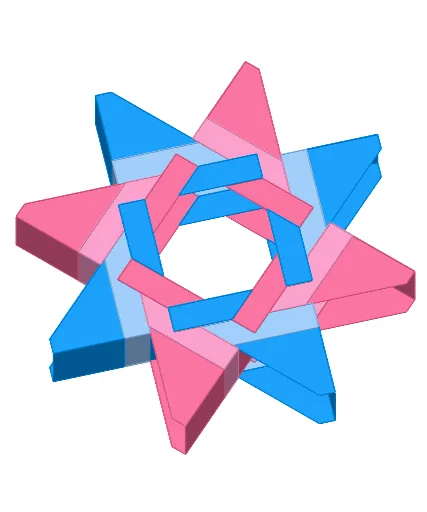
This example demonstrates an animation of a model folded from paper as described in the book 'Action Modular Origami' by Tarquin. It involves core mathematical concepts such as solid geometry, vector operations, and geometric transformations. The construction utilizes GeoGebra commands and objects like OrthogonalLine, Dilate, Intersect, Line, Vector, Translate, Polygon, Midpoint, Rotate, Mirror, and Sequence. Suitable for high school and above students studying solid geometry, geometric constructions, and spatial reasoning.
GeoGebra Commands & Parameters
OrthogonalLine(OOO, xOyPlane) → sDilate(C, ribbonCut, B) → C'_1Intersect(xAxis, yAxis) → ALine(B, A) → qVector(A, B) → vTranslate(A, u) → DPolygon(A, D, nSides, xOyPlane) → poly2, f, F, G, H, I, J, g, h, i, j, k, l, m, EMidpoint(D, H) → OOVector(OO, OOO) → wRotate(B, rot, OO) → B'Polygon(A, B, C) → poly1, c, a, bOrthogonalLine(K, a, xOyPlane) → nIntersect(n, b) → LRotate(L, 180°, A) → L'Rotate(L', rot, OO) → L''OrthogonalLine(L', n, xOyPlane) → pIntersect(p, q) → MRotate(M, rot, OO) → M'Mirror(K, c) → K'Rotate(K', rot, OO) → K''Polygon(K'', L'', M', B') → base', k'', l'', m', b'Polygon(K', L', M, B) → base, k', l', m_1, b_1Intersect(k', k'') → PVector(A, A'') → eTranslate(B, e_2) → B'_2Translate(B, e_0) → B'_3Translate(K', e_0) → K''_2Translate(K', e_2) → K''_1Translate(C'_1, e_0) → C_1Translate(C'_1, e_2) → B_1Dilate(C, topCut, K) → C'Translate(C', e_0) → C''_1Translate(C', e_2) → C''Sequence(Polygon[Rotate[A, (n * rot), OO], Rotate[B, (n * rot), OO], Rotate[C, (n * rot), OO]], n, 0, nSides, 1) → list1Polygon(A, L, K, B) → ribbon, a_1, l_1, k_1, b_2OrthogonalLine(N, a, xOyPlane) → rIntersect(r, b) → OPolygon(K, L, O, N) → top, k_2, l_2, o, n_1Sequence(Polygon[Rotate[K', (n * rot), OO], Rotate[L', (n * rot), OO], Rotate[M, (n * rot), OO], Rotate[B, (n * rot), OO]], n, 0, nSides, 1) → list2Sequence(Polygon[Rotate[A, (n * rot), OO], Rotate[L, (n * rot), OO], Rotate[K, (n * rot), OO], Rotate[B, (n * rot), OO]], n, 0, nSides, 1) → list3Rotate(A, rot, OO) → A'Rotate(L, rot, OO) → L'_1Rotate(K, rot, OO) → K'_1Rotate(B, rot, OO) → B'_1Polygon(A', L'_1, K'_1, B'_1) → ribbon', a', l'_1, k'_1, b'_1Rotate(K, rot, OO) → K'_2Rotate(L, rot, OO) → L'_2Rotate(O, rot, OO) → O'Rotate(N, rot, OO) → N'Polygon(K'_2, L'_2, O', N') → top', k'_2, l'_2, o', n'Polygon(B, D, M', L'', A, L, K) → ribbonCut_1, b_3, d, m'_1, l''_1, a_2, l_3, k_3Polygon(P, L', M, L'') → baseCut, p_1, l'_3, m_2, l''_2Intersect(b, a_1) → QIntersect(m', d) → RIntersect(b, a_1) → SIntersect(m', d) → TIntersect(m', d) → UIntersect(b, l_2) → VIntersect(m', d) → WIntersect(b, l_2) → ZIntersect(b, m') → A_1Polygon(B, D, A_1, L, C'_1) → ribbonLong, b_4, d_1, a_3, l_4, c'_1Translate(Sequence[Polygon[Rotate[B, (n * rot), OO], Rotate[D, (n * rot), OO], Rotate[A_1, (n * rot), OO], Rotate[L, (n * rot), OO], Rotate[C'_1, (n * rot), OO]], n, 0, nSides, 1], w) → listRibbonLongRotate(Translate[Sequence[Polygon[Rotate[B, (n * rot), OO], Rotate[D, (n * rot), OO], Rotate[M', (n * rot), OO], Rotate[L'', (n * rot), OO], Rotate[A, (n * rot), OO], Rotate[L, (n * rot), OO], Rotate[K, (n * rot), OO]], n, 0, nSides, 2], w], α, s) → listRibbonCutRotate(Translate[Sequence[Polygon[Rotate[K, (n * rot), OO], Rotate[L, (n * rot), OO], Rotate[O, (n * rot), OO], Rotate[N, (n * rot), OO]], n, 0, nSides, 2], w], α, s) → listTopRotate(Translate[Translate[Sequence[Polygon[Rotate[P, (n * rot), OO], Rotate[L', (n * rot), OO], Rotate[M, (n * rot), OO], Rotate[L'', (n * rot), OO]], n, 1, nSides, 2], w], Vector[(-3 * e_0)]], α, s) → listBaseCut2Rotate(Translate[Translate[Sequence[Polygon[Rotate[B, (n * rot), OO], Rotate[D, (n * rot), OO], Rotate[M', (n * rot), OO], Rotate[L'', (n * rot), OO], Rotate[A, (n * rot), OO], Rotate[L, (n * rot), OO], Rotate[K, (n * rot), OO]], n, 1, nSides, 2], Vector[(-e_0)]], w], α, s) → listRibbonCut2Rotate(Translate[Sequence[Polygon[Rotate[K, (n * rot), OO], Rotate[L, (n * rot), OO], Rotate[O, (n * rot), OO], Rotate[N, (n * rot), OO]], n, 1, nSides, 2], w], α, s) → listTop2Translate(listTop2, e) → listTop2'Translate(listTop, e) → listTop'Polygon(C''_1, C_1, B_1, C'') → SideTop, t, f_1, g_1, h_1Polygon(B_1, B'_2, B'_3, C_1) → SideRibbon, i_1, j_1, q_1, r_1Translate(O, e_2) → O'_1Polygon(O, C', C'', O'_1) → SideCut, o_1, c'_3, c''_1, o'_1Polygon(B'_2, K''_1, K''_2, B'_3) → SideBase, s_1, t_1, c_1, e_1Translate(Sequence[Rotate[SideCut, (n * rot), OO], n, 0, nSides, 2], w) → listSideCutTranslate(Sequence[Rotate[SideCut, (n * rot), OO], n, 1, nSides, 2], w) → listSideCut2Rotate(Translate[Translate[Sequence[Polygon[Rotate[P, (n * rot), OO], Rotate[L', (n * rot), OO], Rotate[M, (n * rot), OO], Rotate[L'', (n * rot), OO]], n, 0, nSides, 2], w], Vector[(-2 * e_0)]], α, s) → listBaseCutTranslate(listRibbonCut2, Vector[e + (2 * e_0)]) → listRibbonCut2'Rotate(Translate[Sequence[Rotate[SideTop, (n * rot), OO], n, 0, nSides, 2], w], α, s) → listSideTopRotate(Translate[Sequence[Rotate[SideTop, (n * rot), OO], n, 1, nSides, 2], w], α, s) → listSideTop2Rotate(Translate[Sequence[Rotate[SideRibbon, (n * rot), OO], n, 0, nSides, 2], w], α, s) → listSideRibbonRotate(Translate[Sequence[Rotate[SideBase, (n * rot), OO], n, 0, nSides, 2], w], α, s) → listSideBaseRotate(Translate[Sequence[Rotate[SideRibbon, (n * rot), OO], n, 1, nSides, 2], w], α, s) → listSideRibbon2Rotate(Translate[Sequence[Rotate[SideBase, (n * rot), OO], n, 1, nSides, 2], w], α, s) → listSideBase2Translate(listRibbonCut, e) → listRibbonCut'Translate(listBaseCut, Vector[e + (6 * e_0)]) → listBaseCut'Translate(listBaseCut2, Vector[e + (5 * e_0)]) → listBaseCut2'
AI Drawing Prompt Reference
Create an animation of a 3D paper model folding process, demonstrating the transformation from a flat shape to a solid structure. The model is based on the book 'Action Modular Origami', involving multiple geometric faces and edges, formed through rotations and reflections. The animation shows the model unfolding and folding into a 3D shape, utilizing geometric transformations such as translation, rotation, and reflection, along with vector operations and geometric constructions.
The prompt above was compiled from the original drawing commands and is for reference only.