
Skeletal Cube – Rhombic Dodecahedron Origami Animation
Loading the math board and drawing, please wait…
In collections
Action Modular Origami
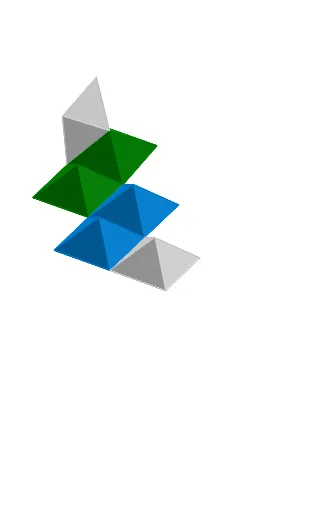
① This example demonstrates a 'skeletal cube' model folded from paper, whose unfolded form is a rhombic dodecahedron, with an animation showing the folding and unfolding process. ② Core mathematical concepts involve solid geometry of polyhedra (rhombic dodecahedron), spatial transformations (rotation and translation), and parametric animation control, also implying symmetry and topological structure. ③ Construction highlights: from the construction summary, GeoGebra commands such as Point, Line, PolyLine, Segment, OrthogonalLine, Intersect, If, Plane, Polygon, Rotate, IntersectPath, RoofPoly2 are used, along with objects like shift, K_1, T, S, m, g_1, D_2, h_1, Z_1, D_4, E_2, B_2, C_2, A_2, t, clock, rot1s, D, C, cc, A, C_1, B_1, A_1, Z, W, V, p, constClock, U, n, A1, rot1a, constSingle, rot0, bControl, rot1, J_1, I_1, G_1; sliders (rot1, rot0) and a clock control the rotation animation. ④ Suitable for upper secondary to early university solid geometry teaching, as well as origami mathematics or dynamic geometry demonstrations, helping students intuitively understand spatial structure and transformations of polyhedra.
GeoGebra Commands & Parameters
Point(xAxis) → SLine(S, T) → mLine(K_1, m) → g_1Line(D_2, m) → h_1Point(h_1) → B_2Point(h_1) → C_2Point(g_1) → A_2PolyLine(Z_1, A_2, B_2, C_2, D_4, E_2) → tSegment(C, D) → ccPoint(h_1) → A_1Point(h_1) → ZPoint(g_1) → WPolyLine(V, W, Z, A_1, B_1, C_1) → pOrthogonalLine(U, m) → nIntersect(n, p) → A1If(bControl ≟ constSingle, rot0, If[bControl ≟ constClock, rot1a, rot1s]) → rot1Point(h_1) → G_1Point(g_1) → F_1Point(t) → H_1PolyLine(E_1, F_1, G_1, H_1, I_1, J_1) → qIntersect(n, q) → A2Point(h_1) → O_1Point(h_1) → N_1Point(g_1) → M_1PolyLine(L_1, M_1, N_1, O_1, P_1, Q_1) → rIntersect(n, r) → A3Point(h_1) → U_1Point(h_1) → T_1Point(g_1) → S_1PolyLine(R_1, S_1, T_1, U_1, V_1, W_1) → sIntersect(n, s) → A4Intersect(n, t) → A5Segment(D, A) → ddPlane(B, C, D) → eSegment(A, B) → aaSegment(B, C) → bbIf(bControl ≟ constSingle, rot0, If[bControl ≟ constClock, rot4a, rot4s]) → rot4Polygon(A, B, C, D) → poly1, a, b, c, dRotate(B, (-rot1), cc) → B'Rotate(C, (-rot1), cc) → C'Rotate(D, (-rot1), cc) → D'Rotate(A, (-rot1), cc) → A'Polygon(A', B', C', D') → poly1', a', b', c', d'If(bControl ≟ constSingle, rot0, If[bControl ≟ constClock, rot2a, rot2s]) → rot2Rotate(poly1', rot2, b') → poly1''Rotate(D', rot2, b') → D''Rotate(A', rot2, b') → A''Segment(B', A'') → fIf(bControl ≟ constSingle, rot0, If[bControl ≟ constClock, rot3a, rot3s]) → rot3Rotate(poly1'', rot3, f) → poly1'''Rotate(D'', rot3, f) → D'''Rotate(C', rot3, f) → C'''Segment(A'', D''') → gRotate(poly1''', (-rot4), g) → poly2Rotate(C''', (-rot4), g) → C''''Rotate(B', (-rot4), g) → B'''Segment(D''', C'''') → hIf(bControl ≟ constSingle, rot0, If[bControl ≟ constClock, rot5a, rot5s]) → rot5Rotate(A'', rot5, h) → A'''Rotate(B''', rot5, h) → B''''Rotate(e, gable, dd) → e'_3Rotate(e, (-roof), aa) → e'_1IntersectPath(e'_3, e'_1) → iRotate(e, gable, bb) → e'IntersectPath(e', e'_1) → jRotate(e, (-roof), cc) → e'_2IntersectPath(e'_3, e'_2) → kIntersectPath(e', e'_2) → lIntersect(l, k) → EIntersect(j, i) → FRoofPoly2(A, B, C, D, gable, roof) → G, H, poly3, poly4, poly5, poly6, poly7RoofPoly2(A', D, C, B', gable, roof) → I, J, poly8, poly9, poly10, poly11, poly12RoofPoly2(C''', B', A'', D''', gable, roof) → K, L, poly13, poly14, poly15, poly16, poly17RoofPoly2(A''', D''', C'''', B'''', gable, roof) → M, N, poly18, poly19, poly20, poly21, poly22RoofPoly2(C, D'', A'', B', gable, roof) → O, P, poly23, poly24, poly25, poly26, poly27RoofPoly2(A'', B''', C'''', D''', gable, roof) → Q, R, poly28, poly29, poly30, poly31, poly32Line(D_1, m) → f_1
AI Drawing Prompt Reference
Draw a skeletal cube model folded from a rhombic dodecahedron, with an animation showing the folding and unfolding process. The figure includes a cubic framework composed of rhombic faces, with rotation and translation transformations. Show auxiliary lines, intersection points, and sliders controlling the animation. Emphasize symmetry and spatial structure, suitable for educational demonstration.
The prompt above was compiled from the original drawing commands and is for reference only.