
120-Vertex Polyhedron from a Biscribed Pentakis Dodecahedron via Trisection of I
Loading the math board and drawing, please wait…
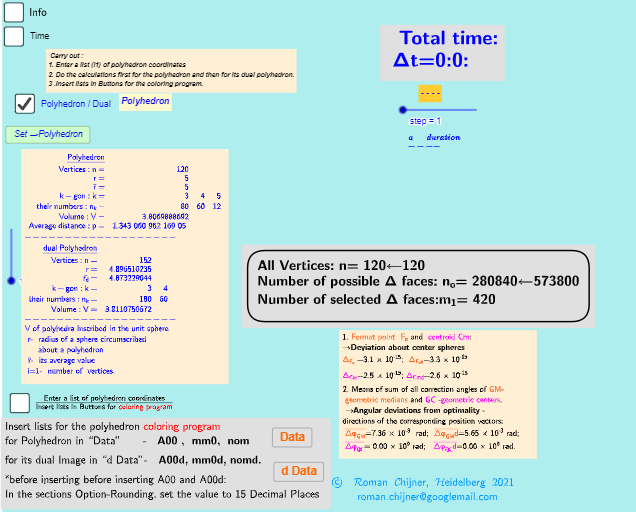
This example constructs a 3D polyhedron with 120 vertices by taking a biscribed pentakis dodecahedron and applying a trisection rule to its 5th-order segments. It demonstrates how a high-symmetry solid can be generated from a structured, parameter-driven subdivision scheme, with accompanying geometric measurement such as lengths and volume-related quantities. The key math concepts include solid geometry of (starred) polyhedra, k-th order segment subdivision, discrete indexing and conditional selection in geometric construction, and aggregation of computed elements through summation to assemble the final surface structure. Construction highlights reflected in the GeoGebra command set include: Text and TableText for labeling parameters/results, Sequence to generate the needed parameter/index sequences, Div to implement segment partitioning, Element/IndexOf/First to retrieve specific geometric entities, If to apply conditional inclusion rules, and Sum to accumulate contributions from selected elements. Length is used to compute critical distances, while objects such as Volsphere, Vol, Vol_r, and Volsphere_d indicate volume-related computations that accompany the geometric build. Suitable for high school advanced geometry, pre-calculus/early university geometry modeling, and explorations using parameterization and discrete construction logic in GeoGebra.
GeoGebra Commands & Parameters
Text("" + p) → txt_pSum(Flatten[Sequence[Append[Sequence[Element[txt_p, i], i, m01(k), m02(k)], " "], k, 1, 5]]) → txtUm1If(bu0, A00, A00d) → A00_0Length(A00_0) → nLength(l2) → läl2Sequence(sgn(Determinant[{Element[A00_0, i1] - Element[A00_0, j], Element[A00_0, i2] - Element[A00_0, j], Element[A00_0, i3] - Element[A00_0, j]}]), j, 1, n) → l01Length(A00d) → zzzSum(Zip[(T * F), T, SysTimeAkt1, F, {1, 1000, 60000, 3600000, 86400000}]) → TimeAbs1Sum(Zip[(T * F), T, SysTimeAkt2, F, {1, 1000, 60000, 3600000, 86400000}]) → TimeAbs2Div(TimeRelab, 3600) → HDiv(TimeRelab - (H * 3600), 60) → MElement(ZwZeit, step) → text10TableText({Append["a duration", Last[ZwZeit, Min[10, Length[ZwZeit]]]]}, "v") → text2cLength(A00) → lm1If(Length[Unique[l01 \ {0}]] ≟ 1, 7, -7) → a7Sum(Zip[(T * F), T, SysTimeAkt0, F, {1, 1000, 60000, 3600000, 86400000}]) → TimeAbs0Div(TimeRelab0, 3600) → H0Div(TimeRelab0 - (H0 * 3600), 60) → M0Text("" + (TimeRelab0 - (H0 * 3600) - (M0 * 60))) → S0aText("" + (TimeRelab - (H * 3600) - (M * 60))) → SIndexOf(".", S) → indexIndexOf(".", S0a) → indexaFirst(S, index + 1) → txtSFirst(S0a, indexa + 1) → txtS0aIf(bu0, " ", "d") → txtbuoMax(Length[A00], Length[A00d]) → maxläElement(A00, 24) → m11TableText({{"\underline{Polyhedron}"}, Append["Vertices: n=", {Length[A00]}], Append["r=", {r}], Append["\bar{r}=", {r_m}], Append["k-gon : k=", mm5a], Append["their\; numbers: n_k=", mm7a], Append["Volume: V=", {Vol_r}], Append["Average\; distance: p=", {txtUm1}]}, "hr ") → text7TableText({{"\underline{dual\;Polyhedron}"}, Append["Vertices: n=", {Length[A00d]}], Append["r=", {r_d}], Append[" \bar{r_d}= ", {r_md}], Append["k-gon : k=", mm5ad], Append["their\; numbers: n_k=", mm7ad], Append["Volume: V=", {Vold_r}]}, "hr ") → text20
AI Drawing Prompt Reference
Draw a 120-vertex 3D polyhedron generated from a biscribed pentakis dodecahedron by applying a trisection rule to its 5th-order segments. Start by creating a biscribed pentakis dodecahedron, then apply the trisection rule to its 5th-order segments to generate 120 vertices. Calculate the coordinates of each vertex, measure the edge lengths, compute the polyhedron's volume, and display the number of vertices, edge lengths, and volume.
The prompt above was compiled from the original drawing commands and is for reference only.