
螺旋索菲亚S
几何画板及绘图内容加载中,请稍等……
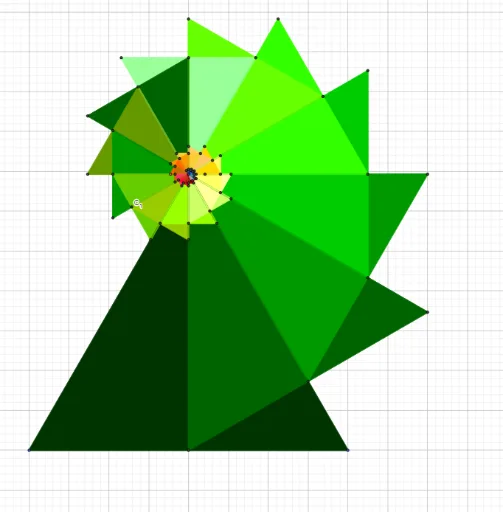
①本范例演示了螺旋索菲亚S图形的构造与特性;②涉及的核心数学概念包括双曲线、对数函数、圆锥曲线、相似三角形等;③作图要点使用了Polygon(多边形)、OrthogonalLine(垂线)、Intersect(交点)等GeoGebra命令与对象;④适合高中及以上数学学习者用于理解复杂几何图形的构造与相关数学概念的应用。
GeoGebra 命令及参数
Polygon(A, B, 3) → poly1, f, g, h, COrthogonalLine(C, f) → iIntersect(i, f) → DPolygon(C, D, 3) → poly2, j, k, l, EOrthogonalLine(C, k) → mIntersect(m, k) → FPolygon(C, F, 3) → poly3, n, p, q, GOrthogonalLine(C, p) → rIntersect(r, p) → HPolygon(C, H, 3) → poly4, s, t, a, IOrthogonalLine(C, t) → bIntersect(b, t) → JPolygon(C, J, 3) → poly5, c, d, e, KOrthogonalLine(C, d) → f_1Intersect(f_1, d) → LPolygon(C, L, 3) → poly6, g_1, h_1, i_1, MOrthogonalLine(C, h_1) → j_1Intersect(j_1, h_1) → NPolygon(C, N, 3) → poly7, k_1, l_1, m_1, OIntersect(l_1, i) → PPolygon(C, P, 3) → poly8, n_1, p_1, q_1, QIntersect(m, m_1) → RIntersect(m, m_1) → SIntersect(m, m_1) → TIntersect(p_1, m) → UPolygon(C, U, 3) → poly9, r_1, s_1, t_1, VIntersect(s_1, r) → WPolygon(C, W, 3) → poly10, a_1, b_1, c_1, ZIntersect(b_1, b) → A_1Polygon(C, A_1, 3) → poly11, d_1, e_1, f_2, B_1Intersect(e_1, f_1) → C_1Polygon(C, C_1, 3) → poly12, g_2, h_2, i_2, D_1Intersect(j_1, h) → E_1Intersect(h_2, j_1) → F_1Polygon(C, F_1, 3) → poly13, j_2, k_2, l_2, G_1Intersect(k_2, i) → H_1Polygon(C, H_1, 3) → poly14, m_2, n_2, p_2, I_1Intersect(n_2, m) → J_1Polygon(C, J_1, 3) → poly15, q_2, r_2, s_2, K_1Intersect(r_2, r) → L_1Polygon(C, L_1, 3) → poly16, t_2, a_2, b_2, M_1Intersect(b, q) → N_1Intersect(a_2, b) → O_1Polygon(C, O_1, 3) → poly17, c_2, d_2, e_2, P_1Intersect(j_1, e) → Q_1Intersect(j_1, e) → R_1Intersect(f_1, a) → S_1Intersect(d_2, f_1) → T_1Polygon(C, T_1, 3) → poly18, f_3, g_3, h_3, U_1Intersect(i, i_1) → V_1Intersect(g_3, j_1) → W_1Polygon(C, W_1, 3) → poly19, i_3, j_3, k_3, Z_1Intersect(j_3, i) → A_2Polygon(C, A_2, 3) → poly20, l_3, m_3, n_3, B_2Intersect(m, m_1) → C_2Intersect(m_3, m) → D_2Polygon(C, D_2, 3) → poly21, p_3, q_3, r_3, E_2Intersect(q_3, r) → F_2Polygon(C, F_2, 3) → poly22, s_3, t_3, a_3, G_2Intersect(b, t_1) → H_2Intersect(t_3, b) → I_2Polygon(C, I_2, 3) → poly23, b_3, c_3, d_3, J_2Intersect(f_1, c_1) → K_2Intersect(c_3, f_1) → L_2Polygon(C, L_2, 3) → poly24, e_3, f_4, g_4, M_2Intersect(j_1, h) → N_2Intersect(j_1, h) → O_2Intersect(f_4, j_1) → P_2Polygon(C, P_2, 3) → poly25, h_4, i_4, j_4, Q_2Intersect(i, j) → R_2Intersect(i_4, i) → S_2Polygon(C, S_2, 3) → poly26, k_4, l_4, m_4, T_2Intersect(m, g) → U_2Intersect(l_4, m) → V_2Polygon(C, V_2, 3) → poly27, n_4, p_4, q_4, W_2Intersect(r, l) → Z_2Intersect(p_4, r) → A_3Polygon(C, A_3, 3) → poly28, r_4, s_4, t_4, B_3Intersect(s_4, b) → C_3Polygon(C, C_3, 3) → poly29, a_4, b_4, c_4, D_3Intersect(b_4, f_1) → E_3Polygon(C, E_3, 3) → poly30, d_4, e_4, f_5, F_3Intersect(j_1, e) → G_3Intersect(e_4, j_1) → H_3Polygon(C, H_3, 3) → poly31, g_5, h_5, i_5, I_3