
非传递性转盘概率模拟与比较实验
几何画板及绘图内容加载中,请稍等……
所属专题
Statistics Demonstrations
Statistics Demonstrations
Statistics Demonstrations
Statistics Demonstrations
Statistics Demonstrations
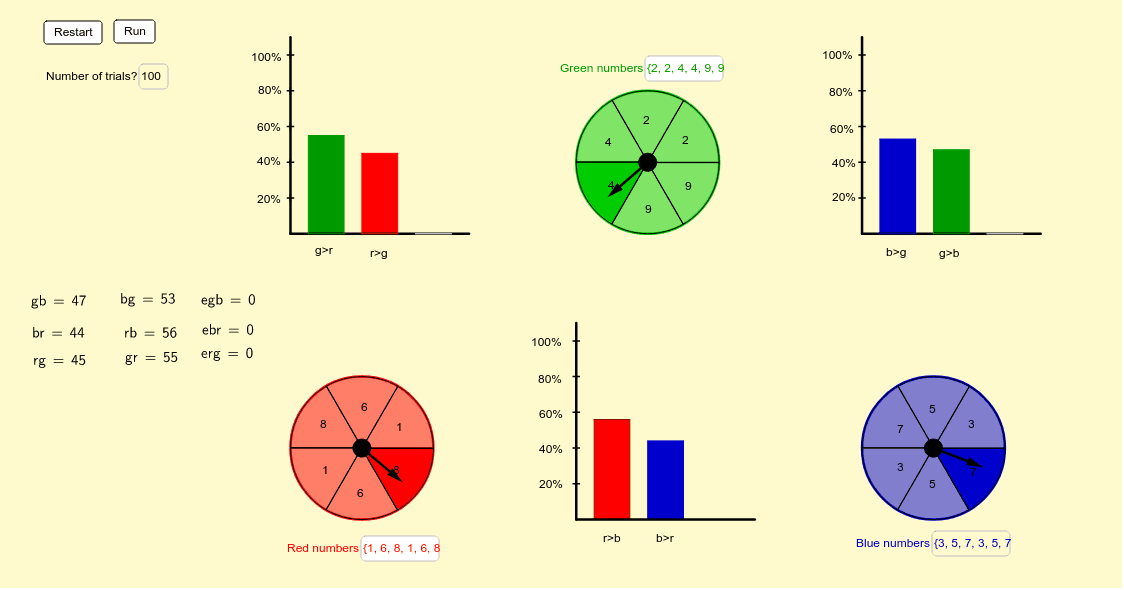
该范例演示三个非传递性转盘(红、绿、蓝)在多次随机试验中胜率呈循环优势的概率现象,即 A 胜 B、B 胜 C、C 胜 A 的非传递关系。核心数学概念涵盖概率统计、随机实验、期望值、比例比较与非传递性逻辑。作图要点:调用了 GeoGebra 命令 Textfield、Element、Circle、Sequence、Vector、Rotate、Segment、Polygon、LaTeX,并利用 rand、listr/listg/listb、inputBoxR/G/B、trials、θ_R/G/B、n_R/G/B、C_R/G/B、c_R/G/B、P_R/G/B 等对象构建转盘扇区、旋转角度、试验次数输入框与胜率统计列表。适合中学概率与统计单元,用于课堂探究、课后模拟实验及非传递骰子或转盘原理的直观演示。
GeoGebra 命令及参数
Textfield(listr) → inputBoxRTextfield(listg) → inputBoxGTextfield(listb) → inputBoxBTextfield(trials) → inputBox1Element(listr, round(θ_R / 60 + 0.5)) → n_RElement(listg, round(θ_G / 60 + 0.5)) → n_GElement(listb, round(θ_B / 60 + 0.5)) → n_BCircle(C_R, 2) → c_RCircle(C_G, 2) → c_GCircle(C_B, 2) → c_BSequence(Rotate[P_R, ((k * 60))°, C_R], k, 0, 5) → listrptSequence(CircleSector[C_R, Element[listrpt, Mod[k, 6] + 1], Element[listrpt, Mod[k + 1, 6] + 1]], k, 0, 5) → listrsegElement(listrseg, 1) → rseg1Element(listrseg, 2) → rseg_2Element(listrseg, 3) → rseg_3Element(listrseg, 4) → rseg_4Element(listrseg, 5) → rseg_5Element(listrseg, 6) → rseg_6Sequence(Rotate[P_G, ((k * 60))°, C_G], k, 0, 5) → listgptSequence(CircleSector[C_G, Element[listgpt, Mod[k, 6] + 1], Element[listgpt, Mod[k + 1, 6] + 1]], k, 0, 5) → listgsegElement(listgseg, 1) → gseg_1Element(listgseg, 2) → gseg_2Element(listgseg, 3) → gseg_3Element(listgseg, 4) → gseg_4Element(listgseg, 5) → gseg_5Element(listgseg, 6) → gseg_6Sequence(Rotate[P_B, ((k * 60))°, C_B], k, 0, 5) → listbptSequence(CircleSector[C_B, Element[listbpt, Mod[k, 6] + 1], Element[listbpt, Mod[k + 1, 6] + 1]], k, 0, 5) → listbsegElement(listbseg, 1) → bseg_1Element(listbseg, 2) → bseg_2Element(listbseg, 3) → bseg_3Element(listbseg, 4) → bseg_4Element(listbseg, 5) → bseg_5Element(listbseg, 6) → bseg_6Vector(C_R, C_R + (1.5, 0)) → v_RVector(C_G, C_G + (1.5, 0)) → v_GVector(C_B, C_B + (1.5, 0)) → v_BRotate(v_R, θ_R°, C_R) → arrow_RRotate(v_G, θ_G°, C_G) → arrow_GRotate(v_B, θ_B°, C_B) → arrow_BSegment((0, 0), (0, 5.5)) → yaxis_1Polygon(Xrb_5, Xrb_6, Xrb_6 + (0, (5 * ebr / count)), Xrb_5 + (0, (5 * ebr / count))) → polyebr, a, b, c, dLaTeX(bg, true, true) → text1LaTeX(br, true, true) → text2LaTeX(ebr, true, true) → text3LaTeX(egb, true, true) → text4LaTeX(erg, true, true) → text5LaTeX(gb, true, true) → text6LaTeX(gr, true, true) → text7LaTeX(rb, true, true) → text8LaTeX(rg, true, true) → text9Polygon(Xrb_1, Xrb_2, Xrb_2 + (0, (5 * rb / count)), Xrb_1 + (0, (5 * rb / count))) → polyrb, e, f, i, jPolygon(Xrb_3, Xrb_4, Xrb_4 + (0, (5 * br / count)), Xrb_3 + (0, (5 * br / count))) → polybr, g, h, k, lSegment((-8, 8), (-8, 13.5)) → yaxis_2Segment((8, 8), (13, 8)) → xaxis_3Segment((8, 8), (8, 13.5)) → yaxis_3Segment((-8, 8), (-3, 8)) → xaxis_2Segment((0, 0), (5, 0)) → xaxis_1Polygon(Xbg_5, Xbg_6, Xbg_6 + (0, (5 * egb / count)), Xbg_5 + (0, (5 * egb / count))) → polyegb, m, n, p, qPolygon(Xbg_1, Xbg_2, Xbg_2 + (0, (5 * bg / count)), Xbg_1 + (0, (5 * bg / count))) → polybg, xbg_1, xbg_2, r, sPolygon(Xbg_3, Xbg_4, Xbg_4 + (0, (5 * gb / count)), Xbg_3 + (0, (5 * gb / count))) → polygb, t, a_1, b_1, c_1Polygon(Xgr_5, Xgr_6, Xgr_6 + (0, (5 * erg / count)), Xgr_5 + (0, (5 * erg / count))) → polyerg, xgr_5, xgr_6, d_1, e_1Polygon(Xgr_1, Xgr_2, Xgr_2 + (0, (5 * gr / count)), Xgr_1 + (0, (5 * gr / count))) → polygr, xgr_1, xgr_2, f_1, g_1Polygon(Xgr_3, Xgr_4, Xgr_4 + (0, (5 * rg / count)), Xgr_3 + (0, (5 * rg / count))) → polyrg, xgr_3, xgr_4, h_1, i_1