
同分母分数与带分数相加的交互练习
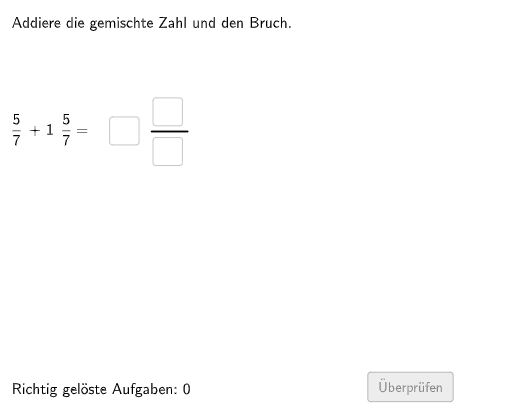
几何画板及绘图内容加载中,请稍等……
该GeoGebra范例用于演示并练习“同分母分数加法”与“带分数加法”的计算过程,通过随机生成题目并校验答案,让学生直观看到分子相加、必要时转成带分数的运算逻辑。核心数学概念包括:同分母分数的加法规则(分母不变、分子相加)、带分数表示与换算、分子/分母的生成与结果正确性判断、以及小题数量的练习模式。作图与构造要点可从下方摘要提炼:使用Shuffle对题目参数随机化;用Element与Textfield承载输入(如dInput/fInput/eInput/bInput/aInput/cInput对应分数相关输入);借助If进行多步条件判断与答案校验(firstTrue、correct1~correct6等);通过Polygon与Segment等图形元素呈现题目可视化布局(如Layout、gemischteZahlLay等);同时使用Corner与Textfield管理标注与交互界面。适合小学高年级到初中衔接阶段的5-6年级课堂练习,或分数运算的巩固与自测用途。
GeoGebra 命令及参数
Shuffle(Sequence[Random[1, 5], i, 1, 100]) → randomNosForGemischteZahl1, {2, 4, 1, 4, 4, 4, 5, 2, 5, 5, 5, 1, 3, 3, 2, 2, 5, 3, 2, 5, 5, 1, 1, 5, 5, 4, 5, 4, 2, 2, 4, 1, 1, 5, 4, 5, 5, 2, 1, 3, 4, 4, 1, 4, 4, 2, 4, 1, 2, 1, 1, 5, 1, 5, 3, 5, 4, 2, 1, 3, 3, 2, 5, 3, 3, 2, 1, 4, 5, 4, 2, 5, 3, 1, 4, 4, 1, 2, 5, 5, 5, 1, 5, 3, 1, 3, 2, 2, 2, 5, 1, 1, 4, 3, 1, 1, 4, 1, 4, 5}Element(randomNosForGemischteZahl1, Mod[questionCount, 100] + 2) → gemischteZahl2Element(randomNosForGemischteZahl1, Mod[questionCount, 100] + 1) → gemischteZahl1Shuffle(Sequence[Random[1, 3], i, 1, 100]) → Layout, {3, 3, 2, 1, 1, 1, 3, 2, 3, 2, 3, 2, 3, 2, 1, 3, 3, 3, 3, 3, 1, 1, 1, 3, 3, 3, 2, 1, 3, 3, 3, 2, 2, 2, 3, 3, 2, 2, 3, 3, 2, 1, 3, 2, 1, 3, 1, 1, 2, 2, 1, 1, 2, 3, 1, 1, 1, 1, 3, 3, 3, 1, 2, 2, 1, 1, 1, 3, 2, 2, 2, 1, 1, 2, 1, 3, 2, 1, 2, 1, 3, 2, 2, 1, 2, 3, 3, 2, 3, 1, 1, 1, 1, 2, 2, 2, 1, 1, 2, 1}Element(Layout, Mod[questionCount, 100] + 2) → gemischteZahlLayElement(Layout, Mod[questionCount, 100] + 1) → layShuffle({2, 3, 4, 5, 6, 7, 8, 9, 10, 12, 15, 16, 24, 25, 2, 3, 4, 5, 6, 7, 8, 9, 10, 12, 15, 16, 24, 25, 2, 3, 4, 5, 6, 7, 8, 9, 10, 12, 15, 16, 24, 25, 2, 3, 4, 5, 6, 7, 8, 9, 10, 12, 15, 16, 24, 25, 2, 3, 4, 5, 6, 7, 8, 9, 10, 12, 15, 16, 24, 25, 2, 3, 4, 5, 6, 7, 8, 9, 10, 12, 15, 16, 24, 25, 2, 3, 4, 5, 6, 7, 8, 9, 10, 12, 15, 16, 24, 25}) → randomNosForNenner, {24, 7, 2, 7, 8, 12, 2, 4, 9, 4, 24, 15, 16, 10, 25, 7, 6, 3, 16, 15, 3, 12, 16, 5, 3, 2, 16, 12, 6, 15, 25, 7, 5, 16, 8, 10, 24, 25, 9, 24, 4, 2, 6, 8, 3, 4, 25, 3, 9, 5, 8, 12, 8, 15, 5, 24, 4, 3, 2, 6, 6, 7, 9, 7, 16, 2, 10, 6, 3, 9, 12, 12, 25, 4, 10, 10, 8, 24, 25, 10, 2, 5, 15, 25, 24, 12, 5, 5, 8, 16, 15, 7, 9, 6, 15, 4, 9, 10}Element(randomNosForNenner, Mod[questionCount, 100] + 1) → nennerShuffle(Sequence[Random[1, (3 * nenner) - 1], i, 1, 100]) → randomNosForZaehlerB1, {15, 12, 8, 15, 19, 15, 14, 11, 12, 5, 16, 18, 3, 16, 7, 4, 4, 18, 9, 1, 6, 17, 4, 14, 14, 6, 8, 4, 12, 18, 10, 10, 15, 18, 19, 17, 1, 16, 13, 16, 19, 18, 2, 8, 6, 17, 15, 18, 6, 3, 5, 1, 6, 14, 12, 8, 2, 7, 6, 12, 9, 19, 13, 16, 19, 7, 10, 1, 2, 18, 2, 12, 16, 3, 3, 7, 20, 1, 1, 20, 7, 13, 2, 20, 2, 4, 15, 3, 11, 4, 10, 16, 9, 4, 1, 8, 16, 19, 19, 4}Element(randomNosForZaehlerB1, Mod[questionCount, 100] + 2) → zaehlerB2Element(randomNosForZaehlerB1, Mod[questionCount, 100] + 1) → zaehlerB1Shuffle(Sequence[Random[1, nenner - 1], i, 1, 100]) → randomNosForZaehlerA1, {1, 5, 5, 2, 3, 4, 1, 5, 5, 5, 6, 1, 3, 5, 1, 3, 6, 6, 4, 4, 6, 5, 6, 2, 6, 6, 1, 5, 5, 5, 1, 5, 2, 4, 3, 4, 5, 1, 2, 5, 1, 5, 3, 4, 2, 2, 4, 3, 2, 2, 2, 2, 5, 5, 5, 6, 4, 2, 5, 4, 4, 5, 2, 3, 1, 1, 3, 1, 3, 5, 3, 2, 4, 1, 1, 4, 4, 1, 5, 1, 2, 3, 2, 5, 6, 6, 6, 5, 3, 5, 2, 3, 4, 6, 3, 4, 2, 3, 3, 5}Element(randomNosForZaehlerA1, Mod[questionCount, 100] + 2) → zaehlerA2Element(randomNosForZaehlerA1, Mod[questionCount, 100] + 1) → zaehlerA1If(lay ≟ 1, zaehlerA1, If[lay ≟ 2, zaehlerB1, If[lay ≟ 3, zaehlerA1]]) → zaehler1If(lay ≟ 1, If[Mod[zaehlerA1 + zaehlerA2, nenner] ≟ 0, zaehlerA2 + 1, zaehlerA2], If[lay ≟ 2, If[Mod[zaehlerB1 + zaehlerB2, nenner] ≟ 0, zaehlerB2 + 1, zaehlerB2], If[lay ≟ 3, zaehlerA2]]) → zaehler2If(lay ≟ 1 ∨ lay ≟ 2, (zaehler1 + zaehler2) / nenner, If[lay ≟ 3 ∧ gemischteZahlLay ≟ 1, (zaehler1 + zaehler2) / nenner + gemischteZahl1, If[lay ≟ 3 ∧ gemischteZahlLay ≟ 2, (zaehler1 + zaehler2) / nenner + gemischteZahl2, If[lay ≟ 3 ∧ gemischteZahlLay ≟ 3, (zaehler1 + zaehler2) / nenner + gemischteZahl1 + gemischteZahl2]]]) → DezimalzahlIf(lay ≟ 1 ∨ lay ≟ 2, floor((zaehler1 + zaehler2) / nenner), If[lay ≟ 3 ∧ gemischteZahlLay ≟ 1, floor((zaehler1 + zaehler2) / nenner) + gemischteZahl1, If[lay ≟ 3 ∧ gemischteZahlLay ≟ 2, floor((zaehler1 + zaehler2) / nenner) + gemischteZahl2, If[lay ≟ 3 ∧ gemischteZahlLay ≟ 3, floor((zaehler1 + zaehler2) / nenner) + gemischteZahl1 + gemischteZahl2]]]) → solGemischteZahlCorner(selectedAufgabe, 3) → CTextfield(aInput) → InputBox1Textfield(bInput) → InputBox2If((lay ≟ 1 ∨ lay ≟ 2) ∧ zaehler1 + zaehler2 < nenner, correct1 ∧ correct2, If[(lay ≟ 1 ∨ lay ≟ 2) ∧ zaehler1 + zaehler2 ≟ nenner ∨ Mod[zaehler1 + zaehler2, nenner] ≟ 0, correct1 ∧ correct2 ∧ correct4, If[(lay ≟ 1 ∨ lay ≟ 2) ∧ zaehler1 + zaehler2 > nenner, correct1 ∧ correct2 ∧ correct4 ∧ correct5 ∧ correct6, If[lay ≟ 3 ∧ zaehler1 + zaehler2 < nenner ∧ aInput < bInput, correct1 ∧ correct2 ∧ correct3, If[lay ≟ 3 ∧ zaehler1 + zaehler2 < nenner ∧ aInput ≥ bInput, correct1 ∧ correct2 ∧ correct3 ∧ correct4 ∧ correct5 ∧ correct6 ∨ aInput / bInput + cInput ≟ Dezimalzahl ∧ (correct4 ∧ correct5 ∧ correct6 ∨ cInput ≟ solGemischteZahl ∧ correct1 ∧ correct2 ∧ correct3), If[lay ≟ 3 ∧ zaehler1 + zaehler2 ≟ nenner, correct1 ∧ correct2 ∧ correct3 ∧ correct4 ∨ aInput / bInput + cInput ≟ Dezimalzahl ∧ (correct4 ∨ cInput ≟ solGemischteZahl ∧ correct1 ∧ correct2 ∧ correct3), If[lay ≟ 3 ∧ zaehler1 + zaehler2 > nenner, correct1 ∧ correct2 ∧ correct3 ∧ correct4 ∧ correct5 ∧ correct6 ∨ aInput / bInput + cInput ≟ Dezimalzahl ∧ (correct4 ∧ correct5 ∧ correct6 ∨ cInput ≟ solGemischteZahl ∧ correct1 ∧ correct2 ∧ correct3)]]]]]]) → correctPolygon(PtopLeftCornerFeedback, PtopRightCornerFeedback, PbottomRightCornerFeedback, PbottomLeftCornerFeedback) → rectangleCorrectGanzeZahl, ptopleftcornerfeedback, ptoprightcornerfeedback, pbottomrightcornerfeedback, pbottomleftcornerfeedbackIf(lay ≟ 3, PosInputBox1_1, PosInputBox2_1) → PosZaehlerTextfield(cInput) → InputBox3Segment(A, B) → bruchstrichTextfield(dInput) → InputBox4Textfield(eInput) → InputBox5Textfield(fInput) → InputBox6Segment(A_1, B_1) → bruchstrich2Polygon(PtopLeftCornerFeedback1, PtopRightCornerFeedback1, PbottomRightCornerFeedback1, PbottomLeftCornerFeedback1) → rectangleCorrectNenner, ptopleftcornerfeedback1, ptoprightcornerfeedback1, pbottomrightcornerfeedback1, pbottomleftcornerfeeback1Polygon(PtopLeftCornerFeedback2, PtopRightCornerFeedback2, PbottomRightCornerFeedback2, PbottomLeftCornerFeedback2) → rectangleCorrectZaehler, ptopleftcornerfeedback2, ptoprightcornerfeedback2, pbottomrightcornerfeedback2, pbottomleftcornerfeedback2Polygon(PtopLeftCornerFeedback3, PtopRightCornerFeedback3, PbottomRightCornerFeedback3, PbottomLeftCornerFeedback3) → rectangelCorrectGanzeZahl2, ptopleftcornerfeedback3, ptoprightcornerfeedback3, pbottomrightcornerfeedback3, pbottomleftcornerfeedback3Polygon(PtopLeftCornerFeedback4, PtopRightCornerFeedback4, PbottomRightCornerFeedback4, PbottomLeftCornerFeedback4) → rectangleCorrectZaehler2, ptopleftcornerfeedback4, ptoprightcornerfeedback4, pbottomrightcornerfeedback4, pbottomleftcornerfeedback4Polygon(PtopLeftCornerFeedback5, PtopRightCornerFeedback5, PbottomRightCornerFeedback5, PbottomLeftCornerFeedback5) → rectangleCorrectNenner2, ptopleftcornerfeedback5, ptoprightcornerfeedback5, pbottomrightcornerfeedback5, pbottomleftcornerfeedback5If(lay ≟ 3 ∧ Defined[(aInput * bInput)] ∧ aInput ≥ bInput ∨ (lay ≟ 1 ∨ lay ≟ 2) ∧ aInput ≥ bInput ∧ Defined[(aInput * bInput)], true, false) → showBoxesIf(showBoxes, PosInputBox2 + (-0.2, -1.5), PosInputBox1 + (0.8, -1.5)) → PosTextCorrectIf(lay ≟ 3, correct1 ∧ correct2 ∧ correct3, correct1 ∧ correct2) → BruchVorne
AI 绘图提示语参考
绘制一个交互式练习题,包含两个分数相加的问题。首先,随机生成两个分数,分数的分母相同,分子不同。然后,输入框让用户输入第一个分数的分子,检查输入是否正确。接着,随机生成另一个分数,分子和分母不同,生成一个混合数。用户需要输入混合数的整数部分和分数部分,检查输入是否正确。最后,根据用户输入的分数和混合数,计算结果并显示在矩形框内,如果输入正确,矩形框会显示正确提示。
以上提示语为根据原始绘图命令整理而来,仅供参考。