
分数乘法演示 by benny varghese
几何画板及绘图内容加载中,请稍等……
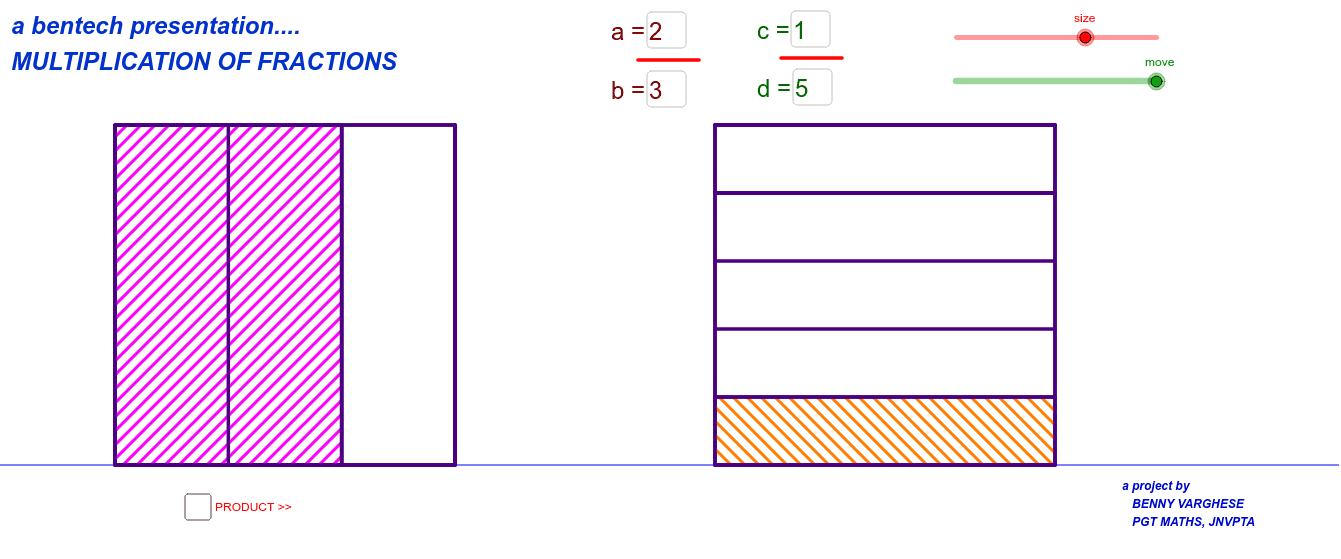
①本范例通过动态图形演示分数乘法的几何意义,直观展示分数相乘的过程与结果;②涉及核心数学概念包括分数运算、几何图形(线段、多边形)、坐标几何与变换;③作图要点运用了Line, Point, Segment, Polygon, Circle, Intersect, OrthogonalLine, Textfield等GeoGebra命令与对象,构建分数乘法的可视化模型;④适合初中及以上数学学习者,用于理解分数乘法原理及几何应用。
GeoGebra 命令及参数
Line(A, B) → a_5Point(a_5) → CPoint(a_5) → DPoint(Circle[D, abs(size)]) → FSegment(D, F) → c_5Polygon(D, F, 4) → poly1, d, e, f, g, G, HCircle(H, i_1) → kIntersect(k, f) → I,Line(I, g) → jIntersect(j, a_5) → F_1Segment(I, F_1) → p_1Intersect(f, g) → R_1Polygon(A, Q_1, S_1, R_1) → poly2, a_3, q_2, s_2, r_2OrthogonalLine(U_1, a_5) → g_2Polygon(T_1, U_1, 4) → poly3, h_2, i_2, j_2, k_2, V_1, W_1Circle(U_1, z) → p_2Intersect(p_2, h_2) → Z_1,Circle(Z_1, z) → c_3Intersect(c_3, h_2) → A_2, B_2Circle(A_2, z) → d_3Intersect(d_3, h_2) → C_2, D_2Circle(C_2, z) → e_3Intersect(e_3, h_2, 1) → H_2Line(H_2, i_2) → m_3Line(A_2, i_2) → n_3Line(Z_1, i_2) → s_3Line(C_2, i_2) → t_3Intersect(j_2, m_3) → C_3Intersect(j_2, t_3) → D_3Intersect(j_2, n_3) → E_3Intersect(j_2, s_3) → F_3Segment(C_2, D_3) → a_4Segment(A_2, E_3) → b_4Segment(Z_1, F_3) → c_4Segment(H_2, C_3) → k_4Line(H_3, i_2) → l_4Line(V_1, W_1) → m_4Intersect(l_4, m_4) → I_3Polygon(B_2, V_1, I_3, H_3) → poly4, b_5, v_1, i_5, h_5Circle(I, i_1) → qIntersect(q, f) → J, KCircle(J, i_1) → rIntersect(r, f) → L, MCircle(L, i_1) → sIntersect(s, f) → N, OCircle(N, i_1) → d_1Intersect(d_1, f) → P, QCircle(P, i_1) → e_1Intersect(e_1, f) → R, SCircle(R, i_1) → f_1Intersect(f_1, f) → T, UCircle(T, i_1) → g_1Intersect(g_1, f) → V, WCircle(V, i_1) → h_1Intersect(h_1, f) → Z, A_1Circle(Z, i_1) → k_1Intersect(k_1, f) → B_1, C_1Circle(B_1, Z) → q_1Intersect(q_1, f) → D_1, E_1Line(J, p_1) → iLine(L, i) → lLine(N, l) → mLine(P, m) → nLine(R, n) → a_1Line(T, a_1) → b_1Line(V, b_1) → j_1Line(Z, j_1) → l_1Line(B_1, l_1) → m_1Line(E_1, m_1) → n_1Intersect(i, a_5) → G_1Intersect(l, a_5) → H_1Intersect(m, a_5) → I_1Intersect(n, a_5) → J_1Intersect(a_1, a_5) → K_1Intersect(b_1, a_5) → L_1Intersect(j_1, a_5) → EIntersect(l_1, a_5) → M_1Intersect(m_1, a_5) → N_1Intersect(n_1, a_5) → O_1Segment(J, G_1) → pSegment(L, H_1) → r_1Segment(J, N) → s_1Segment(I_1, N) → t_1Segment(P, J_1) → a_2Segment(R, K_1) → b_2Segment(T, L_1) → c_2Segment(V, E) → d_2Segment(Z, M_1) → e_2Segment(B_1, N_1) → f_2Segment(E_1, O_1) → t_2Intersect(e_3, h_2) → P_1, E_2Circle(P_1, z) → f_3Intersect(f_3, h_2) → F_2, G_2Circle(F_2, z) → g_3Intersect(g_3, h_2) → I_2, J_2Circle(I_2, z) → h_3Intersect(h_3, h_2) → K_2, L_2Circle(K_2, z) → k_3Intersect(k_3, h_2) → M_2, N_2Circle(M_2, z) → p_3Intersect(p_3, h_2) → O_2, P_2Circle(O_2, z) → q_3Intersect(q_3, h_2) → Q_2, R_2Circle(Q_2, z) → r_3Intersect(r_3, h_2) → S_2, T_2Line(F_2, k_4) → l_2Line(I_2, l_2) → m_2Line(K_2, m_2) → n_2Line(M_2, n_2) → b_3Line(O_2, b_3) → i_3Line(Q_2, i_3) → j_3Line(S_2, j_3) → l_3Intersect(j_2, l_3) → U_2Intersect(j_2, j_3) → V_2Intersect(j_2, i_3) → W_2Intersect(j_2, b_3) → Z_2Intersect(j_2, n_2) → A_3Intersect(j_2, m_2) → B_3Intersect(j_2, l_2) → G_3Segment(F_2, G_3) → d_4Segment(I_2, B_3) → e_4Segment(K_2, A_3) → f_4Segment(M_2, Z_2) → g_4Segment(O_2, W_2) → h_4Segment(Q_2, V_2) → i_4Segment(S_2, U_2) → j_4Segment(J_3, K_3) → n_4Textfield(o) → inputBox1Textfield(h) → inputBox2Textfield(w) → inputBox3Textfield(t) → inputBox4Segment(J_4, K_4) → n_5