
方程平衡模型
几何画板及绘图内容加载中,请稍等……
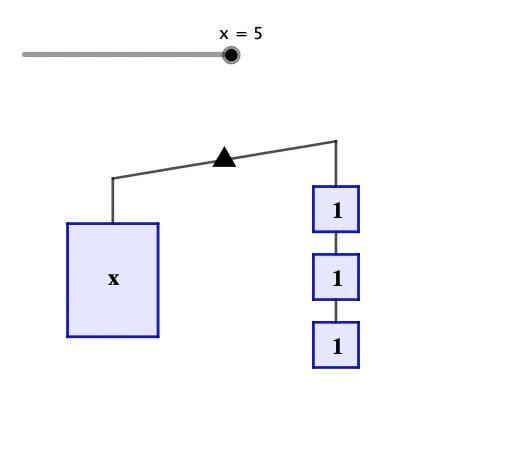
①本范例演示通过修改变量值观察方程平衡状态变化的动态模型;②涉及核心数学概念包括方程平衡、变量影响、解析几何;③作图要点:使用Segment、Circle、Intersect、Line、OrthogonalLine、Polygon、Point等GeoGebra命令构建几何图形与交互元素;④适合高中数学教学,用于理解方程解的几何意义及参数变化影响。
GeoGebra 命令及参数
Segment(C, B) → fCircle(A, 2.5) → cIntersect(c, f, 1) → DIntersect(c, f, 2) → ESegment(D, E) → gLine(E, eq1) → hLine(D, eq1) → iCircle(E, 1) → dCircle(D, 1) → eIntersect(e, i, 2) → FIntersect(d, h, 2) → GCircle(G, 1.5) → kIntersect(k, h, 2) → HCircle(H, 1.5) → pIntersect(p, h, 2) → IOrthogonalLine(F, i) → jOrthogonalLine(G, h) → lOrthogonalLine(H, h) → mOrthogonalLine(I, h) → nCircle(G, 0.5) → qCircle(H, 0.5) → rCircle(I, 0.5) → sIntersect(q, l, 1) → JIntersect(q, l, 2) → KIntersect(r, m, 1) → LIntersect(r, m, 2) → MIntersect(s, n, 1) → NIntersect(s, n, 2) → OOrthogonalLine(K, l) → tOrthogonalLine(J, l) → bCircle(J, 1) → c_1Circle(K, 1) → d_1Circle(L, 1) → e_1Circle(M, 1) → f_1Circle(N, 1) → g_1Circle(O, 1) → h_1Intersect(c_1, b, 1) → PIntersect(d_1, t, 1) → QIntersect(e_1, b, 1) → RIntersect(f_1, t, 1) → SIntersect(g_1, b, 1) → TIntersect(h_1, t, 1) → USegment(E, G) → i_1Segment(J, K) → j_1Segment(K, Q) → k_1Segment(Q, P) → l_1Segment(P, J) → m_1Segment(L, M) → n_1Segment(R, S) → p_1Segment(M, S) → q_1Segment(L, R) → r_1Segment(N, T) → s_1Segment(N, O) → t_1Segment(O, U) → a_1Segment(U, T) → b_1Intersect(h, l_1) → VIntersect(h, p_1) → WSegment(V, H) → f_2Segment(W, I) → g_2Circle(F, a / 5) → c_2Intersect(c_2, j, 1) → ZIntersect(c_2, j, 2) → A_1OrthogonalLine(A_1, j) → h_2OrthogonalLine(Z, j) → i_2Circle(A_1, 2.5) → d_2Circle(Z, 2.5) → e_2Intersect(e_2, i_2, 1) → B_1Intersect(d_2, h_2, 1) → C_1Segment(D, F) → j_2Segment(Z, A_1) → k_2Segment(A_1, C_1) → l_2Segment(C_1, B_1) → m_2Segment(B_1, Z) → n_2Polygon(Z, A_1, C_1, B_1) → q1, z_1, p_2, q_2, r_2Polygon(P, J, K, Q) → q2, p_3, j_3, k_3, q_3Polygon(L, M, S, R) → q3, l_3, m_3, s_2, r_3Polygon(N, O, U, T) → q4, n_3, o, u, t_2Circle(P, 0.3) → c_3Intersect(c_3, m_1, 1) → D_1Line(D_1, l_1) → a_2Circle(D_1, 0.4) → d_3Intersect(d_3, a_2, 1) → E_1Circle(R, 0.3) → e_3Intersect(e_3, r_1, 1) → F_1Circle(F_1, 0.4) → f_3Line(F_1, p_1) → b_2Intersect(f_3, b_2, 2) → G_1Circle(T, 0.3) → g_3Intersect(g_3, s_1, 1) → H_1Circle(H_1, 0.4) → h_3Line(H_1, b_1) → i_3Intersect(h_3, i_3, 1) → I_1Point(n_2) → J_1Circle(B_1, J_1) → s_3Line(J_1, m_2) → t_3Intersect(i, t_3) → K_1Circle(K_1, 0.1) → c_4Intersect(c_4, t_3, 2) → L_1