
四边形分类:按四边、直角与平行边判别
几何画板及绘图内容加载中,请稍等……
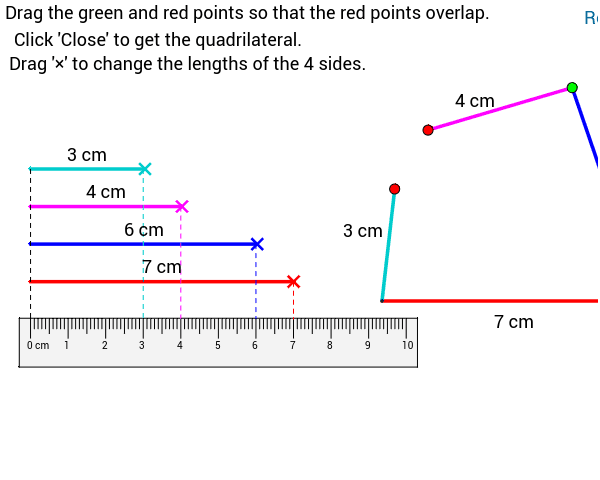
① 本范例演示如何根据四条边的长度、是否存在直角以及是否有平行边,将四边形分类为正方形、长方形、菱形、平行四边形、梯形、风筝形等。② 涉及的核心数学概念包括四边形的定义与性质、平行线判别、直角判别、对称性以及分类学的逻辑推理。③ 作图要点:使用 Point、Segment、Polygon 创建顶点与边;用 Circle、Semicircle、Intersect 构造辅助圆与交点;利用 Sequence、List 生成多组四边形;通过 Midpoint、Angle、Rotate、Vector、If 实现动态判别与标注。④ 适合初中几何分类教学、高中几何复习以及 GeoGebra 动态演示课件制作。
GeoGebra 命令及参数
Point(Segment[(1, 2), (10, 2)]) → BSegment((0, 2), (round(10 * x(B)) / 10, 2)) → bPoint(Segment[(1, 1), (10, 1)]) → ASegment((0, 1), (round(10 * x(A)) / 10, 1)) → aSemicircle((x(Q) - b, y(Q)), (x(Q) + b, y(Q))) → c_qPoint(c_q) → R1Point(Segment[(1, 3), (10, 3)]) → CSegment((0, 3), (round(10 * x(C)) / 10, 3)) → cCircle(R, c) → c_rPoint(Segment[(1, 4), (10, 4)]) → DSegment((0, 4), (round(10 * x(D)) / 10, 4)) → dCircle(P, d) → c_pIntersect(c_r, c_p, 2) → S1Sequence(Segment[(k, 0), (k, -1 * 0.5)], k, 0, 10) → list1Polygon((-0.3, 0.02662), (-0.3, -1.27338), (10.3, -1.27338), (10.3, 0.02662)) → poly1, poly1_1, poly1_2, poly1_3, poly1_4Sequence(Segment[(k + 0.5, 0), (k + 0.5, -1 * 0.375)], k, 0, 9) → list2Sequence(Sequence[Segment[(0.5 * (i - 1) + j / 10, 0), (0.5 * (i - 1) + j / 10, -1 * 0.25)], j, 1, 4], i, 1, 20) → list3Midpoint((0, 1), A) → A'Midpoint((0, 2), B) → B'Midpoint((0, 3), C) → C'Midpoint((0, 4), D) → D'Segment((0, 4), (0, 0)) → iSegment(P, Q) → jSegment(P, R) → kIntersect(c_p, k, 1) → EIntersect(c_r, k, 1) → FSegment((round(10 * x(C)) / 10, 3), (round(10 * x(C)) / 10, 0)) → gSegment((round(10 * x(B)) / 10, 2), (round(10 * x(B)) / 10, 0)) → fSegment((round(10 * x(A)) / 10, 1), (round(10 * x(A)) / 10, 0)) → eSegment((round(10 * x(D)) / 10, 4), (round(10 * x(D)) / 10, 0)) → hAngle(Rotate[P, (-β1)°, Q], Q, P) → βAngle(Rotate[Q, (-γ1)°, R], R, Q) → γAngle(Q, P, Rotate[Q, α1°, P]) → αPolygon(P, Q, R1, S1) → poly2, t, a_1, b_1, c_1Angle(Q, P, Rotate[Q, 90*°, P]) → α_0Angle(R, Q, Rotate[R, 90*°, Q]) → β_0Angle(S, R, Rotate[S, 90*°, R]) → γ_0Angle(P, S, Rotate[P, 90*°, S]) → δ_0Segment(Midpoint[P, Q], Rotate[Intersect[Circle[Midpoint[P, Q], 0.2], Ray[Midpoint[P, Q], P]], 30*°, Midpoint[P, Q]]) → u_2Segment(Midpoint[P, Q], Rotate[Intersect[Circle[Midpoint[P, Q], 0.2], Ray[Midpoint[P, Q], P]], 330*°, Midpoint[P, Q]]) → u_1Segment(Midpoint[S, R], Rotate[Intersect[Circle[Midpoint[S, R], 0.2], Ray[Midpoint[S, R], S]], 330*°, Midpoint[S, R]]) → v_1Segment(Midpoint[S, R], Rotate[Intersect[Circle[Midpoint[S, R], 0.2], Ray[Midpoint[S, R], S]], 30*°, Midpoint[S, R]]) → v_2Segment(Midpoint[Q, R], Rotate[Intersect[Circle[Midpoint[Q, R], 0.2], Ray[Midpoint[Q, R], Q]], 330*°, Midpoint[Q, R]]) → w_1Segment(Midpoint[Q, R], Rotate[Intersect[Circle[Midpoint[Q, R], 0.2], Ray[Midpoint[Q, R], Q]], 30*°, Midpoint[Q, R]]) → w_2Segment(Translate[Midpoint[Q, R], Vector[Q, R] / b * 0.2], Translate[Rotate[Intersect[Circle[Midpoint[Q, R], 0.2], Ray[Midpoint[Q, R], Q]], 330*°, Midpoint[Q, R]], Vector[Q, R] / b * 0.2]) → w_3Segment(Translate[Midpoint[Q, R], Vector[Q, R] / b * 0.2], Translate[Rotate[Intersect[Circle[Midpoint[Q, R], 0.2], Ray[Midpoint[Q, R], Q]], 30*°, Midpoint[Q, R]], Vector[Q, R] / b * 0.2]) → w_4Segment(Midpoint[P, S], Rotate[Intersect[Circle[Midpoint[P, S], 0.2], Ray[Midpoint[P, S], P]], 330*°, Midpoint[P, S]]) → z_1Segment(Midpoint[P, S], Rotate[Intersect[Circle[Midpoint[P, S], 0.2], Ray[Midpoint[P, S], P]], 30*°, Midpoint[P, S]]) → z_2Angle(P, S, Rotate[P, δ1°, S]) → δMidpoint(Midpoint[P, R], Midpoint[Q, S]) → GCircle(H, 1) → rPoint(r) → IRotate(P, ε1°, G) → P'Rotate(Q, ε1°, G) → Q'Rotate(R, ε1°, G) → R'Rotate(S, ε1°, G) → S'Polygon(P', Q', R', S') → poly2', p', q', r'_1, s'_1Angle(Q', P', Rotate[Q', α1°, P']) → α'Angle(Rotate[P', (-β1)°, Q'], Q', P') → β'Rotate(S_0, ε1°, G) → S'_1Angle(Rotate[Q', (-γ1)°, R'], R', Q') → γ'Angle(P', S', Rotate[P', δ1°, S']) → δ'Angle(Q', P', Rotate[Q', 90*°, P']) → α'_0Angle(R', Q', Rotate[R', 90*°, Q']) → β'_0Angle(S', R', Rotate[S', 90*°, R']) → γ'_0Angle(P', S', Rotate[P', 90*°, S']) → δ'_0Segment(Midpoint[P', Q'], Rotate[Intersect[Circle[Midpoint[P', Q'], 0.2], Ray[Midpoint[P', Q'], P']], 330*°, Midpoint[P', Q']]) → u'_1Segment(Midpoint[P', Q'], Rotate[Intersect[Circle[Midpoint[P', Q'], 0.2], Ray[Midpoint[P', Q'], P']], 30*°, Midpoint[P', Q']]) → u'_2Segment(Midpoint[S', R'], Rotate[Intersect[Circle[Midpoint[S', R'], 0.2], Ray[Midpoint[S', R'], S']], 330*°, Midpoint[S', R']]) → v'_1Segment(Midpoint[S', R'], Rotate[Intersect[Circle[Midpoint[S', R'], 0.2], Ray[Midpoint[S', R'], S']], 30*°, Midpoint[S', R']]) → v'_2Segment(Midpoint[Q', R'], Rotate[Intersect[Circle[Midpoint[Q', R'], 0.2], Ray[Midpoint[Q', R'], Q']], 330*°, Midpoint[Q', R']]) → w'_1Segment(Midpoint[Q', R'], Rotate[Intersect[Circle[Midpoint[Q', R'], 0.2], Ray[Midpoint[Q', R'], Q']], 30*°, Midpoint[Q', R']]) → w'_2Segment(Translate[Midpoint[Q', R'], Vector[Q', R'] / b * 0.2], Translate[Rotate[Intersect[Circle[Midpoint[Q', R'], 0.2], Ray[Midpoint[Q', R'], Q']], 330*°, Midpoint[Q', R']], Vector[Q', R'] / b * 0.2]) → w'_3Segment(Translate[Midpoint[Q', R'], Vector[Q', R'] / b * 0.2], Translate[Rotate[Intersect[Circle[Midpoint[Q', R'], 0.2], Ray[Midpoint[Q', R'], Q']], 30*°, Midpoint[Q', R']], Vector[Q', R'] / b * 0.2]) → w'_4Segment(Midpoint[P', S'], Rotate[Intersect[Circle[Midpoint[P', S'], 0.2], Ray[Midpoint[P', S'], P']], 330*°, Midpoint[P', S']]) → z'_1Segment(Midpoint[P', S'], Rotate[Intersect[Circle[Midpoint[P', S'], 0.2], Ray[Midpoint[P', S'], P']], 30*°, Midpoint[P', S']]) → z'_2Vector(H, I) → uAngle((x(H) + 1, y(H)), H, I) → εSegment((x(H) + 1, y(H)), H) → sMidpoint(P, Q) → JMidpoint(Q, R) → KMidpoint(R, S) → LMidpoint(S, P) → MRotate(J, ε1°, G) → J'Rotate(K, ε1°, G) → K'Rotate(L, ε1°, G) → L'Rotate(M, ε1°, G) → M'Segment(Translate[Midpoint[P, S], Vector[P, S] / d * 0.2], Translate[Rotate[Intersect[Circle[Midpoint[P, S], 0.2], Ray[Midpoint[P, S], P]], 330*°, Midpoint[P, S]], Vector[P, S] / d * 0.2]) → z_3Segment(Translate[Midpoint[P, S], Vector[P, S] / d * 0.2], Translate[Rotate[Intersect[Circle[Midpoint[P, S], 0.2], Ray[Midpoint[P, S], P]], 30*°, Midpoint[P, S]], Vector[P, S] / d * 0.2]) → z_4Segment(Translate[Midpoint[P', S'], Vector[P', S'] / d * 0.2], Translate[Rotate[Intersect[Circle[Midpoint[P', S'], 0.2], Ray[Midpoint[P', S'], P']], 330*°, Midpoint[P', S']], Vector[P', S'] / d * 0.2]) → z'_3Segment(Translate[Midpoint[P', S'], Vector[P', S'] / d * 0.2], Translate[Rotate[Intersect[Circle[Midpoint[P', S'], 0.2], Ray[Midpoint[P', S'], P']], 30*°, Midpoint[P', S']], Vector[P', S'] / d * 0.2]) → z'_4Midpoint(P, E) → NMidpoint(F, R) → OIf(d ≟ c ∧ (c ≠ b) ∧ (c ≠ a), 1, If[d ≟ b ∧ (b ≠ a), 0, If[d ≟ a, 1, 0]]) → d1If(d ≟ c ∧ (c ≠ b) ∧ (c ≠ a), 0, If[d ≟ b ∧ (b ≠ a), 0, If[d ≟ a, 0, 0.8]]) → d2If(d ≟ c ∧ (c ≠ b) ∧ (c ≠ a), 1, If[d ≟ b ∧ (b ≠ a), 1, If[d ≟ a, 0, 0.8]]) → d3Segment(R1, S1) → nSegment(P, S1) → mSegment(Q, R1) → lPoint(c_r) → TPoint(c_p) → USegment(R, T) → d_1Segment(P, U) → e_1Midpoint(R, T) → VMidpoint(P, U) → WSegment(F, R) → qSegment(P, E) → p
AI 绘图提示语参考
绘制一个用于四边形分类的教学示意图。底部有一条水平刻度线,上方有四条平行且长度可调的水平线段,分别代表四边形的四条边。在刻度线上方,通过辅助圆和交点构造一个动态四边形,其顶点可沿水平线移动。四边形内部显示边长、角度和垂直标记,并标注平行、垂直或等长关系。同时,在底部刻度线上生成多个小刻度标记,用于测量和比较边长。整体图形强调通过边长、角度和平行性来区分正方形、矩形、菱形、平行四边形、梯形和风筝形等四边形类型。
以上提示语为根据原始绘图命令整理而来,仅供参考。